
30 April 2026
Fadel Partners, Inc.
('FADEL', the 'Company' or, together with its subsidiaries, the 'Group')
Results for the year ended 31 December 2025
FADEL (AIM: FADL), a global leader in AI-driven brand compliance and licensing software, is pleased to announce its full-year results for the year ended 31 December 2025. The Company's full Annual Report and Audited Financial Statements for the year ended 31 December 2025 will be published and made available on the Company's website (www.fadel.com) by 1 May 2026.
Financial Highlights
● Annual Recurring Revenue (ARR) increased 14%, driven by customer wins in the mid-market segment and expansion within existing accounts.
● Revenue decreased by 3% due to less services revenue, resulting from the Group's expansion into the mid-market, where projects are less complex and shorter in duration.
● Gross Profit Margin improved to 64% due to a reduction in lower-margin services revenue, offset partially by higher-margin licensing and support revenue.
● Adjusted EBITDA Loss significantly improved primarily due to lower operating expenses and ongoing efficiency gains in managing discretionary expenditure across the business.
● Cash and Cash Equivalents at 31 December 2025 of $1.9 million, with an undrawn $1.0 million credit facility available for further liquidity.
|
US Dollars ($) |
Year ended |
Year ended |
Change |
|
Group revenue |
13,022,201 |
12,616,439 |
(3%) |
|
Licensing and Support(1) |
7,993,928 |
8,235,003 |
3% |
|
Services(1) |
5,028,273 |
4,381,436 |
(13%) |
|
Gross profit |
8,048,971 |
8,129,411 |
1% |
|
Gross profit margin % |
62% |
64% |
|
|
Adjusted EBITDA(2) Loss |
(3,907,271) |
(743,281) |
81% |
|
Cash and cash equivalents |
2,607,422 |
1,910,755 |
(27%) |
|
ARR(3) |
7,824,602 |
8,904,588 |
14% |
|
|
|
|
|
(1) Beginning with the 2025 year-end results, the Company's services revenue now includes revenue generated under recurring services subscription arrangements, rather than such revenue being included within licensing and support revenue. The prior period has been reclassified to conform to this presentation.
(2) Earnings after capitalised commission costs and before interest, tax, depreciation, amortization, exceptional costs and share-based payments.
(3) Annual Recurring Revenue ("ARR") now comprises only recurring license and support revenue and no longer includes recurring services revenue. The prior period has been reclassified to conform to this presentation.
Operational Highlights
● Launch of AI Business Insights: Introduction of AI-driven analytics capability within IPM Suite, providing predictive modelling, natural language dashboards and enhanced royalty analysis
● Development of Product Approval module: Advancement of the Product Approval module during FY25, with the solution entering beta ahead of its post-period commercial release
● Expansion of LicenSee and mid-market offering: Continued rollout and adoption of LicenSee and modular IPM Suite deployments targeting mid-market customers
● New customer wins across product platforms: Customer additions during the year include Handcraft Manufacturing, Viz Media, Zak! Designs and Bloom Fresh International (IPM Suite), and Comcast Communications and Ferrero (Brand Vision)
● Enhanced Brand Vision capabilities: Delivery of expanded content tracking, additional digital platform coverage and improved analytics functionality
● Operational efficiency improvements: Delivery of a more streamlined operating model following organisational changes initiated in late 2024
Post Period End Highlights
● Launch of FADEL AIVA: In January 2026, the Company launched AIVA, its AI framework integrating generative, predictive and analytical capabilities across its platforms, designed to enhance automation, improve operational insight and support customer productivity
● Product Approval module released: The Product Approval module reached general availability in January 2026, enabling customers to manage the full product approval lifecycle within a single, centralised platform
● Strengthened product platform with embedded AI: AIVA has been embedded across IPM Suite and Brand Vision, enhancing functionality including contract ingestion, content tracking and AI-driven analytics, further differentiating the Company's offering
● Renewal of credit facility: The Company renewed its $1 million undrawn credit facility through May 2027, providing additional financial flexibility to support operations and growth initiatives
Tarek Fadel, Chief Executive Officer, commented: "2025 was a year of disciplined execution for FADEL, as we strengthened the foundations of the business, improved operational efficiency and advanced our product capabilities. The launch of AIVA and the Product Approval module in early 2026 marks an important step in the evolution of our platform, embedding AI more deeply into our solutions and enhancing the value we deliver to customers. With a growing recurring revenue base, an expanded pipeline and a more efficient cost structure, we enter 2026 well positioned to continue executing on our strategy."
This announcement contains inside information for the purposes of the retained UK version of the EU Market Abuse Regulation (EU) 596/2014 ("UK MAR").
For further information, please contact:
Tarek Fadel, Chief Executive Officer
Mark Plotkin, Chief Financial Officer
Cavendish Capital Markets Limited (Nomad & Broker)
Jonny-Franklin Adams, Isaac Hooper (Corporate Finance)
Sunila De Silva (ECM)
Tel: +44 (0)20 7220 0500
FADEL Strategic Communications
Devi Gupta
press@fadel.com
About Fadel Partners Inc.
FADEL delivers AI-enabled software to manage brand compliance and IP licensing with precision and confidence. Its cloud-based platforms help organizations govern content and usage rights at scale, streamline complex licensing and royalty processes, and reduce risk across global operations. Trusted by some of the world's most recognized brands in media, publishing, consumer goods, high-tech, and advertising, FADEL empowers teams to protect intellectual property, accelerate licensing workflows, and operate with clarity in an increasingly complex digital ecosystem.
The Group's main country of operation is the United States, where it is headquartered in New York, with further operations in the UK, France, Lebanon and Jordan.
For more information, please visit the Group's website at: www.fadel.com.
CHAIR'S STATEMENT
Introduction
During the year the Company completed its reorganization of key areas of the business that it had initiated in late 2024. The goal was to drive more efficient delivery against its strategic goals from a lower cost base while continuing to be able to rapidly innovate. This ambitious goal has been supported by the use of AI to enhance customer value through both internal usage and by directly incorporating AI into its product set.
I am pleased to report that as a result, the team has been able to both meet its market forecast for 2025, as well as make exciting progress with product development to meet the needs of both enterprise and mid-market customers. This against a backdrop of having reduced its operating cost base by $3.6 million on an annualized basis.
Further details of product innovations are set out in the CEO's report on Pages 9 - 14.
On behalf of the Board, I would like to extend my thanks to our employees for their hard work and commitment during this important phase of the Company's journey and through the difficult time of an organizational restructuring.. I'd also like to thank our teams in Lebanon and Jordan for their continued professionalism and composure amid recent regional instability. Everyone's contributions throughout the company have been instrumental in delivering the operational and strategic progress that we report on today.
Strategic Direction
Building on the enhancements to LicenSee in FY 2024, the Company's mid-market version of its flagship enterprise product IPM Suite, in 2025 the Company announced two new products that were subsequently launched in January 2026.
FADEL AIVA integrates the Company's generative, analytical and predictive AI capabilities through purpose-built AI agents to help users improve efficiency, reduce operational risk and manage complex global licensing and marketing activities with greater speed and confidence. AIVA is also now embedded in the new Product Approval module, which enables licensors to manage the full product approval lifecycle, from initial concept submission through to final authorization, within a single, centralized platform.
The Company believes that this innovation has strengthened its product offering, further competitively differentiating FADEL within the licensing and brand compliance and governance market and will support new business growth in recurring revenue in FY 2026 and beyond.
Together with a refreshed sales and marketing approach, the Company has been able to grow its new business opportunity, for both new logos as well as customer expansion, which has directly created materially higher sales pipelines than in FY 2024. The results so far in FY 25 have been a creditable 14% annual growth in net new ARR. This focus on strategic product enhancements and AI is the foundation for our growth goals for both new logos and net revenue retention, looking forward to 2026 and beyond.
In the first half of 2025, the Board initiated a review, in conjunction with its advisors Oaklins DeSilva+Phillips, of the Company's strategic options to consider the full range of opportunities available to enhance shareholder value. While several expressions of interest were received, none presented a combination of value, structure and certainty which the Board could recommend to shareholders. Following that full assessment, the Board concluded the process and remains fully committed to executing against the Company's long-term strategy of continued product innovation to meet the growing market demand for the management of the proliferation of digital asset rights.
Corporate Governance
Last year we made several organizational changes to the Board, and I am pleased to report that positive impacts have been felt throughout the year through enhanced strategic discussions, improved information flows, and more frequent trading update reports to the board.
During the year Ian Flaherty, Chief Financial Officer, resigned and following a period of overlap transition was replaced by Mark Plotkin who joined the Company as CFO & Company Secretary on July 28, 2025. Mark is a Certified Public Accountant in the United States and a seasoned financial executive with over 25 years of leadership experience across licensing, publishing, and corporate finance at organizations like Marvel Entertainment, The Walt Disney Company and Ernst & Young. He brings deep expertise in GAAP, internal controls, and financial reporting. Mark is based in New York City alongside Tarek Fadel, the founder and CEO.
Immediately following the year end, Joe Gruttadauria stepped down from his interim role Head of Sales, returning his full focus to his Non-Executive Director role. On behalf of the Board, I would like to thank him for stepping up during FY 2025 to directly assist the Executive team in this way. He had a measurable and positive impact on the Company's go-to-market motions and sales results, which has been extremely helpful.
While Joe has resumed his full focus serving as a Non-Executive Director, he is deemed to remain non-independent under applicable governance guidelines. Sally Tilleray continues to Chair both the Remuneration and Audit Committees, and I, Simon Wilson, serve on both committees to support their work.
The Board is confident that it has retained an appropriate balance of cost, skills, experience, and independence to effectively govern the Company. The Board also recognizes the value and importance of high standards of corporate governance and has, since its IPO, observed the requirements of the Quoted Companies Alliance ("QCA") Corporate Governance Code.
Our goal as a Board continues to be to strike an appropriate balance of robust corporate governance and a nimble entrepreneurial culture that supports rapid forward momentum in the rapidly changing technology market in which we operate. I am therefore grateful for the contributions of our Board of Directors who have a great breadth of experience in international software and technology businesses, as well as the London AIM market.
I believe we have a balanced knowledge of the business and that it can continue to grow within acceptable levels of risk tolerance.
ESG
FADEL remains committed to conducting its business responsibly and minimizing environmental impacts across its operations. While we are a small SaaS business and therefore have a small environmental footprint, it is important that these values are demonstrated to our customers and other key stakeholders, and we continue to promote them throughout our workforce, and wider network of commercial partners. The Board continues to assess metrics for disclosure that appropriately describe progress with ESG.
We also continued to uphold strong social and governance principles, including a focus on ethical business practices, employee well-being, equal opportunity, and responsible supplier engagement across all jurisdictions in which we operate.
Stakeholder Communications
This year we took further steps to improve our regular communications to all investors and expanding disclosures and key metrics to support enhanced understanding of the performance of the business. For example, the Company has expanded its disclosure of the key SaaS metric of Annual Recurring Revenue or ARR across all product lines and limited its definition to exclude recurring services revenue.
We utilize phone and video briefings, and the CEO and CFO also offer regular in-person meetings. As Chair, I am available as a direct line of communication to all shareholders in case other questions arise that need to be answered independently, as is our Senior Independent Director, Sally Tilleray.
Looking Forward
We remain mindful of the complexities of the broader macroeconomic and geo-political environment, especially considering the renewed conflict in the Middle East in March which again has impacted Lebanon. Our office in Lebanon remains fully operational and we have contingency plans already in place to ensure business continuity while keeping employees operating safely. With our lower cost base and improved operating cash flow, the Board continues to manage the business with a clear focus on capital efficiency and long-term value creation. Our recurring revenue model and broadening market reach provide a solid foundation for continued growth in 2026 as we strive to reach and then deliver sustainable profitability.

Simon Wilson
Chair of the Board
29 April 2026
CEO'S REVIEW
2025 was a year of solid progress for FADEL as we focused on strengthening the foundations of the business while advancing the capabilities of our software platforms. Throughout the year we remained focused on expanding our recurring revenue base, enhancing product functionality and improving operational efficiency across the Group.
While macroeconomic uncertainty and evolving trade policy discussions during the first half of the year influenced the timing of certain customer purchasing decisions, underlying demand for automation and data-driven management of licensing and brand compliance activities remained strong, as reflected in a more than doubling of the Company's sales pipeline since the beginning of 2025. During FY25, we continued to invest in product development initiatives designed to support organisations managing increasingly complex intellectual property and licensing environments.
A key focus during the year was the continued integration of artificial intelligence capabilities across our platforms, enabling enhanced analytics, improved workflow automation and deeper operational insight for customers managing complex licensing and brand governance activities.
Financial Performance
In FY25, the Group generated revenue of $12.6 million, compared to $13.0 million in FY24. The slight year-over-year decline was driven by lower services revenue, which more than outweighed growth in higher-quality recurring licensing and support revenue.
Services revenue declined as the Group strategically expanded into the mid-market licensing space, where projects are less complex and shorter in duration. Services revenue from existing enterprise clients also fell since they now have greater familiarity with our product and their requested features are in place. These trends in services are expected to continue through FY26.
Starting with 2025 year-end results, ARR includes only recurring license and support revenue, excluding recurring services revenue. This change was made to better align with SaaS industry benchmark definitions and clarifies core software revenue performance. ARR increased 14% year-on-year to $8.9 million, reflecting continued customer adoption of both IPM Suite and Brand Vision. A significant portion of this ARR growth occurred during the fourth quarter of the year, positioning the Company for improved revenue visibility entering FY26.
Operating expenses were reduced by 27% year-on-year, reflecting structural cost initiatives implemented during late FY24 and refined throughout FY25. As a result, adjusted LBITDA improved significantly compared to the prior year.
The Group ended the year with $1.9 million in cash and cash equivalents, supported by disciplined expense management and improved collections. The Company also retains access to an undrawn $1 million credit facility, providing additional financial flexibility.
The business is now structurally leaner, more focused and better aligned to scale profitably as ARR continues to expand.
Artificial Intelligence Strategy
Artificial intelligence continues to represent an important area of development for FADEL as we enhance the analytical and automation capabilities of our platforms. The Group's software solutions manage large volumes of structured contractual, royalty and brand compliance data, providing a strong foundation for the practical application of AI technologies within licensing and rights management environments.
Our approach focuses on embedding intelligent capabilities directly within our existing software platforms. During 2025 we expanded the use of AI-driven analytics and automation tools within IPM Suite and continued development of AI-assisted workflows designed to support licensing operations, reporting and compliance monitoring.
Through continued investment in analytics, automation and data-driven insight, FADEL aims to enhance the value delivered by its platforms while maintaining a disciplined and practical approach to the deployment of emerging technologies.
IPM Suite
IPM Suite remains the core component of the FADEL platform, enabling organisations to manage intellectual property rights, licensing agreements and complex royalty calculations in a secure and auditable environment.
During 2025 the Company continued to expand adoption of IPM Suite, particularly within the mid-market segment, which represents an important growth opportunity. Mid-market customers benefit from scalable cloud deployments and shorter implementation cycles while contributing attractive recurring revenue streams.
Key new IPM Suite customers secured during the year included Handcraft Manufacturing, Viz Media, Zak! Designs and Bloom Fresh International. A total of 7 new IPM customers were added in FY25, all of which were within the mid-market segment.
Product development during the year focused on strengthening both the analytical capabilities and operational workflows supported by the platform. In April 2025 the Company introduced AI Business Insights, which provides predictive analytics, natural-language dashboards and scenario modelling tools designed to help licensing and finance teams analyse royalty data and evaluate licensing performance more effectively.
Additional enhancements were introduced to streamline royalty reporting and compliance workflows, including configurable royalty reporting templates designed to simplify reporting processes for licensees working with major licensors. Improvements were also made to licensing workflow management and reporting functionality across the platform.
LicenSee and IPM Mid-Market Expansion
In 2024, we launched LicenSee™, our purpose-built royalty automation solution designed to serve smaller licensees and emerging rights holders with simpler, lower-volume royalty requirements. The product was built to deliver enterprise-grade automation and accuracy - without the overhead or complexity of a full-scale IPM Suite deployment. Since launch, LicenSee has gained strong early traction, accounting for approximately 43% of new IPM Suite customers since 2024 and continues to build momentum through short sales cycles and streamlined onboarding.
LicenSee validates our belief that a substantial portion of the licensing market is underserved - especially among small and mid-sized organisations that need to automate royalty calculations and manage contractual obligations but lack the resources for complex systems integration. The success of these early deployments reinforces the scalability of this model and positions LicenSee as a high-margin, repeatable growth engine at the lower end of the client spectrum.
At the same time, we are seeing growth in demand from the broader mid-market organisations that are larger and more complex than LicenSee's core target, but not yet ready for a full enterprise implementation of IPM Suite. These companies, often regional brand owners or multi-line licensors, face sophisticated royalty tracking and product approvals requirements but seek faster implementation timelines, lower IT overhead, and greater configurability than traditional enterprise solutions offer.
This segment represented a key strategic focus area for FADEL in FY25 and will continue to be a critical category for future growth. Accordingly, we actively developed packaging and deployment options that enabled modular adoption of IPM Suite features, thereby extending the strength of our enterprise platform to a broader market with mid-sized budgets and teams.
LicenSee and our flexible mid-market IPM solutions help us meet diverse client needs-from small licensees to large global rights holders-allowing us to reach more customers and support our long-term goal of building a scalable, recurring revenue business.
Brand Vision
Brand Vision provides organisations with tools to monitor and manage the use of their intellectual property and branded assets across digital channels.
As digital media ecosystems continue to expand, organisations increasingly require systems that enable greater visibility and governance of brand usage across multiple platforms and markets.
During 2025 Brand Vision secured several notable new customers, Comcast Communications and Ferrero. In addition to new client acquisitions, existing customers expanded their use of the platform through increased adoption of content monitoring and tracking capabilities.
During the year the Company introduced several product enhancements designed to strengthen Brand Vision's monitoring and governance capabilities, including expanded digital asset management integrations, enhanced content tracking coverage across additional digital and e-commerce platforms, and improved analytics capabilities to help organisations monitor the use of branded content online.
Product Development
Innovation continued to be at the heart of our strategy in 2025 as we invested in the next phase of FADEL's platform evolution. Our focus throughout the year was on enhancing the intelligence, efficiency, and scalability of our solutions to better serve the complex needs of licensing and brand management organizations.
In addition to launching AI Business Insights, we continued development of our Product Approval module, which gives licensors a more streamlined and centralized way to manage product submissions, approval workflows, and brand governance. The module entered beta during 2025 and reached general availability in January 2026, marking another important step in broadening the value of our platform for customers.
We also made meaningful progress against our technology roadmap through the adoption of cloud-based AI infrastructure, including Amazon Web Services' Bedrock platform, which is supporting the development of AI analytics and agent-based automation capabilities across our solutions. These investments are helping us build a stronger foundation for greater licensing automation, improved compliance oversight, and more actionable data-driven decision-making.
Following year-end, we announced FADEL AIVA, a framework designed to bring together generative, predictive, and analytical AI capabilities across the Group's platforms. We see AIVA as an important step in our long-term vision to embed AI more deeply into licensing and brand governance workflows, while further differentiating FADEL's technology and positioning the Company for continued innovation and growth.
Two‑Pronged Practical AI Approach
In 2025, we took a deliberate and disciplined approach to artificial intelligence, focused on delivering tangible productivity gains rather than pursuing AI as a standalone narrative. Our strategy was intentionally two‑pronged.
First, we applied AI internally to improve the efficiency and effectiveness of our R&D and Services teams, supporting faster development cycles, more scalable delivery, and improved execution across the business. These initiatives helped us operate more productively while maintaining focus on quality, accuracy and client outcomes.
Second, we continued to embed AI‑driven capabilities directly into our core product platforms, enabling customers to work more efficiently within their day‑to‑day licensing, royalty and brand governance workflows. By integrating intelligence where users already operate, we aim to reduce manual effort, improve insight and support better decision‑making - without compromising the auditability and governance requirements that are fundamental to rights management environments.
We believe our combination of domain expertise, structured data architecture and enterprise-grade deployment positions us uniquely to apply AI in a practical and durable manner within this niche.
Delivery against growth strategy
In 2025, we expanded our mid-market presence, strengthened client relationships, and enhanced recurring revenue potential through more targeted execution. With IPM Suite and Brand Vision now serving both enterprise and mid-sized organizations, we have strategically repositioned our product portfolio to scale more efficiently across diverse verticals. As a result of these initiatives, our pipeline has more than doubled since the start of 2025.
Our go-to-market strategy continues to centre on three key pillars:
· Purpose-built solutions enabling lower and mid-market expansion across IPM Suite,
· Land-and-expand execution within our established enterprise customer base across all product families, and
· Strategic AI enablement of our products designed to increase user productivity, customer retention and create cross-sell momentum.
We delivered 14% ARR growth in 2025 - a result that reflects both progress and the challenges of an evolving market environment. Development of AI solutions, pricing strategy, and commercial execution leave us better positioned to scale effectively in the periods ahead.
Looking ahead, we remain committed to deepening client engagement, aligning product delivery more closely with mid-market needs, and reinforcing the recurring revenue mix that supports scalable, high-margin growth.
Land and Expand
Our ability to grow recurring revenue from existing customers remains a cornerstone of our model. In 2025, total ARR rose to $8.9 million, representing 14% year-over-year growth. This performance was underpinned by continued expansion in our two core platforms:
· IPM Suite ARR increased 13% to $5.6 million, reflecting strong retention and a healthy cadence of upsells and new deals. The net retention revenue percentage (NRR) for IPM Suite was 100% in 2025.
· Brand Vision ARR grew 22% to $2.5 million, demonstrating deepening customer investment, especially in our Content Tracking solution. NRR for Brand Vision in 2025 was 110%.
We added seven new IPM Suite clients in the year, including Handcraft Manufacturing, Viz Media, Zak! Designs and Bloom Fresh International. These wins were all in the mid-market segment, reflecting our ability to serve both enterprise and mid-market clients through scalable implementations.
On the Brand Vision side, we welcomed Comcast and Ferrero, and existing customers expanded their usage, extending more heavily into Content Tracking.
Our progress in expanding across product lines is also accelerating. Existing clients can now engage with multiple components of our portfolio - using Brand Vision for creative compliance while simultaneously managing royalties and contracts through IPM Suite. These cross-sell motions are expected to scale further and drive higher ARR and NRR, as more Brand Vision clients adopt Product Approval and IPM Suite.
Sales Pipeline and Market Activity
During the first half of 2025, sales cycles lengthened as macroeconomic uncertainty and discussions surrounding U.S. tariff policies led certain prospective customers to defer implementation decisions. This was most evident in enterprise implementation projects and certain mid-market licensing opportunities.
Despite these factors, the Company's sales pipeline more than doubled since the beginning of 2025, driven by the addition of new qualified opportunities rather than extended sales cycles. Sales activity improved during the second half of the year, and FADEL entered FY26 with a broader and more diversified pipeline across both IPM Suite and Brand Vision opportunities.
Management continues to focus on strengthening sales processes, expanding go-to-market initiatives and increasing engagement with both enterprise and mid-market customers.
Current trading and outlook
Building on our 14% ARR growth in FY25, FADEL enters 2026 with a solid operational foundation and disciplined commercial focus. The strategic decisions taken in 2024 and refined in 2025, including AI platform investment, cost optimisation, and commercial realignment, have positioned the Company for scalable growth. Looking ahead, we expect to deliver the following in FY26:
· Continuing ARR growth, supported by broader product adoption and deeper client penetration.
· Continued improvement in LBITDA, as the benefits of our FY24 and FY25 cost reduction programme and increasing ARR positively impact the bottom line.
· Sufficient net cash generated to fund operations, with also having the Company's $1 million credit facility, which was renewed in April 2026 and remains in place through to May 2027.
The demand for systems that support rights management, licensing governance and brand compliance continues to grow as organisations operate in increasingly complex intellectual property environments.
The convergence of three structural forces continues to shape our opportunity:
1. The increasing complexity of global intellectual property management
2. The proliferation of digital content and omnichannel brand exposure
3. The emergence of practical, embedded AI as an operational tool
FADEL operates at the intersection of these forces.
With a strengthened recurring revenue base, a more efficient cost structure and continued investment in an evolving AI-enabled platform, we believe FADEL is well positioned to continue expanding its presence within the global licensing and brand governance technology market.
While macroeconomic conditions, including evolving trade policies and geo-political tensions, may continue to influence purchasing timelines, the underlying need for automated rights management, royalty accuracy and brand governance remains structural and growing.
We enter FY26 focused, more financially disciplined and strategically aligned for the next phase of growth.
 |
Tarek Fadel
Chief Executive Officer
29 April 2026
OUR STRATEGY AND BUSINESS MODEL
Our strategy
We believe several long-term market trends continue to position FADEL favorably for growth. The continued expansion of digital content creation, together with the emergence of new content formats and creation methods, including video, social media, generative AI, and user-generated content, has increased the complexity of how brands, publishers, and marketers manage content and related rights. As a result, these organizations increasingly require technology, workflows, and governance solutions to manage content throughout its lifecycle and to ensure compliance from acquisition through distribution and post-use review.
At the same time, companies are making broader and more strategic use of brand licensing as a means of extending brand reach, engaging consumers, and creating incremental revenue opportunities. These initiatives often involve multiple stakeholders, channels, and contractual relationships, increasing the operational and compliance demands associated with managing intellectual property, approvals, royalties, and brand usage. We believe these dynamics continue to drive demand for enterprise software solutions that improve visibility, control, and efficiency across licensing and content-related operations.
FADEL has positioned itself to address these market needs through its IP and Brand Licensing Management, Digital Content Management, and Brand Compliance software offerings. Our two product families serve a broad range of participants in these markets by enabling content aggregation and searchability, licensing and brand compliance management, and the monitoring and tracking of talent, brand assets, and marketing and advertising content.
Our IPM Suite remains a core component of this strategy. The product continues to be attractive to enterprise publishers and licensors, who require robust and scalable solutions to manage complex intellectual property and licensing operations across large portfolios, multiple counterparties, and international markets. These customers rely on the IPM Suite to centralize and streamline the management of contracts, rights, royalties, financial obligations, and compliance processes.
In addition, we are seeing increasing demand for the IPM Suite from mid-market licensees, which we believe represents the largest current source of market demand for the product. As licensing activity expands across a broader set of companies, these customers are increasingly seeking purpose-built software solutions that provide greater operational discipline, financial visibility, and risk management capabilities without the burden of legacy, highly customized systems. We believe this trend expands the addressable market for the IPM Suite and supports an attractive opportunity for continued growth.
We remain focused on enhancing our platform capabilities through AI-driven features, modular packaging, and expanded IPM Suite functionality, including our recently released Product Approvals module. We believe these investments strengthen our ability to meet evolving customer requirements while reinforcing our competitive differentiation across key verticals. Our product strategy is intended to make our solutions more scalable, more configurable, and easier to adopt across a wider range of customer profiles and use cases.
Brand Vision is also an important part of our growth strategy, addressing the increasing need among large consumer brands for digital rights management and content tracking across rapidly expanding volumes of marketing content. As brands create, adapt, and distribute content across websites, social platforms, retail media, streaming channels, and other digital touchpoints, they must manage the rights, usage terms, approvals, and provenance associated with images, video, and music assets. We believe this complexity is increasing as marketing organizations work with a broader ecosystem of agencies, creators, influencers, production partners, and technology platforms.
Our Brand Vision offering is designed to help large consumer brands bring greater control, visibility, and compliance to this environment by enabling the tracking and monitoring of marketing content and its underlying rights data across asset types and channels. We believe the need for such capabilities is becoming increasingly important as the volume, speed, and fragmentation of content production continue to grow. This creates an opportunity for FADEL to support customers seeking to reduce compliance risk, improve governance, and establish more scalable processes around the creation and use of digital marketing assets.
We introduced AIVA in late 2025 as FADEL's AI for Brand Licensing and Royalties. AIVA reflects our strategy to embed AI directly into the workflows that matter most to our customers, particularly in areas where licensing and royalty operations involve significant data complexity, process intensity, and financial oversight. We believe AI-enabled functionality can improve user productivity, enhance decision support, and help customers manage increasingly sophisticated licensing programs more effectively.
We expect AIVA to strengthen the value proposition of our platform by making our solutions more intelligent, efficient, and differentiated. We believe the introduction of AIVA supports our broader objective of extending our leadership in IP and brand licensing management while creating additional opportunities to expand customer adoption, deepen product usage, and drive long-term growth across our installed base and new business pipeline.
We intend to continue investing in our platform through the integration of AI-driven capabilities, ongoing enhancements to product functionality, the development of new offerings, and expansion into additional customers, industries, and geographies.
In the near term this is being done through a deliberate three-pronged approach;
Strengthening our Go-to-Market Capabilities
We have improved our US and European sales footprint through direct hires, enhanced training, and the integration of sales and marketing automation tools. In parallel, we are pursuing targeted technology partnerships and channel distribution opportunities with enterprise and mid-market ERP and Digital Asset Management software providers to accelerate reach and sales velocity across both enterprise and mid-market segments.
Scaling Demand Generation and Market Visibility
Investments in digital marketing, thought leadership, and content-driven campaigns are generating broader awareness and engagement. Our redesigned website, enhanced inbound funnel, and improved sales enablement workflows are collectively shortening sales cycles and converting a more qualified pipeline into revenue.
AI-Driven Product Innovation and Differentiation
We remain focused on enhancing our platform capabilities through AIVA AI-driven features, modular packaging, and expanded IPM Suite functionality, including our recently released Product Approvals module. These investments ensure we meet evolving customer needs while reinforcing our competitive differentiation across key verticals.
Our business model
IPM Suite and Brand Vision solutions are offered as license / subscription (SaaS) respectively. In addition, the Group offers implementation services to customers, provided under separate contracts. Implementation services are provided to customers who require assistance with configuring the software product they purchased, migrating legacy data into our products and integrating our products with the rest of their systems. Therefore, the Group has a combination of recurring revenue from the ongoing use of the software, and one-off Services revenues for design, configuration, and implementation of the products and solutions development for bespoke needs. We also offer managed services contracts where our team supplements our customer's staff by directly handling daily tasks related to the use of our products.
IPM Suite - Enterprise and Mid-Market
Licence (included in ARR)
· Annual or multi-year agreements; and
· Includes basic post-implementation support
· Recurring revenue stream; Annual Contract Value (ACV) typically ranges from $50 thousand - $500 thousand per customer per annum
Billable Professional Services (excluded from ARR)
· Functional implementation
· Technical services
· Managed services to supplement customers' internal resources.
· Implementation revenue ($30 thousand for smaller deployments - $100s of thousand for Enterprise scale deployments
IPM Suite - LicenSee
Licence (included in ARR)
· Annual or multi-year agreements
· Recurring revenue stream; ACV typically ranges from $10 thousand - $50 thousand per customer per annum
Implementation Service (excluded from ARR)
· Lower implementation revenue ($5 thousand - $20 thousand)
Brand Vision
Licence (included in ARR)
· Annual or multi-year agreements
· Recurring revenue stream; ACV typically ranges from $50 thousand - $400 thousand per customer per annum
Implementation Service (excluded from ARR)
Lower implementation revenue ($50 thousand - $100 thousand for Enterprise scale deployments)
MARKET OVERVIEW
The Group operates within the global market for intellectual property management, licensing and royalty administration solutions, as well as brand compliance and content monitoring. These markets are characterised by increasing complexity, driven by the growth of global licensing programmes, the expansion of digital distribution channels and the increasing volume of data associated with licensing and brand governance activities.
The global market for licensed consumer products continues to represent a significant commercial opportunity, with industry sources, including Licensing International, indicating that retail sales of licensed merchandise exceed $300 billion annually. This scale reflects the widespread use of intellectual property across sectors including media, entertainment, consumer goods and fashion, and underpins the need for robust systems to manage licensing agreements, royalties and contractual relationships.
In addition to consumer products licensing, the Group's solutions are also applicable within the publishing sector, where organisations manage complex royalty arrangements with authors, creators and other rights holders. The global publishing market, including books, journals and digital content, represents a substantial and established industry, with revenues estimated to exceed $120 billion annually according to industry sources. Within this market, the accurate calculation, reporting and payment of royalties to talent remains a critical operational requirement, further supporting demand for systems that provide transparency, auditability and efficiency in royalty administration.
Organisations are required to manage large volumes of contracts, royalty arrangements and intellectual property rights across multiple territories and counterparties. This creates a need for systems that provide accuracy, transparency and control over licensing operations, as well as the ability to manage complex contractual relationships and financial obligations.
At the same time, the continued growth in digital media, e-commerce and online content distribution has increased the importance of monitoring how intellectual property and branded assets are used across a wide range of platforms. As a result, organisations are placing greater emphasis on brand governance and compliance, particularly in digital environments where content can be widely distributed and reused.
The market for Digital Asset Management ("DAM") solutions, which underpins many brand governance and content management activities, is estimated by industry analysts, including Gartner and IDC, to be in excess of $5-7 billion globally, with continued growth driven by increasing volumes of digital content and the need for centralised asset management. In parallel, demand for copyright monitoring, content tracking and compliance solutions continues to expand as organisations seek greater visibility over the use of their intellectual property across digital channels.
In response to these challenges, organisations are increasingly adopting software solutions that enable the centralised management of licensing, royalty and brand compliance activities. There is a continued shift away from manual processes and fragmented systems towards integrated platforms that support contract management, royalty calculation and reporting within a single environment.
Alongside this shift, advances in data analytics and artificial intelligence are increasingly influencing how organisations manage licensing and brand governance processes. AI technologies are being applied to support enhanced data analysis, automate elements of workflow management and improve the monitoring of compliance across large and complex datasets. Within licensing environments, these capabilities can provide greater insight into royalty performance, assist in identifying anomalies and support more efficient processing of contractual and financial data.
While the application of artificial intelligence within these markets continues to evolve, it is expected to play an increasingly important role in supporting operational efficiency and decision-making across licensing and brand governance activities.
The Group's platforms, including IPM Suite and Brand Vision, are designed to address these requirements by providing integrated solutions that support the management of intellectual property, licensing and brand compliance activities. The continued development of AI-enabled capabilities within these platforms supports the Group's ability to respond to evolving customer requirements while maintaining a focus on accuracy, control and data governance.
OUR PRODUCTS
AIVA
AI for Brand Compliance and Licensing Operations - Intelligence in Action
AIVA is FADEL's AI designed to transform how organizations manage end-to-end licensing and marketing compliance operations. It unifies FADEL's generative, analytical, and predictive AI capabilities with purpose-built autonomous AI agents embedded within the Brand Vision and IPM Suite products.
AIVA delivers intelligent automation across complex licensing and marketing workflows:
· AIVA Reviewer Agent - Conducts initial review of Product Approval submissions
· AIVA Contract Ingestion Agent - Instantly extracts rights terms and obligations from licensing contracts and creates Brand Vision and IPM Suite parties and agreements
· AIVA Media Identification - Detects and matches licensed images, video, and music across digital distribution channels
· AIVA Business Insights - Generates dashboards, executive reports, and predictive models using natural language prompts
AIVA Intelligence - AI assistant that provides real-time user support, while also delivering detailed insights on agreement terms and obligations using contract and deal intelligence.
Brand Vision
AI-Powered Brand Protection & Content Compliance
FADEL Brand Vision is an AI-powered brand protection and rights management solution that enables global enterprises to accelerate creative production while ensuring brand consistency, compliance, and control across the marketing content lifecycle.
Trusted by leading global brands, Brand Vision transforms how organizations manage and protect creative assets, driving measurable business impact.
· Lower Marketing Costs: Visibility into asset rights maximizes content reuse and eliminates unnecessary spend
· Faster Speed-to-Market: Automated rights checks and seamless DAM integration accelerate campaign execution
· Reduced Corporate Risk: Proactive expiration and clearance controls minimize violations and legal exposure
· Stronger Global Collaboration: Centralized rights intelligence aligns marketing, production, legal, and agency teams
· Actionable Insights: Advanced reporting and analytics enable informed, data-driven decisions
Brand Vision proactively protects content beyond campaign launch. Content Tracking with AIVA Media Identification monitors digital, social, and e-commerce channels to identify licensed images, video, and music and flag expired or non-compliant usage, minimizing legal and financial risk.
As content ecosystems grow more complex, FADEL Brand Vision delivers the clarity and control organizations need to create confidently, operate efficiently, and protect their most valuable brand assets.
IPM Suite
Smarter Licensing, Automated & AI-Optimized
FADEL's licensing management solutions, IPM Suite and LicenSee, empower licensors, licensees, and publishers to modernize licensing operations, support innovative business models, and drive sustainable revenue growth.
IPM Suite transforms royalty and licensing management by streamlining licensing processes, bolstering financial accuracy, and providing brand and sales compliance oversight.
· Revenue Innovation: Enable new licensing models across emerging platforms and channels
· Financial Alignment: Align royalties and revenue recognition with evolving business models and ERP financials
· Operational Efficiency: Streamline workflows from deal management and product approval through royalty reporting
· Risk and Compliance Control: Reduce penalties and payment discrepancies while strengthening audit readiness
· Brand Integrity: Ensure product quality and consistency through automated approvals
Embedded AI capabilities powered by AIVA enhance efficiency and insight across the licensing lifecycle by accelerating product approvals, extracting and transforming contract data into structured agreements and parties in IPM Suite, and delivering executive insights, predictive analytics, and intelligent guidance driven by contract and deal intelligence.
LicenSee
Streamlined Royalties, Stronger Partnerships, Bigger Growth
LicenSee is an all-in-one royalty management solution designed specifically for small to mid-market licensees. The platform automates royalty calculations, royalty statement generation in licensor-specific formats, compliance checks, and audit management, simplifying reporting while ensuring financial accuracy and control.
Built on the same proven architecture as IPM Suite, LicenSee delivers scalable, user-friendly tools that streamline workflows, reduce audit risk, and strengthen collaboration with licensors.
By automating complex financial processes and enhancing compliance visibility, LicenSee enables licensees to operate with confidence, improve transparency, and focus on strategic growth.
PictureDesk
Centralize, Monetize, and Revitalize Your Digital Content
PictureDesk is a content discovery and asset management platform built for media companies, publishers, and brands to find, manage, and monetize published articles and digital assets.
The platform centralizes live and licensed content in a single hub, enabling rapid response to 24/7 news cycles while streamlining editorial workflows and content syndication.
· Operational Efficiency: Reduce repetitive editorial tasks and improve workflow productivity by up to 20%.
· Content Monetization: Expand syndication opportunities and maximize the value of published content.
· Real-Time Access: Manage live and licensed assets within a centralized, searchable environment.
· Brand Impact Monitoring: Leverage AI-powered visual search and real-time ambassador tracking to monitor and amplify brand presence.
As digital publishing accelerates and content demands intensify, PictureDesk delivers the speed, visibility, and control organizations need to operate efficiently and maximize content value.
CFO'S REVIEW
During 2025, we continued to strengthen financial discipline while supporting investment in our platform and AI-enabled capabilities, enabling more efficient delivery and innovation across the Group. This supported improved operating efficiency and the strong progress delivered during the year.
2025 was a year of continued financial discipline and operational realignment for FADEL. During the year we maintained focus on strengthening our recurring revenue base, supporting AI-enabled product development and enabling more efficient innovation across the group, while improving cost efficiency and enhancing the quality of revenue generation.
While total revenue declined modestly year-on-year, due to a reduction in lower-margin services revenue offset partially by higher-margin licensing and support revenue, the underlying fundamentals of the business improved meaningfully.
These developments reflect the benefits of the restructuring initiatives implemented in late FY24 and further refined throughout FY25, as well as management's continued focus on disciplined cost control and cash management.
 Revenue
Beginning with the 2025 year-end results, the Company's services revenue now includes revenue generated under recurring services subscription arrangements, rather than such revenue being included within licensing subscription and support revenue. The prior period amounts have been reclassified to conform to this presentation. The Company believes that this presentation is more consistent with prevailing SaaS industry reporting practices and with how senior management evaluates the performance of the business.
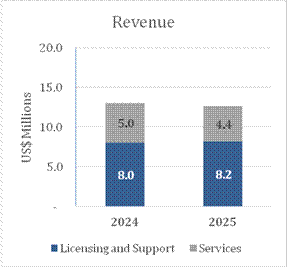
Total revenue for the year ended 31 December 2025 was $12.6 million compared to $13.0 million in FY24, representing a decrease of approximately 3%.
The decline reflects a reduction in services revenue, which decreased to $4.4 million (FY24: $5.0 million). This reduction was largely attributable to the Company's strategic expansion into the mid-market licensing space, where projects are less complex and shorter in duration. Also, technical services revenue from existing enterprise clients has decreased since they now have greater familiarity with our product and their requested features are in place. The Company expects this downward trend to continue in FY26.
Licensing and support revenue increased to $8.2 million (FY24: $8.0 million), reflecting continued adoption of the Company's core software platforms and expansion within existing customer relationships. As the business continues to prioritise scalable recurring revenue, we expect licensing subscription and support revenue to represent an increasing proportion of the Group's revenue mix over time.
Expenditure highlights
We continued to build on our 2024 cost-cutting efforts. Cost of sales decreased by approximately 10%, moving from $5.0 million in 2024 down to $4.5 million in 2025. This reduction was driven by ongoing improvements in how we deliver services and allocate resources. Our gross margins increased from 62% in 2024 to 64% in 2025, primarily due to our revenue mix shifting from lower-margin services revenue to higher-margin licensing and support revenues. In 2025, the margins for our licensing and support revenue was 84% (83% in 2024) and the margins for our services revenue was 28% (28% in 2024).
Operating expenses for the year were $9.5 million-a decrease of approximately 27% compared to $13.1 million in FY24. These savings resulted from structural changes and cost restructuring that began in late FY24 and continued through FY25, including organisational streamlining, reduced administrative overhead, and tighter expense controls. These actions aimed to better align costs with recurring revenue, while still enabling investment in product development and innovation.
Some of the key operating cost reductions include:
· Research and Development (R&D) expenses decreased to $3.1 million from $3.5 million in 2024, representing an 11% reduction. It's important to highlight that, under US GAAP, we fully expense R&D costs, while many comparable companies using IFRS accounting capitalise some development spending. This means our expense profile is more conservative and direct EBITDA margin comparisons are affected.
· Selling, General, and Administrative (SG&A) expenses also decreased significantly-down 31% to $5.9 million from $8.6 million
Gross Profit
Gross profit was $8.1 million (2024: $8.0 million) with a 64% margin, slightly higher than last year. Despite lower revenue, margins improved due to cost control and operational efficiency. Management anticipates further margin gains as more revenue comes from high-margin licensing subscriptions rather than services.
Key Performance Indicators
The Board monitors a number of financial and operational Key Performance Indicators ("KPIs") to assess the performance of the Group and to track progress against its strategic objectives. In addition to statutory measures prepared under U.S. GAAP, management uses certain non-GAAP metrics, particularly those relevant to SaaS businesses, to evaluate operating performance and long-term growth potential.
These KPIs provide additional insight into the strength of the Company's recurring revenue base, customer retention and operational efficiency.
Adjusted EBITDA Loss
Adjusted EBITDA loss, defined as earnings after capitalized commission costs and before interest, tax, depreciation, amortization, exceptional costs, and share-based payments, improved significantly to approximately $0.7 million loss for FY25 compared to a $3.9 million loss in FY24. The improvement was driven primarily by the lower operating expense base and ongoing discipline in managing discretionary expenditure across the business. While revenue declined modestly year-on-year, the improvement in cost structure more than offset this impact, resulting in a substantial narrowing of operating losses. This metric is conservative, and when used for comparison with other companies, it should be noted that, in accordance with U.S. GAAP, we fully expense our R&D costs, which totalled $3.1M in 2025.
|
|
2024 |
2025 |
|
EBITDA |
$ (3,959,347) |
$ (812,471) |
|
Adjustments to operating expenses |
|
|
|
Commissions Capitalized during the period |
(474,965) |
(344,947) |
|
Exceptional items |
|
|
|
Corporate Strategic Initiatives |
- |
75,000 |
|
Restructuring expenses (1) |
251,398 |
92,377 |
|
Share based payments |
275,643 |
246,760 |
|
Total Adjustments |
52,076 |
69,190 |
|
Adjusted EBITDA |
$ (3,907,271) |
$ (743,281) |
|
|
|
|
(1) primarily consist of severance payments made to employees affected by our workforce reduction as part of cost-cutting initiatives. The restructuring was necessary to reduce overhead costs and ensure long-term financial sustainability.
Annual recurring revenue (ARR)
ARR represents the annualised value of recurring licensing subscription and support revenue from active customer contracts at the reporting date. While ARR is a non-US GAAP measure, ARR is a key indicator of the health and growth of the Group's recurring revenue base and provides visibility into future revenue streams.
Starting with 2025 year-end results, ARR includes only recurring licensing subscription and support revenue, excluding recurring services revenue. Prior periods have been reclassified for consistency. This adjustment better aligns with SaaS industry standards and clarifies core software revenue performance.
We report ARR across three categories: IPM Suite (including LicenSee™), Brand Vision, and PictureDesk. ARR increased 14% year-on-year to $8.9 million (FY24: $7.8 million). This growth was driven by solid retention. new customer wins and expansion within existing accounts.
|
|
As at |
As at |
ARR Growth Rate |
|
IPM Suite |
4,964,784 |
5,625,862 |
13% |
|
Brand Vision |
2,015,235 |
2,463,751 |
22% |
|
PictureDesk |
844,583 |
814,975 |
-4% |
|
Total |
7,824,602 |
8,904,588 |
14% |
The growth in IPM was driven by seven new mid-market IPM customers secured during the year. These customer wins underscore our ability to scale our solutions beyond enterprise accounts. We continue to gain traction and expand in this important market segment.
Brand Vision experienced expansion of enhanced content tracking capabilities among existing clients and secured a new major media customer. We continue to enhance content tracking capabilities which strengthen Brand Vision's role as a real-time compliance layer across digital, retail, and partner platforms.
A significant portion of ARR growth was achieved during the fourth quarter of 2025, which is expected to contribute more fully to reported revenue during 2026.
Customer numbers
As with ARR metrics, we track our active client base across the same three core categories: IPM Suite, Brand Vision, and PictureDesk. In 2025, total net customer count decreased to 134 (2024: 140), driven by attrition in PictureDesk, offset by new logo additions in IPM and Brand Vision.
|
|
2024 |
Wins |
Loss |
Merged |
2025 |
Net logo (1) expansion (reduction) |
|
IPM Suite |
22 |
7 |
(2) |
- |
27 |
23% |
|
Brand Vision |
15 |
2 |
- |
(1) |
16 |
13% |
|
PictureDesk |
103 |
5 |
(13) |
(4) |
91 |
-8% |
|
Total |
140 |
14 |
(15) |
(5) |
134 |
(1)% |
(1) excludes the impact of merged clients
The decline in PictureDesk customer count came from smaller "Public Cloud" instance clients, whose ARR contributions averaged approximately $4,000 per client.
Customer retention remained strong across the Group's core platforms of IPM and Brand Vision during FY25. FADEL continues to benefit from the mission-critical nature of its solutions, which support complex licensing, royalty management and brand governance operations for global organisations.
In addition to new customer wins, the Group recorded expansion within several existing accounts, particularly through increased adoption of enhanced content tracking capabilities within Brand Vision and additional licensing functionality within IPM Suite.
These upsell opportunities remain an important contributor to ARR growth and reinforce the long-term value of the Company's land-and-expand strategy.
The Group continued to expand its customer base during the year, particularly within the mid-market segment for IPM Suite. Key new customers secured during FY25 included Handcraft Manufacturing, Viz Media, Zak! Designs and Bloom Fresh International for IPM Suite, as well as Comcast Communications and Ferrero for Brand Vision.
Growth in the mid-market IPM segment remains an important strategic focus, as it offers shorter sales cycles and scalable recurring revenue opportunities while complementing the Group's established enterprise customer base.
Cash and working capital
As of December 31, 2025, cash and cash equivalents stood at $1.9 million, down from $2.6 million at the end of 2024. The Company also has an undrawn $1.0 million credit facility available, which has been renewed through May 2027 to offer further financial flexibility if needed. There were no borrowings under this facility as of 31 December 2025. Total year-end receivables were $3.2 million, with much of this amount collected after year-end.
Even though cash levels dropped, the year-end balance was higher than previous market expectations. This result demonstrates ongoing efforts to manage working capital, especially by speeding up collections and negotiating better contract renewal terms. Cash used in operations totalled $1.1 million (2024: $0.6 million). The 2025 outflow reflects revenue timing and normalised working capital flows.
Mark Plotkin
Chief Financial Officer
29 April 2026
RISK MANAGEMENT
Principal Risks and Uncertainties relating to the Group and its Business
Like all businesses, we operate in an environment of risk, which the Company mitigates and manages. These risks are carefully balanced to ensure that we maximise returns for our shareholders. The Group has a risk management process that identifies, reviews and takes action on a regular basis and is overseen by the Board.
The risks and opportunities set out below are not exhaustive, and additional risks, uncertainties and opportunities may arise or become material in the future. Any of these risks, as well as other risks and uncertainties discussed in this report, could have a material adverse effect on the business.
Ability to retain and attract new customers
Our growth strategy is dependent on the acquisition of new customers, which depends on the perceived value of our products versus those offered by its competitors. Mitigant: Our products provide solutions to complex problems that are an important and growing part of the business model needs of large multinationals across a wide range of sectors. Existing customers highly value our products, as evidenced by the very low levels of churn with our enterprise IPM customers. Since the launch of Brand Vision, we have seen an increasing number of new logos and increasing awareness of our new AI-driven products, and their ability to address key business challenges is creating both new log as well as upsell opportunities.
Ability to retain and attract key staff
We recognise that to achieve our strategy we need to continue to take an active approach to identify, attract and retain the skills and expertise needed and to incentivise employees appropriately.
Mitigant: We ensure that we have in place the appropriate staffing levels, with a focus on technical and commercial capabilities and that employees' and contractors' contracts provide maximum mutual protection, should they leave our employment. We retain key staff by providing a competitive salary and bonus structure and the award of share options. We mitigate the risks associated with our business through the employment of high-quality, experienced staff and contractors, combined with efficient and effective management overview and controls.
Concentration risk
We derive a significant portion of our revenue from a relatively concentrated base of enterprise customers, with a limited number of clients accounting for a large share of annual revenue. The loss of a major customer, a reduction in contract scope, or delays in contract renewals could have a material adverse impact on revenue and cash flow. In addition, certain customers operate in industries that may experience cyclical demand or budgetary constraints, which could influence purchasing decisions or project timelines. Mitigant: We mitigate this risk through a diversified go-to-market and product strategy, including the launch of Brand Vision, and targeting the mid-market with the launch of LicenSee and our packaging and deployment options that enables modular adoption of IPM Suite. In this way we are increasing recurring license and support revenue across a larger number of customers. Management continues to monitor customer concentration metrics and actively seeks to broaden the customer base across industries and geographies.
Key partner and supplier relationships
We rely on a number of key partners and third-party suppliers to support the delivery and development of our software platforms, including cloud infrastructure providers and technology partners. Disruption to these relationships, changes in commercial terms, service interruptions or the failure of a key supplier to perform its obligations could adversely affect our ability to deliver services to customers, maintain platform performance or execute elements of our product development roadmap. Mitigant: We mitigate this risk through careful selection of established partners, ongoing performance monitoring and the use of contractual arrangements designed to ensure appropriate service levels and operational continuity. Where practical, we also maintain flexibility within our technology architecture and vendor relationships to reduce dependency on any single supplier and to support the transition to alternative providers if required. Most recently we have added multiple LLM vendor relationships in support of our internal and product-based usage of AI.
A failure, breach, or interruption, of the Group's IT systems
Our business depends on the availability, integrity, and security of its cloud-based platforms and internal systems. A system failure, cybersecurity breach, or material service disruption-whether internal or from a third-party provider-could result in operational downtime, loss of data, reputational harm, and financial impact. Mitigant: To manage this risk, we maintain a comprehensive operational security framework. This includes role-based access controls, environment segregation, and the encryption of data both at rest and in transit. All infrastructure changes are governed by documented change management procedures, with regular system backups and restore testing to support continuity. Proactive monitoring tools are in place to detect and respond to threats, and our security posture is validated through annual SOC audits and third-party penetration testing. These measures are reviewed and updated regularly to remain aligned with industry best practices and evolving risks.
Artificial Intelligence Governance and Regulatory Risk
We continue to integrate artificial intelligence ("AI") capabilities into our software platforms to enhance analytics, automation and compliance workflows. As the use of AI technologies expands, we may face risks associated with evolving regulatory frameworks, ethical considerations, and customer expectations regarding transparency, accuracy and responsible use of AI-driven tools. In addition, the misuse, unintended bias or incorrect outputs from AI systems could lead to reputational damage or reduced customer confidence if not properly governed. Mitigant: We manage these risks by adopting a structured and controlled approach to AI development, embedding AI capabilities within governed product environments, maintaining human oversight of critical workflows, and monitoring emerging regulatory developments relating to AI technologies. Management continues to evaluate industry best practices and regulatory guidance to ensure AI functionality within the Company's platforms is deployed responsibly and in accordance with applicable standards.
Macro global economic risk
Our customers and the markets in which it offers its services are directly affected by many national and international factors that are beyond our control. Any one of the following factors, amongst others, may cause a substantial decline in the markets to which we offer our services:
• Economic and political conditions
• The imposition of tariffs and counter-tariff measures, particularly by or against the United States
• The level and volatility of interest rates
• Collapse of financial markets
• Concerns about inflation
• Changes in investor sentiment and consumer confidence levels
• Legislative and regulatory changes
Uncertain economic prospects or a sustained period of financial instability could have a material adverse effect on our business, results of operations, financial condition and growth prospects. In particular, recent and proposed tariff regimes-including those involving the U.S. and its trading partners-have introduced additional uncertainty for global enterprises. These measures have the potential to increase costs and affect buying decisions, particularly for customers outside the U.S. who are more sensitive to price fluctuations. Mitigant: We actively monitor macroeconomic and geopolitical developments, including recent tariff policy changes around the world, to assess and manage potential risks to our operations, customer relationships, and financial performance. While we have not observed a material impact to date, we have seen an increase in price sensitivity and delays in the sales process among certain customer segments that have themselves been directly impacted by tariffs.
Despite this, FADEL's products are generally positioned as cost-saving as well as revenue generating solutions due to their AI driven automation of complex, manual processes and identification of unlicensed use of digital assets. As such, our software often serves as a means for customers to enhance efficiency and reduce operational overhead-making our value proposition more compelling in uncertain economic climates.
In addition, currency-related risks are mitigated using multi-currency deposits and proactive planning around expected revenue and expenditure. Tax compliance and planning are managed through local and multi-jurisdictional tax advisors, and we continue to align our global footprint with strategic needs to enhance operational resilience.
Geopolitical Risk - Beirut, Lebanon Office
We maintain operational offices in Beirut, Lebanon and Amman, Jordan, which exposes us to geopolitical risks associated with political instability, regional conflicts and the recent broader security developments in the Middle East. Escalation of regional tensions, including those involving Iran and neighbouring states, may result in infrastructure disruption, mobility restrictions, regulatory changes or broader economic instability that could affect business continuity or employee safety. Mitigant: The Group closely monitors geopolitical developments and maintains contingency and business continuity plans designed to mitigate potential operational disruption, including flexible working arrangements, remote working capabilities and the ability to redistribute operational activities across locations where necessary. Employee safety remains a priority, and the Company maintains communication protocols and security measures to support staff in the region, while the presence of offices in Jordan provides geographic diversification and additional operational resilience.
Liquidity and Funding Risk
As a growth-stage technology company, we continue to invest in product development and customer acquisition while working toward sustained profitability. As a result, we face risks associated with maintaining sufficient liquidity to support ongoing operations and strategic initiatives. Variations in revenue timing, particularly related to implementation projects or enterprise contract cycles, could influence short-term cash flows. Mitigant: We manage this risk through disciplined cost management, careful monitoring of working capital and maintaining access to additional liquidity resources, including an undrawn credit facility. During FY 2025, the annual run rate of overhead cost was reduced by $3.6 million. Management and the Board regularly review cash flow forecasts and funding requirements to ensure that we maintain adequate financial flexibility to support our operations and strategic objectives.
CORPORATE GOVERNANCE REPORT
The Directors acknowledge the importance of high standards of corporate governance and taking account of the Company's size and stage of development, have developed appropriate governance procedures.
Board of Directors and its Role
On 31 December 2025, the Board was made up of three Non-Executive Directors and one Executive Director. Their biographies are detailed on pages 42 and 43.
The Board meets regularly and is responsible for providing effective leadership to promote the Company's long-term success and oversee its generation of shareholder value and contribution to the wider society.
The Company, as a Delaware corporation, is not required to comply with the UK Corporate Governance Code (the 'Code'), nonetheless the Directors have decided to adopt many of its provisions. The Company formally reports against the Quoted Companies Alliance Corporate Governance Code (the 'QCA Code'), full details of which are available at www.fadel.com. Below are the ten QCA Code Principles and how they have been applied to the Company.
Principle 1: Establish a strategy and business model which promotes long-term value for shareholders
Each year, the Company communicates its purpose, strategy and business model in the Company's annual report and can be found within this Annual Report on pages 15 and 17. The Board believes that the current strategy of the Company will lead to an increase in shareholder value through the focus on:
• Growing license ARR through investment in sales outreach and effective marketing; and
• Continuing innovation through R&D expenditure on AI and current and new products.
The Group continually invests in the above-mentioned items. These investments will mean the Group will remain loss making in the short-term while waiting for recognized revenue to grow, although in FY 2025 the Group has made significant progress to its goal of breaking even. These expenditures are also expected to yield long-term benefits such as an increased market share in a competitive marketplace, making its product offering more attractive to potential customers and building a business that is resilient to macro-economic shifts.
Principal risks facing the Group are detailed further on pages 31 - 33. The Board periodically discusses and reviews these risks and identifies and deploys mitigation steps to manage these risks of the business.
Principle 2: Seek to understand and meet Shareholder needs and expectations
The Board is committed to open and continuing engagement with the Company's shareholders. There are four main ways in which the Company communicates with its shareholders:
• The Company's Investors website;
• The Annual General Meetings ("AGM");
• The Annual Report; and
• The half-year and full-year results announcements, and other trading updates (where required and appropriate), when the CEO and CFO offer up investor calls; and
• The Chair and SID making themselves available for meetings with institutional shareholders.
The Company's Chief Executive Officer and Chief Financial Officer oversee investor relations with shareholders, prospective investors, analysts and the various regulators. We do this via, meeting with independent investment analysts, regular reporting processes and at our Annual General Meeting. The Board is kept informed of the views and concerns of major shareholders by briefings from the CEO and CFO. Any internal communications, with employee shareholders and option holders, are handled with input from HR and the senior management team.
We are committed to listening and communicating with shareholders to ensure that our purpose, strategy, business model and performance are clearly understood. We maintain an active corporate website (https://fadel.com/) and post regular trade updates on various social media platforms (LinkedIn, Facebook, X) to inform stakeholders of business updates and key events. These updates also include the required financial reporting and market updates for significant events on the Regulatory News Service. The Company's senior management team meet on a weekly basis, and the Chief Executive Officer and Chief Financial Officer speak with the NOMAD on at least a tri-weekly basis to share internal developments, strategy and other matters should they arise.
As mentioned above, the AGM is one forum for dialogue with shareholders and the Board. The Notice of Meeting will be sent to shareholders at least 21 days before the AGM. The results of the AGM will subsequently be published on the Company's website.
Principle 3: Take into account wider stakeholder and social responsibilities and their implications for long-term success
The Board recognises that its long-term success comes from the continuing efforts of employees, customers, contractors, suppliers, partners, vendors and other stakeholders. Engaging effectively with them all strengthens those relationships and helps us meet our commitments. The Directors and the Group maintain an ongoing dialogue with these various stakeholders through the channels highlighted in principle 2 above. The Board is regularly updated on broader stakeholder engagement to stay up to date with stakeholder insights into the issues that matter most to them and our business, thus enabling the Board to understand and consider these issues in decision-making.
FADEL is a socially responsible business and strives to have a positive impact on the communities in which it operates. Our geographic working location spread, and business model, facilitates the identification of shared challenges, and opportunities and ideas, whilst also identifying the key resources and relationships to drive the business forward and achieve its goals.
We welcome, and listen to, feedback from employees who all have the opportunity to progress and develop their capabilities and careers. We have a diverse workforce of colleagues of many nationalities, thus making communication and feedback crucial development tools within the Group.
Principle 4: Embed effective risk management, considering both opportunities and threats, throughout the organisation
Financial Controls
The Company's Audit, Risk and Sustainability Committee comprises Sally Tilleray (Chair) and Simon Wilson. The Audit, Risk and Sustainability Committee meets as often as required and at least three times a year. Its duties and responsibilities are detailed on page 47 and 48
The Audit, Risk and Sustainability Committee main functions are:
• Internal control and risk assessment;
• Review and appointment of third-party audit and tax services providers;
• Monitoring the integrity of the financial statements of the Group, both the annual and interim accounts, and any other formal announcements in relation to financial performance; and
• Review of the policies in place in regard to sustainability and ESG.
The Audit, Risk and Sustainability Committee considers the nature, scope and results of the external auditors work, whilst also reviewing any non-audit services provided by the external auditors where appropriate. The ultimate responsibility for reviewing and approving the annual report and accounts remain with the Board as a whole.
The Chair of the Audit, Risk and Sustainability Committee reviews on an annual basis, the membership of the Audit, Risk and Sustainability Committee and its terms of reference.
Risk Management
Principal risks facing the Group and the industry in which it operates are reviewed at least once a year and are detailed on pages 31 - 33. The Company maintains a risk register that is managed by the Chief Financial Officer which is reviewed by the Board at least once a year, on a more regular basis by the Audit, Risk and Sustainability Committee, and the Chief Financial Officer.
Standards and policies
The Audit, Risk and Sustainability Committee reports to the Board who define and set out the policies in communicated procedures, and these are reviewed and revised each year to ensure consistency in application throughout the business.
As a result of the application of these policies, alongside the identification of any risks in connection with the annual audit, there have been no material issues raised during the year under review, other than ordinary operational matters.
The Company has formally adopted a social media policy which sets out to minimise the risks to the Company through the use of social media by all Directors, employees and vendors. This policy covers both the use of social media for business use and personal use, and a wide variety of social media sites, from social networking sites such as X, to the Company website.
The Company has also adopted an artificial intelligence ("AI") policy which establishes guidelines for the appropriate and secure use of AI technologies by Directors, employees and contractors. The policy sets out controls around the use of approved AI tools, data input and confidentiality, and emphasises the importance of human oversight, accountability and responsible use of AI-generated outputs. It also restricts the use of non-approved or public AI tools for Company-related activities and prohibits the use of confidential or client data without appropriate safeguards. The policy is designed to support the responsible adoption of AI while protecting the Company's data, including customer data, systems and reputation.
Other key policies implemented include, but are not limited to, anti-bribery procedures, a share dealing code and material contract review procedures.
Principle 5: Maintain the Board as a well-functioning, balanced team led by the Chair
The Board has been constructed to ensure that there is the appropriate balance of knowledge of the business, independence and experience relative to the Group's size. The Board is currently, as of April 29, 2026, made up of the Non-Executive Chairperson, two Non-Executive Directors and one Executive Director, as detailed on pages 42 and 43. The Board now considers Joe Gruttadauria to no longer be independent because of his additional responsibilities in the sales organization held during the year ended 31 December 2025, and therefore there are an equal number of independent and non-independent directors. The Board continues to believe it has maintained an appropriate balance of independence and experience. This has been supported by Sally Tilleray assuming Chair of the Remunerations Committee from Joe Gruttadauria, and Simon Wilson joining both the Audit, Risk & Sustainability and Remuneration Committees.
The Board meets at least six times each year with eight meetings occurring in the 12 months ended 31 December 2025. The higher than minimum number of meetings is expected to continue in 2026. Processes are in place to ensure that each Director is provided on a frequent basis with such information as is necessary to enable them to discharge their duties.
The Board is supported by the Audit, Risk and Sustainability Committee, and the Remuneration Committee. Each committee has its own terms of reference. Additional details on these committees can be found on page 46, including frequency of meetings.
Key Board activities in the coming year will include reviewing of the progress made towards the Group's goal/mission and continued monitoring of the Group's annual development goals. In addition to these two main goals, the Board will:
• Review feedback from shareholders post full and half-year results;
• Discuss internal governance processes;
• Review the Company's risk profile, with input from the Audit, Risk and Sustainability Committee;
• Discuss strategic priorities, including product updates and potential new markets; and
• Review and discuss the sustainability/ESG policy in place, including a review of the internal culture of the Group.
The Board regularly asks Directors to confirm that they have no conflicts of interest and that they are independent. The Company is satisfied that the current Board is sufficiently resourced to discharge its governance obligations on behalf of all stakeholders.
Principle 6: Ensure that between them the directors have the necessary up to date experience, skills and capabilities
The Non-Executive Chair leads the Board, and also has ultimate responsibility for the Company's governance structures and their effectiveness. The Non-Executive Directors bring independence and objectivity to the Board's deliberations, while the Executive Director is responsible for managing the day-to-day operations of the business and delivering its strategic objectives.
In January 2025, the Board implemented a reorganization to enhance its alignment with the Group's operational focus and growth strategy. As part of this, Joe Gruttadauria, one of the Company's Non-Executive Directors, assumed the additional role of Interim Head of Sales through 31 December 2025. In this capacity, he worked closely with the sales team and the CEO to support new business development. Joe brought significant enterprise B2B sales leadership experience within the software sector, which the Board viewed as highly complementary to the Company's commercial objectives.
While Joe is no longer acting Head of Sales effective 31 December 2025, he continues to serve as a Non-Executive Director. Having held this past operational role, Joe is no longer classified as an independent director under applicable corporate governance guidelines. As a result, Sally Tilleray continues to serve as the Chair of the Remuneration Committee and the Audit, Risk and Sustainability Committee. To further support effective governance, the Non-Executive Chair, Simon Wilson, is also a member of both committees.
The Board is confident that the current composition offers an appropriate balance of experience, skills, and perspectives for the Group's size and strategic direction. The Directors' qualifications are summarised on pages 42 and 43, and reflect strengths across sector knowledge, financial management, and operational execution. This is further supported by access to training and external advice as needed.
All Directors are encouraged to remain current on regulatory and governance developments through regular update sessions and briefings. Independent professional advice is available to all Directors at the Company's expense, with prior Board approval, and the Company Secretary remains available to support all governance matters.
Principle 7: Evaluate board performance based on clear and relevant objectives, seeking continuous improvement
During the year the Non-Executive Chair again conducted an assessment of board and committee effectiveness through 1:1 meetings with each member of the Board and the new Company Secretary, frank and open group discussions among all board directors together, and by receiving feedback from the Company's key shareholders and NOMAD. Specific areas for improvement were identified, for example frequency of communication and improvements in internal metric reporting. A monitored plan of action is in place for FY 2026.
The objective of these assessments is to enable the board, its committees and its directors to continue along a path of continuous and incremental improvement of our governance at all levels. As part of the goal for continuous improvement, the evaluation of board effectiveness is therefore an on-going periodic assessment process.
Principle 8: Promote a corporate culture that is based on ethical values and behaviours
The Board has set out and promotes a corporate culture based on sound ethical values and behaviour, which they believe are essential in engaging with all stakeholders. The Company promotes its corporate culture based on its five core values:
1. Passion
2. Innovation
3. Respect
4. Trust
5. Integrity
The Company embeds all these core values in everything it does, including annual staff training and development conversations. The Board takes responsibility for the promotion of the above-mentioned core values, alongside ethical values and behaviours throughout the Group. Employees have access to the policies that promote this culture through the employee handbook, and the annual training/updates required on these items.
The Group's purpose, strategy and business model is based on its award-winning enterprise-ready cloud software built over the last seventeen years with a product suite that provides solutions for content and IP creators (licensors) and content and IP users (licensees), built on a highly scalable cloud architecture. Its customers have complex needs. Our IPM Suite software assists clients in managing and processing complex licensing contracts and requirements. It streamlines licensing operations while ensuring comprehensive oversight of brand and sales compliance. Our Brand Vision software helps marketers and licensees accelerate their digital strategy to manage large volumes of content and associated usage rights. The Group has a customer-centric approach, with a significant amount of product development taking place continuously in collaboration with customers ensuring current market relevance.
The Board has a zero-tolerance approach to bribery, corruption, bullying, harassment, and dishonesty. This commitment is communicated clearly to all employees through training and communication, and specific policies that employee are made to sign on an annual basis.
The Board also looks beyond its stakeholders to ensure the Company and its Group entities make a meaningful contribution to society as a whole. During the year ended 31 December 2025, the Company made $5,000 in donations across charitable organisations in the US and Lebanon. The Company is also taking steps to reduce its carbon footprint, through less printing of Company documents, only making necessary business trips and making use of video conferencing solutions wherever possible.
Principle 9: Maintain governance structures and processes that are fit for purpose and support good decision-making by the Board
The Board meets at least 6 times each year in accordance with a scheduled meetings calendar. Prior to the start of the financial year, the dates of that year's Board meetings are circulated to all Board members. This is compiled to facilitate both the financial as well as operational cadence of the Company.
The Board and its Committees receive an agenda for each meeting, alongside the appropriate information prior to each meeting. These papers are generally distributed at least two days before the meetings take place. The Board meetings involve open conversation, and any Director is given the opportunity to voice any questions or concerns. Any specific actions required after the Board meetings are noted in the minutes, and are agreed upon by the Board, and/or the relevant Committee. Where management input is required, this is requested on a case-by-case basis.
The Board is ultimately responsible for the long-term success of the Company, and its Group entities. The Board has formally adopted a schedule of matters reserved for the Board. The Board is responsible for:
• Overall Group strategy;
• Structure and capital;
• Financial reporting and controls;
• Approval of the annual and interim results;
• Annual budgets and forecasts; and
• Board structure
The Board, alongside its Committee's and Management, continually monitors the business risks and reviews the annual budgets and the performance in relation to those budgets. The Non-Executive Directors (including the Chair) are responsible for bringing independence and objectivity to decisions whilst the Executive Directors are responsible for the day-to-day operations of the business and delivering the strategic aims.
The Board is supported by the Audit, Risk and Sustainability Committee, and the Remuneration Committee. Each committee has a terms of reference, about which additional details on these committees can be found on page 46, including how many times a year they are scheduled to meet. Each committee has access to such resources, information, and advice as it deems necessary, at the cost of the Company, to enable the committee to discharge its duties with prior Board agreement.
Principle 10: Communicate how the Company is governed and is performing by maintaining a dialogue with shareholders and other relevant stakeholders
The Company communicates with its shareholders mainly through the following four channels:
• The Company's Investors website;
• The Annual General Meetings;
• The Annual Report;
• The half-year and full-year results announcements, and other trading updates (where required and appropriate), with the CEO and CFO being available for shareholder meetings; and
• The Chair and SID making themselves available for meetings with institutional shareholders
A range of corporate information (including all Company announcements and presentations) is also available to shareholders, investors, and the public on the Company's corporate website (https://investors.fadel.com/). The Company's website is updated frequently with information regarding the Group's activities and performance. This includes the Company's reports, presentations, notices of AGM's and results of voting.
In addition, analysts' notes and brokers' briefings are reviewed to achieve a wide understanding of investors' views. The Company communicates with institutional investors frequently through briefings with management. As applicable The Company will also communicate to individual investors and private client brokers through a dedicated email address, investor roadshows and presentations at investor conferences.
Annual General Meeting
FADEL's Annual General Meeting will be scheduled to be held in June 2026, with the formal date and details to be announced in the Notice of Meeting in advance of the event.
Simon Wilson
Chair, Board of Directors
29 April 2026
THE BOARD OF DIRECTORS
Simon Wilson
Non-Executive Chair
Simon has over 20 years of experience in board and advisory roles with British and American B2B software companies. He is a seasoned executive, specializing in guiding both listed and growth equity-backed technology companies. He has extensive knowledge of AIM and broad expertise across the technology sector, having held board positions at U.K.-listed companies such as SurfControl plc, Endace Limited, and PCI-PAL plc. Simon has also held advisory, board and Chair positions at many international software companies including The Innovation Group (USA), Workshare, M86 Security, Uberflip and Rootstock. He currently serves as Chair on the boards of PCI-PAL plc (UK), and as Independent NED at Hazelcast (USA).
Tarek Fadel
Executive Director, Chief Executive Officer
Tarek founded FADEL in 2003, he is responsible for driving its long-term strategic plan as well as overseeing the day-to-day management of the Group. He has more than 28 years of experience building, selling and implementing enterprise software applications. He served at Cambridge Technology Group between 1995 and 1997, before spending 6 years with Oracle Corporation, a cloud technology company, where he managed a consulting practice for Oracle responsible for the success of several large ERP and E-Commerce client implementations and held the position of Director of Product Management releasing several Oracle CRM products. Tarek graduated from the Lebanese American University in Computer Science, has a Bachelor of Science in Computer and Information Science from The City University of New York and an Executive MBA from Columbia Business School and holds a technology patent for his work on Method and Apparatus for e-Commerce Integration Architecture and Process.
Sally Tilleray
Senior Independent Non-Executive Director
Sally is a qualified accountant (Chartered Institute of Management Accountants - CIMA) and an experienced UK public company director. She has served as Group Chief Operating Officer and Group Chief Financial Officer at Huntsworth plc, the international public relations and healthcare communications group, from 2004 to 2014. She is senior independent Non-Executive Director of Mind Gym plc, an international behavioural science company delivering business improvement solutions to companies across the world, which she joined at the time of its AIM listing in 2018, Non-Executive Director of NAHL plc, the consumer legal-focused marketing and services business since 2019 and Non-Executive Director of Skillcast Group plc, provider of e-learning software and content subscriptions and related professional services, which she joined at the time of its AIM listing in 2021. She has been Non-Executive Chair of digital experience agency, UNRVLD since 2020 and senior independent Non-Executive Director of Nominet UK, the domain name registry which runs .UK - part of the UK's critical national infrastructure since 2022.
Joe Gruttadauria
Non-Executive Director
Joe is experienced in building and managing sales teams. Joe served as Chief Revenue Officer for ERP Maestro, a technology company focused on providing access security and compliance software for companies running SAP. Prior to joining ERP Maestro, he led strategic sales initiatives for Qstream and San Jose-based Clarity Consultants. He has held executive leadership roles for several successful enterprise software firms including Peoplefluent, Softscape and Centra Software, as well as senior sales, service, and business development positions at Oracle and SAP. Joe graduated from The State University of New York at Fredonia in Business and has an MBA from the Rochester Institute of Technology in Finance.
DIRECTORS' REPORT
The Directors present their report together with the audited Group and Company financial statements for the year ended 31 December 2025.
Annual General Meeting
FADEL's Annual General Meeting will be scheduled to be held in June 2026 with the formal date and details to be announced in the Notice of Meeting in advance of the event.
Results and Dividends
The Group's net loss after taxes for the year was $1.5 million (2024: Net Loss $5.8 million). The Directors do not recommend the payment of a dividend (2024: Nil).
Going Concern
The Directors have assessed the Group's financial position and performance for the year ended 31 December 2025 and have a reasonable expectation that the Group has adequate resources to continue in operational existence for at least 12 months.
As at 31 December 2025, the Group held $1.9 million in cash and cash equivalents and maintained access to a further $1.0 million in undrawn credit facilities. While the Group reported a net loss for the year, it continues to grow its Annual Recurring Revenue (ARR), which increased approximately 14% year over year, and maintains strong visibility into future contracted revenues.
In Q4 2024, the Group completed a comprehensive operational review which resulted in a series of targeted cost reduction and organizational efficiency measures. This review was further refined in 2025 and resulted in a reduction in operating expense of $3.5 million in FY25 compared to FY24. The resulting leaner operating structure extends the Group's cash runway and strengthens its path toward cash flow breakeven.
Taking into account the Group's current cash position, cost base, access to additional liquidity, and recurring revenue growth, the Directors consider that the Group is well positioned to meet its obligations as they fall due for a period of at least twelve months from the date of approval of these financial statements. Accordingly, the Directors have adopted the going concern basis of accounting in preparing the Consolidated Financial Statements.
Financial Instruments
The Group's principal financial instruments comprise cash balances, short-term deposits and receivables or payables that arise through the normal course of business. The Group does not have any derivative financial instruments.
Board Committees
Information on the Audit, Risk and Sustainability Committee and the Remuneration Committee is included in the Corporate Governance section on pages 47.
Disclosure of Information to the Auditors
Each of the Directors at the date of approval of this report confirms that:
1. So far as the Directors are aware, there is no relevant audit information of which the Group's auditors are unaware; and
2. Each Director has taken all the steps that they ought to have taken as a Director in order to make themselves aware of any relevant audit information and to establish that the Group's auditors are aware of that information.
(Although this confirmation is not required for the Company as it is incorporated and registered in the State of Delaware, it is given and should be interpreted in accordance with the provisions of s418 of the Companies Act 2006).
Directors' Third-Party Indemnity Provisions
During the year and to the date of approval of the financial statements, the Group maintained indemnity insurance for its Directors and Officers against liability in respect of proceedings brought by third parties.
Employees
The business depends upon maintaining a highly qualified and well-motivated workforce and every effort is made to achieve a common awareness of the financial and economic factors affecting performance. The Group is committed to being an equal opportunities employer and engages employees with a broad range of skills and backgrounds.
Independent Auditors
A resolution to reappoint Crowe U.K. LLP as Auditors will be proposed at the forthcoming Annual General Meeting at a fee to be agreed in due course by the Audit, Risk and Sustainability Committee and the Directors.
Nominated Adviser & Broker
The Group's Nominated Adviser and Broker is Cavendish Capital Markets Limited.
Share Capital
At 31 December 2025, 20,231,250 (2024: 20,231,250 ) ordinary shares of $0.001 each were issued and fully paid. Each ordinary share carries one vote.
Significant Shareholders
|
Shareholders |
|
|
Impact Fund |
28.7% |
|
Tarek Fadel |
20.0% |
|
Amati AIM VCT plc |
10.3% |
|
Ziad Fadel |
9.9% |
|
Canaccord Genuity Limited |
7.9% |
|
BBEF (HOLDING) SAL |
5.3% |
|
NICOLAS JABBOUR |
4.0% |
|
Rathbone Investment Management Ltd |
3.4% |
Up to date details and changes of significant shareholders are contained on the Company's website at (www.investors.fadel.com).
 On behalf of the Board
Simon Wilson
Chair
29 April 2026
BOARD COMMITTEES
The Company has established two Committees of the Board as follows:
• Audit, Risk and Sustainability Committee
• Remuneration and Nominations Committee
Each committee has formally delegated duties and responsibilities with written terms of reference.
As of the date of this report, the Audit, Risk and Sustainability Committee consists of Sally Tilleray (Chair) and Simon Wilson and meets formally at least three times each year and at such other times as required.
As of the date of this report the Remuneration Committee consists of Sally Tilleray (Chair) and Simon Wilson and meets at least twice annually and otherwise as required.
Environmental, Social and Corporate Governance Policy
The Company recognises the importance of doing business responsibly and reducing any adverse impacts of its operations on people, the climate and the environment, and we encourage those with whom it does business to adopt the same values.
However, the matter has been discussed and given the present size and stage of development of the Group it was considered inappropriate to establish a separate committee for Environmental, Social and Governance purposes and that this decision would be reviewed as part of its annual review process by the Board as a whole.
In conducting its business and operations, the Company consistently upholds its commitment to sustainable resource management, waste reduction, and the promotion of employee wellbeing. The Company is dedicated to fostering equal opportunities, supporting charitable initiatives, and operating ethically across all jurisdictions where it conducts business and employs personnel.
Board and Committee Attendance in 2025
|
|
Board |
Audit, Risk and Sustainability Committee |
Remuneration Committee |
|||
|
Number of meetings |
Attended |
Number of meetings |
Attended |
Number of meetings |
Attended |
|
|
Non-Executive Directors |
|
|
|
|
|
|
|
Simon Wilson |
8 |
8 |
3 |
3 |
3 |
3 |
|
Sally Tilleray |
8 |
8 |
3 |
3 |
3 |
3 |
|
Joe Gruttaduria |
8 |
8 |
3 |
2 |
3 |
2 |
|
Kenneth West(1) |
- |
- |
- |
- |
- |
- |
|
Executive Directors |
|
|
|
|
|
|
|
Tarek Fadel |
8 |
8 |
3 |
3 |
3 |
3 |
|
Ian Flaherty(2) |
5 |
5 |
3 |
3 |
2 |
2 |
|
Mark Plotkin (3) |
4 |
4 |
1 |
1 |
2 |
2 |
(1) Ken West resigned from the Board of Directors with effect from 1 January 2025.
(2) Ian Flaherty resigned from the Board of Directors with effect from 5 September 2025.
(3) Mark Plotkin is the Chief Financial Officer and Board Secretary and attended meetings in that capacity.
AUDIT, RISK AND SUSTAINABILITY COMMITTEE REPORT
"I am pleased to present this report of the Audit, Risk and Sustainability Committee for the year 2025"
The composition and responsibilities of the Audit, Risk and Sustainability Committee (the "Committee") are set out on page 46 of this Annual Report. The Chief Executive Officer, Chief Financial Officer, Joe Gruttadauria, and representatives of the Company's external auditors attend meetings by invitation, as appropriate.
During the year ended 31 December 2025, the Committee held three formal meetings, in addition to a number of informal discussions, to support timely oversight of audit, risk, and compliance matters.
All Committee members attended each formal meeting. Throughout the year, Joe Gruttadauria (Non-Executive Director), Tarek Fadel (Chief Executive Officer) and Mark Plotkin (Chief Financial Officer), and previously Ian Flaherty during his tenure as CFO, made themselves available to the Committee to provide insight into the Company's financial processes, internal controls, and risk management practices. The Committee also engaged directly with the Company's external auditors, Crowe U.K. LLP and LMC LLP, as required.
Activities During the Year
The Committee reviewed and updated its terms of reference in January 2026, which were approved by the Board and are published on the Company's website.
The Committee works on a planned programme of activities focused on key events in the annual financial reporting cycle and other matters that are included in its terms of reference. It provides oversight and guidance to contribute to the ongoing good governance of the business, particularly by assuring that shareholders' interests are being properly protected by appropriate financial management, reporting and internal controls.
The committee reviewed, among other matters, the Group's revenue recognition policy, the annual impairment review of goodwill and the appropriateness of the Group's tax provisions. The committee also reviewed various tax matters and approved the appointment of a new US tax compliance accounting firm for the Group.
Financial Reporting
The Committee reviewed the half-year and annual financial statements. As part of this review, the Committee discussed the financial statements with the external auditor and management and considers the appropriateness of the accounting principles, the reasonableness of significant accounting judgements and the clarity of disclosures in the financial statements. The Committee reviewed and challenged the external auditor's report on these matters.
The Committee also considered management's assessment of going concern concerning the Group's cash position and commitments for the next 12 months.In fulfilling its responsibility for monitoring the integrity of financial reports to shareholders, the Committee gave due consideration as to whether the Annual Report and Accounts are fair, balanced and understandable.
External Auditors
The Committee oversees the relationship with the external auditors and monitors all their services and fees payable to them. The Committee considers various matters when reviewing the ongoing appointment of an external auditor, including their performance in conducting the audit and its scope and planning, terms of engagement including remuneration, and their independence and objectivity.
LMC the Company's component auditor and Crowe U.K. the Company's auditor were reappointed as external auditors at the Company's Annual General Meeting in October 2025. The Audit and Risk Committee has confirmed it is satisfied with LMC and Crowe U.K.'s knowledge of the Company and their effectiveness as an external auditor. As such, the Committee has recommended the reappointment of LMC and Crowe U.K. LLP to the Board, and there will be a resolution to this effect at the forthcoming Annual General Meeting.
Risk Management and Internal Controls
The Committee is responsible for overseeing internal financial controls and risk management systems. Throughout the year, it reviewed key risks and the risk register and examined updated budget and cash flow projections.
The Committee reviewed the requirement for an internal audit function and determined this was not deemed necessary due to the relatively small size of the Group.
Annual General Meeting
As Chair of the Committee, I will be attending the forthcoming Annual General Meeting of the Company and will be pleased to respond to shareholder questions on the Committee's activities.

Sally Tilleray
Chair - Audit, Risk and Sustainability Committee
29 April 2026
REMUNERATION COMMITTEE REPORT
"I am pleased to present this report of the Remuneration Committee for 2025"
The composition and responsibilities of the Remunerations Committee (the "Committee") are set out on page 46 of this Annual Report. The Chief Executive Officer, Chief Financial Officer, and Joe Gruttadauria attend meetings by invitation, as appropriate.
The number of formal meetings held during the year and members' attendance records are disclosed on page 46. In addition to its formal meetings, the Committee held a number of informal discussions to support timely decision-making on remuneration and governance matters. The Board and Committee are satisfied that all responsibilities were appropriately fulfilled in accordance with the Committee's Terms of Reference.
Remuneration policy
The Committee ensures that remuneration is set at an appropriate level for the Group and its operations based on the following principles:
• Remuneration levels support the Group strategy
• There is an appropriate link between performance and reward
• Directors, senior management and shareholder interests are aligned
• Long-term incentives are linked to shareholder returns
• Recruitment, retention and motivation of individuals is linked with skills, capabilities and experience to achieve Group objectives
• Good teamwork is ever present, enabling all employees to share in the success of the business
No Director is present for discussions concerning their own remuneration. The Non-Executive Directors do not have any personal interest in the matters decided by the Committee or have any potential conflicts of interest or day-to-day involvement in Company operations. Non-Executive Directors receive an annual fee as remuneration and remuneration packages for Executive Directors, senior management and employees are based on 4 elements:
• Basic salary or fees
• Benefits in kind
• Discretionary annual bonus
• Share option awards - A long-term incentive plan (originally the Fadel Partners, Inc. 2014 Equity Incentive Plan), replaced by the Fadel Partners, Inc. 2023 Equity Incentive Plan at IPO.
Basic salary and benefits in kind
Basic salaries and any benefits for Executive Directors are determined by the Committee at the end of each year with any changes taking effect from Q2 of the following year. Salaries are reviewed and adjusted taking into account individual performance, market factors and sector conditions together with recommendations and information from independent sources on rates of salaries for similar roles and responsibilities.
The Chief Executive Officer did not receive a salary increase for 2025. In addition, Non-Executive Directors' fees have been the same since the Company's IPO in April 2023 through December 2025. In 2026, both the Chief Executive Officer and the Non-Executive Directors will receive modest increases. The Committee considers this a disciplined and suitable approach to remuneration in the current environment.
Discretionary Annual Bonus
Bonuses are awarded based on a combination of business performance and individual achievement, taking into account the overall effect on the Company's progress against its strategic and financial objectives. Amounts shown in the Directors' emoluments tables below represent payments made to Directors during each financial year but principally relate to performance achieved during the preceding financial year.
For the year ended 31 December 2025, the Committee reviewed performance against set targets. Most metrics were met and, accordingly, FY25 bonus awards to management below the executives-paid in FY26-were broadly in line with target, reflecting overall achievement against those targets. The Committee considers this outcome a fair reflection of performance and ensures management incentives remain aligned with shareholder value.
The Committee also reviewed bonus outcomes for the Chief Executive Officer and Chief Financial Officer. The Chief Executive Officer received an award slightly below target in line with overall performance. In the case of the Chief Financial Officer, who joined during the year, no formal bonus plan had been established, and any award was therefore determined on a discretionary basis. In reaching its decisions, the Committee considered individual contribution alongside overall Group performance for both the Chief Executive Officer and Chief Financial Officer.
Share based compensation
|
FY25 |
Share option schemes |
Option Term |
Opening amount at 1 Jan 2025 |
Granted during year |
Lapsed / exercised during the year |
Closing amount at 31 Dec 2025 |
|
Executive Directors |
|
|
|
|
|
|
|
Tarek Fadel |
2023 Equity Incentive Plan |
10 years |
798,720 |
- |
- |
798,720 |
|
Ian Flaherty(1) |
2023 Equity Incentive Plan |
10 years |
252,890 |
- |
(252,890) |
- |
|
Non-Executive Directors |
|
|
|
|
|
|
|
Simon Wilson |
|
|
- |
- |
- |
- |
|
Ken West(2) |
2014 Equity Incentive Plan |
10 years |
54,012 |
- |
(54,012) |
- |
|
Sally Tilleray |
2023 Equity Incentive Plan |
10 years |
10,000 |
- |
- |
10,000 |
|
Joe Gruttadauria(2) |
2014 Equity Incentive Plan |
10 years |
54,012 |
- |
(54,012) |
- |
(1) Ian Flaherty resigned with effect from 5 September 2025, with his options expiring 90 days after resignation.
(2) Option term expired on the tenth anniversary of its issuance.
|
FY24 |
Share option schemes |
Option Term |
Opening amount at |
Granted during year |
Lapsed / exercised during the year |
Closing amount at 31 Dec 2024 |
|
Executive Directors |
|
|
|
|
|
|
|
Tarek Fadel |
2023 Equity Incentive Plan |
10 years |
- |
798,720 |
- |
798,720 |
|
Ian Flaherty(1) |
2023 Equity Incentive Plan |
10 years |
- |
252,890 |
- |
252,890 |
|
Non-Executive Directors |
|
|
|
|
|
|
|
Simon Wilson |
|
|
- |
- |
- |
- |
|
Ken West |
2014 Equity Incentive Plan |
10 years |
54,012 |
- |
- |
54,012 |
|
Sally Tilleray |
2023 Equity Incentive Plan |
10 years |
- |
- |
- |
10,000 |
|
George Kadifa(2) |
2014 Equity Incentive Plan |
10 years |
32,407 |
- |
(32,407) |
- |
|
Joe Gruttadauria |
2014 Equity Incentive Plan |
10 years |
54,012 |
- |
- |
54,012 |
(1) Ian Flaherty was appointed to the Board on 26 February 2024.
(2) George Kadifa resigned with effect from 30 November 2023, with his options expiring 90 days after resignation.
Directors' emoluments
|
FY25 |
Salary or fees and benefits |
Cash bonus(4) |
Stock-based compensation(5) |
Pension contributions |
Total |
|
Executive Directors |
|
|
|
|
|
|
Tarek Fadel |
$523,670 |
$35,000 |
$161,985 |
$10,074 |
$730,729 |
|
Ian Flaherty(1) |
$227,976 |
$39,000 |
$30,785 |
$9,982 |
$307,743 |
|
Non-Executive Directors |
|
|
|
|
|
|
Simon Wilson |
$82,500 |
- |
- |
- |
$82,500 |
|
Sally Tilleray |
£45,000 |
- |
£1,508 |
- |
£46,508 |
|
Joe Gruttadauria (2) |
£40,000 $60,135 |
- |
- |
- |
£40,000 $60,135 |
|
Ken West(3) |
£3,333 |
- |
- |
- |
£3,333 |
(1) Ian Flaherty resigned from the Board of Directors with effect from 5 September 2025. Mark Plotkin, the new CFO/Company Secretary who joined the company on 28 July 2025 is not a director of the Company.
(2) In January 2025, Joe Gruttadauria, in addition to his board duties, took on the operating role of Interim Head of Sales to work directly with sales team and Tarek Fadel to drive new business growth. Although Joe resigned from this position with effect from 31 December 2025, he is no longer deemed to be an independent director. Joe earned $60,135 in sales commissions as compensation for these services.
(3) Ken West stepped down from his role as Chair on June 30, 2024, but remained on the board as a Non-Executive Director until his resignation of the 31st of January 2025.
(4) Represent payments made to Directors during each financial year but principally relate to performance achieved during the preceding financial year.
(5) The Group records stock-based compensation in accordance with FASB ASC Topic 718 "Compensation-Stock Compensation". The fair value of awards at the time of the original grant is then recognised as an expense over the requisite service period.

Sally Tilleray
Chair - Remuneration and Nominations Committee
29 April 2026
STATEMENT OF DIRECTORS' RESPONSIBILITIES REPORT
The Directors are responsible for preparing the Annual Report and the financial statements in accordance with applicable law and regulations.
The Company is a United States of America corporation incorporated under the laws of the State of Delaware, which does not require the Directors to prepare audited financial statements for each financial year. However, the Group is required to do so in order to satisfy the requirements of the AIM Rules for listed Companies. When preparing the financial statements, the Directors are required to prepare the Group financial statements in accordance with an appropriate set of generally accepted accounting principles or practices, and have elected to use those in the United States of America ("US GAAP"). In preparing the financial statements, the directors are required to:
· select suitable accounting policies and then apply them consistently;
· state whether applicable Generally Accepted Auditing Standards ("GAAS") have been followed, subject to any material departures being disclosed and explained in the financial statements;
· make judgements and accounting estimates that are reasonable and prudent; and
prepare the financial statements on the going concern basis.
The Directors must not approve the accounts unless they are satisfied that they give a true and fair view of the state of affairs of the Company and of the profit or loss of the Company for that period.
The Directors are responsible for keeping adequate accounting records that correctly explain the transactions of the Company, enable the financial position of the Company to be determined with reasonable accuracy at any time and allow financial statements to be prepared. They are also responsible for safeguarding the assets of the Company and hence for taking reasonable steps for the prevention and detection of fraud and other irregularities.
The Directors are responsible for the maintenance and integrity of the corporate and financial information included on the Company's website. Information published on the website is accessible in many countries and legislation in the United Kingdom governing the preparation and dissemination of financial statements may differ from legislation in other jurisdictions. The Directors' responsibility also extends to the continued integrity of the financial statements.
This Directors' Report was approved and signed on behalf of the Board.

Tarek Fadel
Chief Executive Officer
29 April 2026
FINANCIAL STATEMENT
INDEPENDENT AUDITOR'S REPORT TO THE MEMBERS OF FADEL PARTNERS, INC
Opinion
We have audited the financial statements of Fadel Partners, Inc (the "Company") and its subsidiaries (the "Group") for the year ended 31 December 2025, which comprise:
· the consolidated statements of comprehensive income for the year ended 31 December 2025;
· the consolidated statements of financial position as at 31 December 2025;
· the consolidated statements of changes in equity for the year then ended;
· the consolidated statements of cash flows for the year then ended; and
· the notes to the financial statements, including a summary of significant accounting policies.
The financial reporting framework that has been applied in the preparation of the financial statements is applicable law and US Generally Accepted Accounting Practice ('US GAAP').
In our opinion the financial statements:
· give a true and fair view of the state of the Group's affairs as at 31 December 2025 and of the Group's loss for the year then ended;
· have been properly prepared in accordance with US Generally Accepted Accounting Practice ('US GAAP').
Basis for opinion
We conducted our audit in accordance with International Standards on Auditing (UK) (ISAs (UK)) and applicable law. Our responsibilities under those standards are further described in the Auditor's responsibilities for the audit of the financial statements section of our report. We are independent of the Group and the Parent Company in accordance with the ethical requirements that are relevant to our audit of the financial statements in the UK, including the FRC's Ethical Standard as applied to listed entities, and we have fulfilled our other ethical responsibilities in accordance with these requirements. We believe that the audit evidence we have obtained is sufficient and appropriate to provide a basis for our opinion.
Conclusions relating to going concern
In auditing the financial statements, we have concluded that the directors' use of the going concern basis of accounting in the preparation of the financial statements is appropriate. Our evaluation of the directors' assessment of the Group's ability to continue to adopt the going concern basis of accounting included obtaining and reviewing management's working capital projections, evaluating the consistency of key assumptions by comparison to historical performance, and assessing the ability of the Group to maintain positive cash balances under a range of reasonably possible scenarios.
Based on the work we have performed, we have not identified any material uncertainties relating to events or conditions that, individually or collectively, may cast significant doubt on the Group's ability to continue as a going concern for a period of at least twelve months from when the financial statements are authorised for issue.
Our responsibilities and the responsibilities of the directors with respect to going concern are described in the relevant sections of this report.
Overview of our audit approach
Materiality
In planning and performing our audit we applied the concept of materiality. An item is considered material if it could reasonably be expected to change the economic decisions of a user of the financial statements. We used the concept of materiality to both focus our testing and to evaluate the impact of misstatements identified.
Based on our professional judgement, we determined overall materiality for the Group financial statements as a whole to be $130,000 (2024 $130,000), based on 1% percent of Group revenue.
We use a different level of materiality ('performance materiality') to determine the extent of our testing for the audit of the financial statements. Performance materiality is set based on the audit materiality as adjusted for the judgements made as to the entity risk and our evaluation of the specific risk of each audit area having regard to the internal control environment. This is set at $91,000 (2024: $91,000) for the group.
Where considered appropriate performance materiality may be reduced to a lower level, such as, for related party transactions and directors' remuneration.
We agreed with the Audit, Risk and Sustainability Committee to report to it all identified errors in excess of $6,500 (2024: $6,500). Errors below that threshold would also be reported to it if, in our opinion as auditor, disclosure was required on qualitative grounds.
Overview of the scope of our audit
The audit was conducted on a consolidated basis, encompassing all entities within the scope of audit testing. The underlying audit work was performed by a component auditor under the direction and supervision of the group engagement team. The group team maintained ongoing communication with the component auditor throughout the audit and at the conclusion of the audit. The underlying working papers were obtained and reviewed by the group engagement team, and selected audit procedures were reperformed and agreed to underlying source documentation by the group engagement team.
Key Audit Matters
Key audit matters are those matters that, in our professional judgement, were of most significance in our audit of the financial statements of the current period and include the most significant assessed risks of material misstatement (whether or not due to fraud) that we identified. These matters included those which had the greatest effect on: the overall audit strategy, the allocation of resources in the audit; and directing the efforts of the engagement team. These matters were addressed in the context of our audit of the financial statements as a whole, and in forming our opinion thereon, and we do not provide a separate opinion on these matters.
This is not a complete list of all risks identified by our audit.
|
Key audit matter |
How the scope of our audit addressed the key audit matter |
|
|
Revenue Recognition |
|
|
|
The Group enters into revenue contracts with customers that include different performance obligations. Depending on the nature of the services provided and the specific contractual terms, revenue is recognised either over time or at a point in time. Determining the appropriate timing of revenue recognition requires judgement, particularly for certain material contracts. Incorrect determination of the revenue recognition point could result in a material misstatement of revenue recognised for the year. The Group's accounting policies relating to revenue recognition are set out in Note 3 to the Financial Statements. |
· We performed substantive testing on a sample of revenue transactions by agreeing them to underlying contracts, invoices and cash receipts. · We reviewed relevant contracts and assessed the appropriateness of the revenue recognition point in accordance with ASC 606, comparing this to management's assessment. · We evaluated whether sufficient evidence existed to support that each of the five steps of the revenue recognition model set out in the standard had been satisfied. |
|
Assessment of Impairment Indicators for Intangible Assets
|
Included in the Group's statement of financial position (and note 7) are material intangible assets, principally comprising goodwill and software‑based assets. These assets are required to be assessed for indicators of impairment ("Step 0") to determine whether a quantitative impairment test is necessary. This assessment involves judgement in evaluating whether relevant events or changes in circumstances indicate that it is more likely than not that the carrying value of an asset may exceed its fair value. There is a risk that impairment indicators are not appropriately identified, which could result in an impairment assessment not being performed when required and result in a material misstatement of the financial statements. |
· We evaluated management's ASC 350 Step 0 impairment assessment for goodwill and management's ASC 360 recoverability analysis for identifiable intangible assets, including whether projected undiscounted cash flows supported the asset group carrying value and aligned with underlying business performance. · We evaluated management's assessment of market capitalisation relative to net assets, including whether market‑based trends indicated a potential impairment trigger · We assessed the completeness of the impairment indicator assessment, challenging management's consideration of reporting unit's operating performance and share price movements. · We evaluated management's estimate of the reporting unit's fair value prepared to support the Step 0 conclusion, including the use of ARR and revenue multiples. With the involvement of our internal valuation specialists, we performed an independent corroborative assessment of whether it was more likely than not that the reporting unit's fair value exceeded its carrying amount. · We assessed whether management's conclusions were supported by the audit evidence obtained and evaluated the appropriateness of the related disclosures. |
Our audit procedures in relation to these matters were designed in the context of our audit opinion as a whole. They were not designed to enable us to express an opinion on these matters individually and we express no such opinion.
Other information
The directors are responsible for the other information contained within the annual report. The other information comprises the information included in the annual report, other than the financial statements and our auditor's report thereon. Our opinion on the financial statements does not cover the other information and, except to the extent otherwise explicitly stated in our report, we do not express any form of assurance conclusion thereon.
Our responsibility is to read the other information and, in doing so, consider whether the other information is materially inconsistent with the financial statements or our knowledge obtained in the audit or otherwise appears to be materially misstated. If we identify such material inconsistencies or apparent material misstatements, we are required to determine whether this gives rise to a material misstatement in the financial statements themselves. If, based on the work we have performed, we conclude that there is a material misstatement of this other information, we are required to report that fact.We have nothing to report in this regard.
Responsibilities of the directors for the financial statements
As explained more fully in the directors' responsibilities statement set out on page 44, the directors are responsible for the preparation of the financial statements and for being satisfied that they give a true and fair view, and for such internal control as the directors determine is necessary to enable the preparation of financial statements that are free from material misstatement, whether due to fraud or error.
In preparing the financial statements, the directors are responsible for assessing the Group's ability to continue as a going concern, disclosing, as applicable, matters related to going concern and using the going concern basis of accounting unless the directors either intend to liquidate the Group or to cease operations, or have no realistic alternative but to do so.
Auditor's responsibilities for the audit of the financial statements
Our objectives are to obtain reasonable assurance about whether the financial statements as a whole are free from material misstatement, whether due to fraud or error, and to issue an auditor's report that includes our opinion. Reasonable assurance is a high level of assurance, but is not a guarantee that an audit conducted in accordance with ISAs (UK) will always detect a material misstatement when it exists. Misstatements can arise from fraud or error and are considered material if, individually or in the aggregate, they could reasonably be expected to influence the economic decisions of users taken on the basis of these financial statements.
Irregularities, including fraud, are instances of non-compliance with laws and regulations. We design procedures in line with our responsibilities, outlined above, to detect material misstatements in respect of irregularities, including fraud. The extent to which our procedures are capable of detecting irregularities, including fraud is detailed below:
· We obtained an understanding of the legal and regulatory frameworks that are applicable to the Group and the procedures in place for ensuring compliance. These included the Companies Act 2006, AIM rules and tax legislations. Our work included understanding management's compliance procedures and considering whether any instances of non‑compliance identified during the audit could give rise to a material misstatement.
· As part of our audit planning, we assessed the various areas of the financial statements, including the related disclosures, to identify risks of material misstatement. This included consideration of fraud risk, for which we made direct enquiries of management and those charged with governance regarding any actual or suspected fraud, as well as their assessment of the susceptibility of the financial statements to fraud. We identified a higher risk in areas involving significant management judgement or estimation, such as the impairment assessments and revenue recognition. Based on this assessment, we designed our audit procedures to focus on these specific areas of heightened risk.
· To obtain an understanding of fraud risks and any instances of non-compliance with laws and regulations, we:
o made enquiries of management to understand the processes in place to ensure the Group's compliance with applicable laws and regulations;
o held discussions with individuals outside of finance; and
o reviewed legal and professional fee expenditures.
· We assessed the appropriateness of journal entries posted throughout the year, on a sample basis, and agreeing each item to supporting documentation and management explanations.
· We performed a detailed review of the Group's year end adjusting journal entries and investigated any entries that appeared unusual in nature or amount by agreeing them to supporting documentation.
· We assessed whether there was any evidence of significant transactions occurring outside the normal course of business.
· We performed a detailed review of the financial statement disclosures to assess their completeness, taking into account the explanations and information obtained during the audit
Owing to the inherent limitations of an audit, there is an unavoidable risk that some material misstatements of the financial statements may not be detected, even though the audit is properly planned and performed in accordance with the ISAs (UK).
The potential effects of inherent limitations are particularly significant in the case of misstatements resulting from fraud because fraud may involve sophisticated and carefully organized schemes designed to conceal it, including deliberate failure to record transactions, collusions or intentional misrepresentations being made to us.
A further description of our responsibilities is available on the Financial Reporting Council's website at: www.frc.org.uk/auditorsresponsibilities. This description forms part of our auditor's report.
Use of our report
This report is made solely to the company's members, as a body. Our audit work has been undertaken so that we might state to the company's members those matters we are required to state to them in an auditor's report and for no other purpose. To the fullest extent permitted by law, we do not accept or assume responsibility to anyone other than the company and the company's members as a body, for our audit work, for this report, or for the opinions we have formed.

Crowe U.K. LLP
Statutory Auditor
55 Ludgate Hill
London
EC4M 7JW
29 April 2026
CONSOLIDATED STATEMENTS OF COMPREHENSIVE INCOME
The audited, consolidated Statements of Comprehensive Income of the Group for each of the years ended 31 December 2024 and 2025 are set out below:
|
Continuing operations |
Notes |
Year ended 31 December 2024* $ |
Year ended 31 December 2025 $ |
|
Licensing and Support |
|
7,993,928 |
8,235,003 |
|
Services |
|
5,028,273 |
4,381,436 |
|
Total revenue |
|
13,022,201 |
12,616,439 |
|
|
|
|
|
|
Cost of fees and services |
|
4,973,230 |
4,487,028 |
|
Gross Profit |
|
8,048,971 |
8,129,411 |
|
|
|
|
|
|
Research and development |
|
3,456,310 |
3,089,665 |
|
Selling, general and administrative expenses |
|
8,552,008 |
5,852,217 |
|
Depreciation and amortisation |
|
700,851 |
592,403 |
|
Net interest expense |
|
72,583 |
49,302 |
|
Foreign exchange losses/(gains) |
|
275,075 |
(48,036) |
|
Other income |
|
- |
- |
|
Total operating expenses |
|
13,056,827 |
9,535,551 |
|
|
|
|
|
|
Loss before income taxes |
|
(5,007,856) |
(1,406,140) |
|
|
|
|
|
|
Income tax (gain) / expense |
|
818,485 |
91,612 |
|
Net loss after taxes |
|
(5,826,341) |
(1,497,752) |
|
|
|
|
|
|
|
|
|
|
|
Foreign currency translation adjustments |
|
134,999 |
411,599 |
|
Total comprehensive loss |
|
(5,691,342) |
(1,086,153) |
|
|
|
|
|
|
|
|
|
|
|
Net income attributable to non-controlling interest |
|
23 |
35 |
|
Net loss attributable to the Group |
|
(5,826,364) |
(1,497,787) |
|
Net loss after taxes |
|
(5,826,341) |
(1,497,752) |
|
|
|
|
|
|
|
|
|
|
|
Comprehensive income attributable to non-controlling interest |
|
23 |
35 |
|
Comprehensive loss attributable to the Group |
|
(5,691,365) |
(1,086,188) |
|
Total comprehensive loss |
|
(5,691,342) |
(1,086,153) |
|
|
|
|
|
|
|
|
|
|
|
Basic and diluted loss per Share ($) |
|
(0.28) |
(0.05) |
CONSOLIDATED STATEMENTS OF FINANCIAL POSITION
The audited, consolidated Statements of Financial Position of the Group for each of the years as at 31 December 2024 and 31 December 2025 are set out below:
|
|
|
As at 31 December 2024 |
As at 31 December 2025 |
|
Assets |
Notes |
$ |
$ |
|
Cash and cash equivalents |
|
2,607,422 |
1,910,755 |
|
Accounts receivable, net |
|
1,839,305 |
2,051,601 |
|
Unbilled work-in-progress |
|
1,160,680 |
1,210,651 |
|
Other current assets |
|
275,984 |
196,586 |
|
Current assets |
|
5,883,391 |
5,369,593 |
|
|
|
|
|
|
Intangible assets, net |
|
1,800,613 |
1,709,311 |
|
Goodwill |
|
2,178,198 |
2,332,185 |
|
Furniture, equipment and purchased software |
|
206,678 |
174,933 |
|
Contract costs |
|
835,521 |
900,926 |
|
Right-of-use asset |
|
134,777 |
44,789 |
|
Non-current assets |
|
5,155,787 |
5,162,144 |
|
TOTAL ASSETS |
|
11,039,178 |
10,531,737 |
|
|
|
|
|
|
Liabilities |
|
|
|
|
Accounts payable and accrued expenses |
|
2,542,049 |
2,433,919 |
|
Income tax payable |
|
1,021,905 |
1,043,368 |
|
Deferred revenue |
|
2,849,163 |
3,266,824 |
|
Notes payable - related parties |
|
162,396 |
162,396 |
|
Current lease liability |
|
74,248 |
44,789 |
|
Current liabilities |
|
6,649,761 |
6,951,296 |
|
Provisions - end of services indemnity |
|
308,824 |
317,602 |
|
Deferred revenue |
|
445,799 |
532,843 |
|
Non-current-Lease liability |
|
60,529 |
- |
|
Non-current liabilities |
|
815,152 |
850,445 |
|
Total liabilities |
|
7,464,913 |
7,801,741 |
|
|
|
|
|
|
Shareholders' equity |
|
|
|
|
Common shares |
|
20,231 |
20,231 |
|
Treasury stock, at cost |
|
- |
(4,876) |
|
Additional paid-in capital |
|
25,592,686 |
25,839,446 |
|
Accumulated deficit |
|
(22,537,014) |
(24,034,801) |
|
Cumulative translation adjustment |
|
497,279 |
908,878 |
|
|
|
3,573,182 |
2,728,878 |
|
|
|
|
|
|
Non-controlling interest |
|
1,083 |
1,118 |
|
Total Shareholders' equity |
|
3,574,265 |
2,729,996 |
|
TOTAL LIABILITIES AND SHAREHOLDERS' EQUITY |
|
11,039,178 |
10,531,737 |
CONSOLIDATED STATEMENTS OF CHANGES IN EQUITY
The audited, consolidated Statements of Changes in Equity of the Group for each of the years 31 December 2024 and 31 December 2025 are set out below:
|
|
Preferred shares # |
Preferred shares $ |
Common shares # |
Common shares $ |
Treasury Stock # |
Treasury Stock $ |
Additional paid in capital $ |
Accumulated deficit $ |
Cumulative translation adjustment $ |
Non-controlling interest $ |
Total $ |
|
||||||||
|
As at 31 December 2023 (audited) |
- |
- |
20,231,250 |
20,231 |
- |
- |
25,317,043 |
(16,710,650) |
362,280 |
1,060 |
8,989,964 |
|
||||||||
|
Non-controlling interest |
- |
- |
- |
- |
- |
- |
- |
- |
- |
23 |
23 |
|
||||||||
|
Stock-based compensation |
- |
- |
- |
- |
- |
- |
275,643 |
- |
- |
- |
275,643 |
|
||||||||
|
Net loss |
- |
- |
- |
- |
- |
|
- |
(5,826,364) |
- |
- |
(5,826,364) |
|
||||||||
|
Foreign exchange translation expense |
- |
- |
- |
- |
- |
- |
- |
- |
134,999 |
- |
134,999 |
|
||||||||
|
As at 31 December 2024 (audited) |
- |
- |
20,231,250 |
20,231 |
- |
- |
25,592,686 |
(22,537,014) |
497,279 |
1,083 |
3,574,265 |
|
||||||||
|
Non-controlling interest |
- |
- |
- |
- |
- |
- |
- |
- |
- |
35 |
35 |
|
||||||||
|
Common stock repurchased |
- |
- |
- |
- |
(5,555) |
(4,876) |
- |
- |
- |
- |
(4,876) |
|
||||||||
|
Stock-based compensation |
- |
- |
- |
- |
- |
- |
246,760 |
- |
- |
- |
246,760 |
|
||||||||
|
Net loss |
- |
- |
- |
- |
- |
- |
- |
(1,497,787) |
- |
- |
(1,497,787) |
|
||||||||
|
Foreign exchange translation expense |
- |
- |
- |
- |
- |
- |
- |
- |
411,599 |
- |
411,599 |
|
||||||||
|
As at 31 December 2025 (audited) |
- |
- |
20,231,250 |
20,231 |
(5,555) |
(4,876) |
25,839,446 |
(24,034,801) |
908,878 |
1,118 |
2,729,996 |
|
||||||||
|
|
|
|
|
|
|
|
|
|
|
|
|
|||||||||
CONSOLIDATED STATEMENTS OF CASH FLOWS
The audited, consolidated Statements of Cash Flows of the Group for each of the years ended 31 December 2024 and 2025 are set out below:
|
|
|
Year ended 31 December 2024 |
Year ended 31 December 2025 |
|
|
|
$ |
$ |
|
Net loss after taxes |
|
(5,826,341) |
(1,497,752) |
|
Adjustments to reconcile net loss to net cash used in operating activities: |
|
|
|
|
Depreciation and amortisation |
|
700,851 |
592,403 |
|
Non-cash stock compensation |
|
275,643 |
246,760 |
|
Non-cash impact of foreign exchange on intangibles |
|
71,102 |
(340,017) |
|
Changes in assets and liabilities |
|
|
|
|
Accounts receivable |
|
469,275 |
(212,296) |
|
Unbilled work-in-progress |
|
2,543,215 |
(49,971) |
|
Income tax receivable |
|
660,624 |
- |
|
Other current assets |
|
22,590 |
79,398 |
|
Deferred tax asset |
|
830,778 |
- |
|
Capitalisation of commissions |
|
(474,965) |
(344,947) |
|
Right of use assets |
|
67,451 |
89,989 |
|
Accounts payable and accrued expenses |
|
16,647 |
(189,340) |
|
Income tax payable |
|
(240,797) |
21,463 |
|
Deferred revenue |
|
261,867 |
504,705 |
|
Net cash used in operating activities |
|
(622,060) |
(1,099,605) |
|
|
|
|
|
|
Purchase of furniture, equipment and software |
|
(96,975) |
(3,785) |
|
Net cash used by investing activities |
|
(96,975) |
(3,785) |
|
|
|
|
|
|
Repurchases of common stock |
|
- |
(4,876) |
|
Proceeds from line of credit |
|
300,000 |
200,000 |
|
Repayment of line of credit |
|
(300,000) |
(200,000) |
|
Net cash used in financing activities |
|
- |
(4,876) |
|
Effect of exchange rates on cash |
|
134,999 |
411,599 |
|
Net (decrease)/increase in cash and cash equivalents |
|
(584,036) |
(696,667) |
|
|
|
|
|
|
Cash and cash equivalents, beginning of year |
|
3,191,458 |
2,607,422 |
|
Cash and cash equivalents, end of year |
|
2,607,422 |
1,910,755 |
|
|
|
|
|
|
Supplemental disclosure of cash flow information |
|
|
|
|
Cash paid for interest |
|
59,792 |
42,957 |
|
Cash received from interest |
|
3,000 |
317 |
|
Cash paid for income taxes |
|
207,782 |
101,174 |
|
Conversion of preferred stock to common shares |
|
- |
- |
|
Conversion of warrants to common shares |
|
- |
- |
|
Commissions and fees paid through issuance of common shares |
|
- |
- |
NOTES TO THE FINANCIAL STATEMENTS
1. ORGANISATION AND NATURE OF BUSINESS
The Financial Information consolidates the financial information of the Company and:
· its wholly-owned subsidiaries:
o Fadel Partners UK Limited ("Fadel UK"), and its wholly-owned subsidiary;
§ Image Data Systems (UK) Limited ("IDS"); and
o Fadel Partners France SAS ("Fadel France").
· its 99.99%-owned subsidiary, Fadel Partners SAL Lebanon ("Fadel Lebanon").
The Company is a New York Corporation formed in July 2003 and reincorporated in Delaware in January 2014. Fadel Lebanon was incorporated in Lebanon in August 2014 and Fadel UK was formed in the United Kingdom ("UK") in January 2015. Fadel France was formed in France in February 2020. IDS was formed in April 1992 in the UK, by an unrelated party, and acquired by the company on 1 October 2021. Together the entities are collectively referred to herein as the "Group". The Group is headquartered in New York, with a presence in Los Angeles, London, Paris and Beirut (Lebanon) and is engaged in providing and servicing its Intellectual Property Rights and Royalty Management suite of software.
On 6 April 2023, the Company was listed and started trading on AIM, a market operated by the London Stock Exchange plc ("AIM").
2. LIQUIDITY AND FINANCIAL CONDITION
Under Accounting Standards Update, or ASU, Presentation of Financial Statements-Going Concern (Accounting Standard Codification ("ASC") Subtopic 205-40) ("ASC 205-40"), the Company has the responsibility to evaluate whether conditions and/or events raise substantial doubt about the Group's ability to meet its future financial obligations as they become due within one year after the date that the Consolidated Financial Information is issued. As required by ASC 205-40, this evaluation shall initially not take into consideration the potential mitigating effects of plans that have not been fully implemented as of the date the Consolidated Financial Information is issued. The Company has assessed the Group's ability to continue as a going concern in accordance with the requirement of ASC 205-40.
As reflected in the consolidated financial information, the Group had approximately $1.9 million in cash and cash equivalents on the Statement of Financial Position as at 31 December 2025. As at 31 December 2025, the Group had negative working capital of approximately $1.6 million and an accumulated deficit approximating $24 million. Additionally, the Group had a net loss of approximately $1.5 million and cash used in operating activities of approximately $1.0 million during the year ended 31 December 2025.
The Group continued to expand its Annual Recurring Revenue (ARR), growing approximately 14% year over year in 2025. The Group also maintains access to an undrawn $1.0 million credit facility, providing additional liquidity if required.
Taking into account the Company's cash position, access to additional liquidity, continued ARR expansion, and the substantial cost reductions in 2025 which will be maintained in 2026, management believes the Group has sufficient resources to meet its obligations and continue as a going concern for a period of at least twelve months from the date of issuance of these consolidated financial statements. Accordingly, the financial statements have been prepared on a going concern basis.
3. SUMMARY OF SIGNIFICANT ACCOUNTING POLICIES
Basis of consolidation
The consolidated financial Information has been prepared in accordance with accounting principles generally accepted in the United States of America ("US GAAP"). They include the accounts of the Company, and interest owned in subsidiaries as follows: 99.99% of Fadel Lebanon, 100% of Fadel UK and its wholly-owned subsidiary IDS, and 100% of Fadel France. All significant intercompany balances and transactions are eliminated on consolidation. The non-controlling interest represents the 0.00011% share of Fadel Lebanon owned by outside parties.
Use of estimates
The preparation of the consolidated financial information in conformity with US GAAP requires the Group to make estimates and assumptions that affect the reported amounts of the Group's assets and liabilities and disclosure of contingent assets and liabilities, as at the reporting dates, as well as the reported amounts of revenue and expenses during the reporting period. Actual results could differ from these estimates.
Fair value measurements
Generally accepted accounting principles require the disclosure of the fair value of certain financial instruments, whether or not recognised on the Consolidated Statement of Financial Position, for which it is practicable to estimate fair value. The Group estimated fair values using appropriate valuation methodologies and market information available as of year-end. Considerable judgment is required to develop estimates of fair value, and the estimates presented are not necessarily indicative of the amounts that the Group could realise in a current market exchange. The use of different market assumptions or estimated methodologies could have a material effect on the estimated fair values. Additionally, the fair values were estimated at year end, and current estimates of fair value may differ significantly from the amounts presented.
Fair value is estimated by applying the following hierarchy, which prioritises inputs used to measure fair value into three levels and bases categorisation within the hierarchy upon the lowest level of input that is available and significant to the fair value measurement:
Level 1: Quoted prices in active markets for identical assets or liabilities;
Level 2: Observable inputs other than quoted prices in active markets for identical assets and liabilities, quoted prices for identical or similar assets or liabilities in inactive markets, or other inputs that are observable or can be corroborated by observable market data for substantially the full term of the assets or liabilities; and
Level 3: Inputs that are generally unobservable and typically management's estimate of assumptions that market participants would use in pricing the asset or liability.
Cash and cash equivalents
All highly liquid investments with maturities of three months or less at the date of purchase are classified as cash equivalents.
Concentrations of credit risk
Financial instruments that potentially subject the Group to concentrations of credit risk consist primarily of cash and cash equivalents, accounts receivable and unbilled work-in-progress. The Company performs on-going evaluations of the Group's customers' financial condition and, generally, requires no collateral from customers.
The Group maintains its bank accounts with major financial institutions in the United States, Lebanon, the UK, and France. At 31 December 2025, the Group had cash balances in excess of the Federal or National insured limits at financial institutions in the United States, France and the UK totalling some US$0.8 million out of a total of US$1.9 million cash deposits. The Company believes the risk is limited as the institutions are large national institutions with strong financial positions. Cash amounts held in Lebanon are not insured and as such minimal deposits are held in Lebanese accounts, with payments transferred in country only on an as needed basis.
Accounts receivable, unbilled work-in-progress and credit losses
Accounts receivable is recorded at the invoiced amount and do not bear interest. Credit is extended based on the evaluation of a customer's financial condition and collateral is not required. Unbilled work-in-progress is revenue which has been earned but not invoiced. An allowance is placed against accounts receivable or unbilled work-in-progress for management's best estimate of the amount of probable credit losses. The Company determines the allowance based on historical write-off experience and information received during collection efforts.
Credit losses
The Company estimates an allowance for expected credit losses on accounts receivable in accordance with ASC 326-20, Financial Instruments - Credit Losses. The estimate is based on historical loss experience, current conditions, and reasonable and supportable forecasts.
Accounts receivable is primarily short-term and derived from a diversified SaaS customer base with historically insignificant credit losses. The Company applies a collective assessment, as receivables share similar risk characteristics.
Given the short duration of receivables and minimal historical losses, the allowance for credit losses is not material to the financial statements. See Note 8 for more details.
Revenue recognition
The Group follows the guidance of ASC 606, Revenue from Contracts with Customers, and ASC 340, Other Assets and Deferred Cost, to account for revenue.
Sources of Revenue
The Group's revenue is primarily derived from the following sources:
1. Licensing Fees (includes basic support)
2. Subscription Services Fees
3. Customer Support
4. Implementation Services
Beginning with the year ended 31 December 2025, the Group has reclassified certain revenue streams such that services revenue now includes revenue generated under recurring services subscription arrangements, which were previously presented within licensing subscription and support revenue. Comparative amounts have been reclassified to conform to the current year presentation. This reclassification has no impact on total revenue, operating profit or net income. Management believes that this presentation is more consistent with industry practice and with how the performance of the business is evaluated.
Recognition Criteria
Revenue is recognized when control of the promised goods or services is transferred to customers in an amount that reflects the consideration the Group expects to receive in exchange for those goods or services. When a contract includes variable consideration, such as overage fees, contingent fees, or service level penalties, the Group estimates the amount to include in the transaction price only if it is probable that a significant reversal of cumulative revenue will not occur once the uncertainty associated with the variable consideration is resolved.
The Group applies the following five steps to determine the amount of revenue to recognize:
1. Identify the contract(s) with a customer.
2. Identify the performance obligations in the contract.
3. Determine the transaction price.
4. Allocate the transaction price to the performance obligations in the contract.
5. Recognize revenue when or as the Group satisfies a performance obligation.
Performance obligations and timing of revenue recognition
ASC 606 requires the identification of distinct performance obligations within a contract. The Group customer agreements primarily fall into the three distinct contract structures:
1. SaaS Offerings (Brand Vision, Picture Desk, LicenSee)
2. IPM Suite: FADEL Hosted
3. IPM Suite: Client Hosted
Each of these contract structures includes various promised goods and services that have been assessed to determine if they are distinct or not:
|
Contract Structures |
Promised Goods and Services |
Distinct Performance Obligations |
Revenue Recognition |
|
1- SaaS Products |
- SaaS Subscriptions |
SaaS subscription, support, and software updates are highly interdependent and interrelated, forming a single performance obligation. |
Over Time |
|
- Support |
|||
|
- Software Updates |
|||
|
- Services |
Services can be provided independently of the SaaS product functionality, either by the customer or other third parties. |
As Delivered |
|
|
2- IPM Suite: FADEL Hosted |
- Software License |
The software license and hosting are highly interdependent and are treated as a single performance obligation. |
Over Time |
|
- Hosting |
|||
|
- Support / ESS |
Support and ESS provide additional, but not. essential, benefits separate from the software license and hosting |
Over Time |
|
|
- Software Updates |
Software updates are considered separate, allowing customers to decide on implementation independently. |
Over Time |
|
|
- Services |
Additional services are not essential to the core functionality of the software license and hosting. |
As Delivered |
|
|
3 - IPM Suite: Client Hosted |
- Software License |
The software license is distinct since it does not depend on other FADEL-managed services. |
As Delivered |
|
- Support / ESS |
These remain separate from the software license, enhancing customer experience but not critical for core software operation. |
Over Time |
|
|
- Software Updates |
Clients can choose whether to implement updates, keeping this service separate from the primary software license obligation. |
Over Time |
|
|
- Services |
Additional services are not essential to the core functionality of the software license and hosting. |
As Delivered |
The Group allocates the transaction price first by considering if standalone sales data is available for each identified performance obligation. Based on a review of historical subscription agreements, the combined Software License or SaaS Subscription is sold and renewed on a standalone basis. Consequently, the Group utilizes these observable inputs to develop the standalone selling prices of these services.
The Group typically invoices customers annually, with payment terms requiring settlement within 30 days of invoicing. Amounts invoiced are recorded as accounts receivable and as either unearned revenue or revenue, depending on whether control has transferred to the customer.
Costs of obtaining a revenue contract
The Group capitalises costs of obtaining a revenue contract. These costs consist of sales commissions related to the acquisition of such contracts that would not have been incurred if these contracts were not won.
For licenses, the Group estimated the amortisation period based on the remaining expected life of the customer/the term for which it anticipates the Group's contract will remain effective. It anticipates the term due to the project size, terms, complexity and cost of implementation and transition, making it less likely that a client will change vendors for this service.
For service and support contracts, the amortisation period is based on the duration of the contract in consideration that it would be less difficult and costly for clients to transition to another vendor for continued service.
Amortisation periods for customer lives typically vary between 5 and 10 years. The Group elected not to apply the practical expedient for contracts that have a duration of less than one year. The Group has also elected to not include amortisation of the costs of obtaining a revenue contract within gross profit in order to help the reader see the business through the eyes of management.
Depreciation
Furniture and equipment are stated at cost. Depreciation is computed using the straight-line method over the estimated useful lives of the assets, generally three to seven years. When assets are retired or otherwise disposed of, the cost and related accumulated depreciation are removed from the accounts and any resulting gain or loss is reflected in operations for the period. The cost of maintenance and repairs is charged to operations as incurred. Significant renewals and betterments are capitalised.
Intangible assets - goodwill
Goodwill arises on the acquisition of a business. Goodwill is not amortized. Instead, goodwill is tested annually for impairment, or more frequently if events or changes in circumstances indicate that it might be impaired and is carried at cost less accumulated impairment losses. Impairment losses on goodwill are taken to profit or loss and are not subsequently reversed. The Group determined that an impairment charge was not necessary during the years ended 31 December 2024 and 2025.
Intangible assets other than goodwill
The Group has three categories of intangible assets:
Brand assets
The Group purchased IDS in October 2021 and with it acquired a long-established and respected brand. At the time of purchase, the Group estimated the useful life of the brand assets acquired for financial reporting purposes and recognises amortisation on a straight-line basis over the useful life of the asset, typically 10 years. Purchased brand assets are reviewed for impairment at each reporting date or when events and circumstances indicate an impairment. The Group determined that an impairment charge was not necessary during the years ended 31 December 2024 and 2025.
Customer relationships
The Group purchased IDS in October 2021 and with it acquired a number of customer relationships. At the time of purchase, the Group estimated the useful life of the customer relationships acquired for financial reporting purposes and recognises amortisation on a straight-line basis over the useful life of the asset, typically 10 years. Purchased customer relationships are reviewed for impairment at each reporting date or when events and circumstances indicate an impairment. The Group determined that an impairment charge was not necessary during the years ended 31 December 2024 and 2025.
Software and technology assets
The Group purchased IDS in October 2021 and with it acquired a number of software and technology assets. At the time of purchase, the Group estimates the useful life of the software and technology assets acquired for financial reporting purposes and recognised amortisation on a straight-line basis over the useful life of the asset, typically 10 years. Purchased software and technology assets are reviewed for impairment at each reporting date or when events and circumstances indicate an impairment. The Group determined that an impairment charge was not necessary during the years ended 31 December 2024 and 2025.
In assessing impairment, the Group evaluated both goodwill and intangible assets in accordance with applicable accounting standards. For intangible assets, the Group determined the relevant asset group to be the IDS subsidiary, as the assets do not generate cash inflows independently. The carrying value of the asset group, excluding goodwill, was compared to the expected undiscounted cash flows over the remaining useful life of the assets. Based on this analysis, the projected cash flows exceeded the carrying value of the asset group and no impairment was identified.
For goodwill, the Group performed a qualitative assessment at the reporting unit level, which is consistent with the level at which management monitors performance. The assessment considered current operating performance, projected future cash flows and external market data, including valuation benchmarks for comparable SaaS businesses. Based on this evaluation, the Group concluded that it was not more likely than not that the fair value of the reporting unit was less than its carrying value. Accordingly, no impairment charge was recognised.
Research and development costs:
The Group incurs research and development ("R&D") costs related to the development of software products that are marketed externally as well as internally hosted cloud-based solutions. As such, the Company evaluates its software development activities under both ASC 985-20, Software to be Sold, Leased, or Marketed and ASC 350-40, Internal-Use Software.
In accordance with these standards, the Group historically expenses all R&D costs as incurred. While certain costs could potentially qualify for capitalization under the applicable guidance, management has determined that, due to the integrated nature of development activities and the inability to reasonably segregate capitalizable costs from non-capitalizable costs on a cost-effective basis, all costs are expensed as incurred.
Deferred revenues
The Group's contract liabilities primarily consist of amounts invoiced to customers in advance of the delivery of services or the satisfaction of performance obligations under licensing and services agreements.
As of 31 December, 2024 and 2025, deferred revenue balances were $3,294,962 and $3,799,667, respectively. During the year ended 31 December, 2025, $2,656,008 of the deferred revenue was recognized as revenue (2024: $2,650,934).
Unbilled work-in-progress
Unbilled work-in-progress represents revenue recognized over time under ASC 606, for performance obligations satisfied but not yet invoiced as of the reporting date, and is included in contract assets on the balance sheet.
As of 31 December, 2025 and 2024, unbilled work-in progress balances were and $1,160,680 and $1,210,651 respectively. During the year ended 31 December, 2025, $1,165,676 of the unbilled revenues was billed (2024: $1,800,426).
Segmental reporting
The Group reports its business activities in two areas:
· Licensing and support revenue; and
· Services,
which are reported in a manner consistent with the internal reporting to the CEO, who has been identified as the chief operating decision maker.
Advertising and promotion costs
Advertising and promotion costs are expensed as incurred. These costs totalled $463,726 for the year ended 31 December 2024 and $412,300 for the year ended 31 December 2025.
Advertising and promotion expenses include external costs related to events and marketing activities and do not include the Company's internal costs for these activities, mainly payroll and related costs. We applied this classification consistently to 2024 for comparability.
Income taxes
The Group records deferred tax assets and liabilities for the estimated future tax effects of temporary differences between the tax bases of assets and liabilities and amounts reported in the Group's Consolidated Statements of Financial Position, as well as operating loss and tax-credit carry-forwards. The Group also measures deferred tax assets and liabilities using enacted tax rates expected to be applied to taxable income in the years in which those temporary differences are expected to be recovered or settled. Deferred tax assets are reduced by a valuation allowance if, based on available evidence, it is more likely than not that these benefits will not be realised.
Stock-based compensation
The Group records stock-based compensation in accordance with FASB ASC Topic 718 "Compensation-Stock Compensation". The fair value of awards granted is recognised as an expense over the requisite service period.
Leases
The Group accounts for leases under ASC 842, Leases, which requires the recognition of right-of-use ("ROU") assets and lease liabilities on the Consolidated Statements of Financial Position. including those leases classified as operating leases. Under the standard, disclosures are required to meet the objective of enabling users of financial statements to assess the amount, timing, and uncertainty of cash flows arising from leases.
The Group determines if an arrangement is a lease at inception. If applicable, operating leases are included in operating lease ROU assets, other current liabilities, and operating lease liabilities on the accompanying Consolidated Statements of Financial Position. If applicable, finance leases are included in property and equipment, other current liabilities, and other long-term liabilities on the accompanying Consolidated Statements of Financial Position.
ROU assets represent the right to use an underlying asset for the lease term and lease liabilities represent our obligation to make lease payments arising from the lease. Operating lease ROU assets and liabilities are recognized at commencement date based on the present value of lease payments over the lease term.
Foreign currency
The Group's reporting currency is the US Dollar. The functional currency of foreign operations, excluding the Lebanon entity, is the local currency for the foreign subsidiaries. Assets and liabilities of those foreign operations denominated in local currencies are translated at the spot (historical) rate in effect at the applicable reporting date. The Group's Consolidated Statements of Comprehensive Income are translated at the weighted average rate of exchange during the applicable period. Realised and unrealised transaction gains and losses generated by transactions denominated in a currency different from the functional currency of the applicable entity are recorded in other income (expense) in the Consolidated Statements of Comprehensive Income in the period in which they occur.
Foreign currency amounts denominated in British pounds sterling ("£") and euros ("€") are translated into U.S. dollars using average exchange rates for the periods presented for the Consolidated Statements of Comprehensive Income and Consolidated Statements of Cash Flows, and exchange rates in effect at the balance sheet date for the Consolidated Statements of Financial Position.
In accordance with applicable US GAAP, on January 1, 2023, our company transitioned Fadel Lebanon to a USD functional currency entity due to the hyperinflationary conditions prevalent in the Lebanese currency. As a result, all financial statements for periods end 31 December 2024 and 2025, reflect the Lebanon subsidiary's operations and financial position in USD.
Comprehensive loss
Comprehensive loss consists of two components:
• net loss; and
• other comprehensive loss.
Other comprehensive loss refers to revenue, expenses, gains and losses that are recorded as an element of Shareholder's equity but are excluded from net loss. Other comprehensive loss consists of foreign currency translation adjustments from those subsidiaries not using the $ as their functional currency.
Statement of cash flows
Cash flows from the Group's operations are calculated based upon the functional currencies. As a result, amounts related to assets and liabilities reported on the Consolidated Statements of Cash Flows will not necessarily agree with changes in the corresponding balances on the Consolidated Statements of Financial Position.
New Accounting Pronouncements
From time to time, new accounting pronouncements are issued by the FASB or other standard setting bodies and adopted by the Company as at the specified date. Unless otherwise discussed, the Company believes that the impact of recently issued standards that are not yet effective will not have a material impact on the Group's Consolidated Statements of Financial Position, Consolidated Statements of Comprehensive Income or Consolidated Statements of Cash Flows.
Recently Issued Accounting Pronouncements
The Company adopted ASU 2023-07, Segment Reporting (Topic 280): Improvements to Reportable Segment Disclosures, effective January 1, 2024. The adoption resulted in expanded disclosure requirements but did not have an impact on the Company's consolidated financial position, results of operations, or cash flows.
The Company adopted ASU 2023-09, Income Taxes (Topic 740): Improvements to Income Tax Disclosures, effective January 1, 2025. The adoption resulted in expanded income tax disclosures but did not have an impact on the Company's consolidated financial position, results of operations, or cash flows.
In November 2024, the FASB issued ASU 2024-03, Income Statement - Reporting Comprehensive Income - Expense Disaggregation Disclosures (Topic 220): Disaggregation of Income Statement Expenses. This standard enhances the transparency of financial reporting by requiring public entities to disclose additional information about the nature of certain expense line items presented in the income statement. FADEL is currently evaluating the impact of this standard on its financial statement disclosures.
4. SEGMENTAL REPORTING
The Group reports its business activities in two areas:
· Licensing and support revenue; and
· services,
which are reported in a manner consistent with the internal reporting the Chief Executive Officer, which has been identified as the chief operating decision maker.
While the chief operating decision maker considers there to be only two segments, the Group's revenue is further split between "licensing and support" (recurring in nature) and "services" (recurring for subscription-based services and non-recurring for implementation and other support services) and by key product families IPM Suite and Brand Vision (which includes PictureDesk) and hence to aid the readers understanding of our results, the split of revenue from these categories is shown below:
|
|
|
Audited As at 31 December 2024* |
Audited As at 31 December 2025 |
|
|
|
$ |
$ |
|
Revenues |
|
|
|
|
Licensing and Support |
|
|
|
|
IPM Suite |
|
5,434,562 |
5,185,270 |
|
Brand Vision |
|
2,559,366 |
3,049,733 |
|
Total Licensing and Support |
|
7,993,928 |
8,235,003 |
|
|
|
|
|
|
Services |
|
5,028,273 |
4,381,436 |
|
Total Revenues |
|
13,022,201 |
12,616,439 |
|
|
|
|
|
|
Cost of Sales |
|
|
|
|
Licensing and Support |
|
1,340,079 |
1,312,865 |
|
Services |
|
3,633,151 |
3,174,163 |
|
Total Cost of Sales |
|
4,973,230 |
4,487,028 |
|
Gross Profit Margins |
|
|
|
|
Gross profit margin - Licensing and Support |
|
83% |
84% |
|
Gross profit margin - Services |
|
28% |
28% |
|
Total Gross Profit Margin |
|
62% |
64% |
* Revenues and cost of sales have been reclassified to conform to the current year revenue presentation.
5. ACCOUNTS RECEIVABLE
Accounts receivable consists of the following:
|
|
As at 31 December 2024 |
As at 31 December 2025 |
|
|
$ |
$ |
|
Accounts receivable |
1,952,329 |
2,117,914 |
|
Allowance for doubtful accounts |
(113,024) |
(66,313) |
|
Accounts receivable, Net |
1,839,305 |
2,051,601 |
6. CONTRACT COSTS
The Group accounts for commission costs in accordance with ASC 606, Revenue from Contracts with Customers, which requires the capitalization of incremental costs of obtaining a contract when the expected amortization period is greater than one year. These costs are amortized on a systematic basis consistent with the pattern of transfer of the goods or services to which the asset relates. Amortization periods for customer lives typically range from 5 to 10 years.
As of 31 December, 2024, and 2025, the Group recorded accumulated amortization of $1,863,969 and $2,143,511, respectively. The Group has elected not to apply the practical expedient available under ASC 606 for contracts with a duration of less than one year.
Contract costs consist of the following:
|
|
As at 31 December 2024 |
As at 31 December 2025 |
|
|
$ |
$ |
|
Contract Costs - Opening balance |
763,323 |
835,521 |
|
Commissions capitalised during the year |
474,965 |
344,947 |
|
Amortisation charge for the year |
(402,767) |
(279,542) |
|
Contract costs - Ending Balance |
835,521 |
900,926 |
7. INTANGIBLE ASSETS
The Company recognized identifiable intangible assets and goodwill in connection with an acquisition completed in 2021 in accordance with ASC 805, Business Combinations. The identifiable intangible assets primarily consist of customer relationships, developed technology, and brand assets, which are amortized over their estimated useful lives.
The carrying value of intangible assets was as follows:
|
|
Goodwill |
Customer Relationships |
Technology Based Assets |
Brand Assets |
Total |
|
|
$ |
$ |
$ |
$ |
$ |
|
As at 31 December 2025 |
2,332,185 |
396,341 |
2,062,041 |
397,778 |
5,188,345 |
|
|
|
|
|
|
|
|
Accumulated Amortisation: |
|
|
|
|
|
|
As at 31 December 2024 |
- |
120,642 |
625,378 |
120,942 |
866,962 |
|
Amortisation charge for the period |
- |
38,839 |
202,068 |
38,980 |
279,887 |
|
As at 31 December 2025 |
- |
159,481 |
827,446 |
159,922 |
1,146,849 |
|
|
|
|
|
|
|
|
Carrying amount: |
|
|
|
|
|
|
As at 31 December 2024 |
2,178,198 |
249,530 |
1,300,512 |
250,571 |
3,978,811 |
|
As at 31 December 2025 |
2,332,185 |
236,860 |
1,234,595 |
237,856 |
4,041,496 |
Amortization expense for the year ended 31 December, 2024 was $273,104. Estimated future amortization expense is approximately $270,000 annually for each of the next five years.
Goodwill represents the excess of the purchase price over the fair value of net assets acquired and primarily reflects expected synergies and the assembled workforce. As of 31 December 2024, and 2025, goodwill was $2.2 and $2.3 million respectively.
The Company evaluates goodwill for impairment annually or more frequently if indicators of impairment exist. Based on projections of income, cash flows and the conditions of current operations, it believes the fair value of the reporting unit is greater than it carrying amount and no impairment is needed.
8. FURNITURE, EQUIPMENT AND PURCHASED SOFTWARE
Furniture, equipment and purchased software consist of the following:
|
|
As at 31 December 2024 |
As at 31 December 2025 |
|
|
$ |
$ |
|
Furniture, equipment and purchased software |
363,328 |
367,113 |
|
Accumulated depreciation |
(156,650) |
(192,180) |
|
Furniture and equipment |
206,678 |
174,933 |
Depreciation expense was $26,003 and $35,530 for the years ended 31 December 2024 and 2025, respectively.
9. LEASES
A lease is defined as a contract that conveys the right to control the use of identified property, plant or equipment for a period of time in exchange for consideration. The Company accounts for its leases in accordance with the guidance in Accounting Standards Codification ("ASC") 842 ("ASC 842"). Substantially all of the leases in which the Company is the lessee are comprised of real estate property for remote office spaces and corporate office space. Substantially all of the leases are classified as operating leases.
As at the year ended 31 December 2024 and 31 December 2025, the Company had approximately$134,777 and $44,789 respectively, of operating lease ROU assets $134,777 and $44,789, respectively of operating lease liabilities on the Group's Consolidated Statements of Financial Position. The Company has elected not to recognize right-of-use ("ROU") assets and lease liabilities arising from short-term leases, leases with initial terms of twelve months or less, or equipment leases (deemed immaterial) on the Group's Consolidated Statements of Financial Position.
As at 31 December 2025, these leases do not contain material residual value guarantees or impose restrictions or covenants related to dividends or the Company's ability to incur additional financial obligations. The discount rate for operating leases was based on market rates from a bank for obligations with comparable terms effective at the lease inception date.
The following table presents lease costs, future minimum lease payments and other lease information as of 31 December of the remaining years under lease:
|
|
|
|
Year Ending 31 December, |
Operating |
|
2026 |
44,789 |
|
Total Operating Lease Liabilities |
44,789 |
|
Less amounts representing interest |
- |
|
Present Value of Future Minimum Lease Payments |
44,789 |
|
Less current maturities |
44,789 |
|
Long-term Lease Liability |
- |
Lease Cost:
|
|
2024 |
2025 |
|
Operating lease - operating cash flows (fixed payments) |
62,438 |
61,605 |
|
Weighted average remaining lease term -operating |
1.7 years |
0.7 years |
|
Weighted average discount rate - operating |
10% |
10% |
10. RETIREMENT PLAN
The Company has a 401(k) safe harbor plan that covers all employees of the U.S. entity at least 21 years of age who have worked for the Company for at least three months. Employees vest immediately for all employer matching contributions. The retirement plan expense was $84,421 for the year ended 31 December 2025 and $112,333 for the year ended 31 December 2024.
The Group also maintains a provision for end-of-service indemnity for employees of its Lebanese subsidiary, in accordance with local labor regulations. This liability reflects the estimated obligation for benefits payable to employees upon separation from service. During 2024, the Company adopted a refined approach to estimating this provision, representing a change in accounting estimate. The updated methodology incorporates a forfeiture rate of 11.40% for 2025, derived from historical employee turnover data, and applies a present value discounting approach using a 10% discount rate, consistent with prevailing economic conditions in Lebanon. These changes enhance the accuracy of the estimate by reflecting both expected employee behavior and the time value of money. As at 31 December, 2025 the liability to end of services indemnity was $317,602 (2024: $308,824).
11. LINE OF CREDIT: Bank of America:
The Group maintains access to a revolving credit facility with Bank of America, N.A., originally established in June 2022 and renewed on an annual basis. The facility provides for borrowings of up to $1.0 million to support working capital and general corporate purposes.
During the year ended 31 December 2024 and during the year ended 31 December 2025, the Group drew $300,000 and $200,000 respectively on the facility, which was fully repaid prior to year-end. Borrowings during the year bore interest at a variable rate equal to the U.S. Prime Rate plus 0.95%.
The facility is secured by substantially all assets of Fadel Partners, Inc., and is further supported by a personal guarantee from the Group's Chief Executive Officer, Tarek Fadel.
Subsequent to year end, on April 7, 2026, the facility was renewed and extended through 31 May 2027.
12. INCOME TAXES
The components of income/(loss) before income taxes are as follows:
|
|
|
Audited As at 31 December 2024 |
Audited As at 31 December 2025 |
|
|
|
$ |
$ |
|
Domestic |
|
(4,817,109) |
(2,474,329) |
|
Foreign |
|
(83,175) |
1,046,347 |
|
US taxable profit before income taxes |
|
(4,900,284) |
(1,427,982) |
Provision for income taxes consisted of the following:
|
Provision components are as follows: |
|
Audited As at 31 December 2024 |
Audited As at 31 December 2025 |
|
|
|
$ |
$ |
|
Current: |
|
|
|
|
Foreign |
|
90,025 |
208,196 |
|
Federal |
|
7,041 |
(125,340) |
|
State |
|
(109,360) |
8,756 |
|
Total current expense/(income) |
|
(12,294) |
91,612 |
|
Deferred: |
|
|
|
|
Foreign |
|
39,732 |
- |
|
Federal |
|
587,582 |
- |
|
State |
|
203,465 |
- |
|
Total deferred expense |
|
830,779 |
- |
|
Provision for/(benefit from) income taxes |
|
(818,485) |
(91,612) |
The differences between income taxes expected at the U.S federal statutory income tax rate and income taxes reported were as follows:
|
Effective Tax Rate Reconciliation
|
Audited As at 31 December 2024 |
Tax Rate As at 31 December 2024 % |
Audited As at 31 December 2025 |
Tax Rate As at 31 December 2025 % |
|
$ |
|
$ |
|
|
|
U.S federal income tax (benefit) at statutory rate |
(1,029,060) |
21 |
(299,876) |
21 |
|
State tax (net of federal benefit) |
(186,769) |
4 |
(116,008) |
8 |
|
Foreign tax rate differential |
(8,785) |
-
|
(5,889) |
-
|
|
Meals and entertainment |
- |
- |
4,027 |
- |
|
GILTI income |
459,569 |
(9) |
487,842 |
(34) |
|
Stock Compensation |
57,885 |
(1) |
51,820 |
(4) |
|
Change in Valuation Allowance |
(316,895) |
6 |
(351,166) |
25 |
|
SALT rate change |
- |
- |
(35,545) |
2 |
|
RTP |
- |
- |
(43,926) |
3 |
|
Deferred True-up |
- |
- |
529,042 |
(37) |
|
Payable True up |
1,894,965 |
(39) |
(125,340) |
9 |
|
Other |
(42,692) |
1 |
(3,369) |
- |
|
Provision for/(benefit from) income taxes |
828,218 |
(17) |
91,612 |
(6) |
The Company is subject to taxation in the United States and certain foreign jurisdictions. Earnings from non-U.S. activities are subject to local country income tax.
The material jurisdictions where the Company is subject to potential examination by tax authorities include the United States, France, Lebanon and the UK.
U.S Companies are eligible for a deduction that lowers the effective tax rate on certain foreign income. This treatment is referred to as the Foreign-Derived Intangible Income deduction.
As at 31 December 2024, the Company had a federal and state NOL carry forward of approximately $2.5 million and $2.8 million. The state NOL will expire beginning in 2037. As at 31 December 2024, the Company had NOLs in California, Connecticut, Florida, Massachusetts, New York and Pennsylvania.
As at 31 December 2025, the Company had a federal and state NOL carry forwards of approximately $1.4 million, and $2.9 million, respectively. The state NOL will begin to expire in 2037. As at 31 December 2025, the Company had NOLs in California, Florida, Massachusetts, North Carolina, New Jersey, New York, Pennsylvania and Rhode Island.
The Tax Cuts and Jobs Act ("TCJA") introduced a provision to tax global intangible low-taxed income ("GILTI") of foreign subsidiaries. For the years ended 31 December, 2024 and 2025, the Company had to include GILTI relating to the Company's foreign subsidiaries. The Company elected to account for GILTI as a current period cost. The One, Big, Beautiful Bill Act (OBBBA) enacted in 2025 set the GILTI tax rate to 40%.
Significant components of the Company's deferred tax assets and deferred tax liabilities are as follows:
|
Deferred Tax Table
|
|
Audited As at 31 December 2024 |
Audited As at 31 December 2025 |
|
|
|
$ |
$ |
|
Amortisation |
|
780,186 |
567,189 |
|
Net Operating loss carry forwards |
|
488,500 |
289,256 |
|
Net Operating loss carry forwards (state) |
|
179,115 |
195,291 |
|
Net Operating loss carry forwards (foreign) |
|
675,799 |
714,328 |
|
Reserves and accruals |
|
152,563 |
94,027 |
|
Deferred revenue |
|
111,410 |
135,060 |
|
Unrealized FX Gain/Loss |
|
- |
79,786 |
|
R&D credit |
|
- |
- |
|
Net deferred tax assets |
|
2,387,573 |
2,074,937 |
|
Less valuation allowance |
|
(2,387,573) |
(2,074,937) |
|
Total deferred tax assets |
|
- |
- |
|
Total deferred tax liabilities |
|
- |
- |
|
Deferred tax assets, net |
|
- |
- |
As required by the authoritative guidance on accounting for income taxes, the Company evaluates the realizability of deferred tax assets on a jurisdictional basis at each reporting date. Accounting for income taxes requires that a valuation allowance be established when it is more likely than not that all or a portion of the deferred taxes will not be realized. The Company considers all positive and negative evidence in determining if, based on the weight of such evidence, a valuation allowance is required. In circumstances where there is sufficient negative evidence indicating that the deferred tax assets are not more likely than not realizable, the Company establishes a valuation allowance. The significant 2025 pre-tax loss, coupled with cumulative book losses projected in early future years, was significant negative evidence considered by the Company. As a result, the Company's valuation allowance balance as of 31 December 2025 is $2.1M.
The change in the valuation allowance is as follows:
|
|
Beginning of the Year |
Additions/ (Deductions) |
Balance at the end of the year |
|
|
|
|
|
|
2024 |
|
|
|
|
Reserves Deducted from deferred income taxes, net: |
3,535,416 |
(1,147,843) |
2,387,573 |
|
Valuation Allowance |
(2,704,468) |
(316,895) |
(2,387,573) |
|
2025 |
|
|
|
|
Reserves Deducted from deferred income taxes, net: |
2,387,573 |
(312,636) |
2,074,937 |
|
Valuation allowance |
(2,387,573) |
(312,636) |
(2,074,937) |
|
|
|
|
|
|
|
|
|
|
At 31 December 2025, the Company did not have any unrecognized tax benefits and did not anticipate any significant changes to the unrecognized tax benefits within twelve months of this reporting date. In the year ended 31 December 2025, the Company recorded $16K of accrued interest in the income tax payable related to the 2021 amended return.
The Company considers the earnings of its foreign entities to be permanently reinvested outside the United States based on estimates that future cash generation will be sufficient to meet future domestic cash needs. Accordingly, deferred taxes have not been recorded for the $2.4 million of undistributed earnings of the Company's foreign subsidiaries. As a result of the TCJA and the current U.S. taxation of deemed repatriated earnings, the additional taxes that might be payable upon repatriation of foreign earnings are not significant. All other outside basis differences not related to earnings were impractical to account for at this period of time and are currently considered as being permanent in duration.
13. COMMON SHARES
The Company has authority to issue 150,000,000 shares at $0.001 par value per Share. As at 31 December 2024 and 31 December 2025, the Company had 20,231,250 common shares of $0.001 each in issue. Shareholders may use this figure as the denominator by which they are required to notify their interest in, or change their interest in, the Company under the Disclosure Guidance and Transparency Rules.
14. EARNINGS PER SHARE
The Company computes earnings (loss) per share in accordance with ASC 260, Earnings per Share, which requires presentation of both basic and diluted earnings per share on the face of Consolidated Statements of Comprehensive Income. Basic earnings (loss) per share is computed by dividing net income (loss) available to common shareholders by the weighted average number of outstanding shares during the period.
Diluted earnings (loss) per share gives effect to all dilutive potential common shares outstanding during the period. Due to their anti-dilutive effect, the calculation of diluted net loss per share for the years ended 31 December 2024 and 31 December 2025 does not include stock options and warrants. The number of dilutive shares would have been 1,846,296 and 1,396,786 as at 31 December 2024 and 31 December 2025, respectively.
|
|
|
Audited As at 31 December 2024 |
Audited As at 31 December 2025 |
|
|
|
$ |
$ |
|
Total comprehensive income attributable to Shareholders |
|
(5,691,342) |
(1,086,153) |
|
|
|
|
|
|
Weighted average number of Shares |
|
20,231,250 |
20,231,250 |
|
|
|
|
|
|
Basic and diluted earnings per share ($) |
|
(0.28) |
(0.05) |
15. STOCK OPTION PLANS
The Group maintains equity incentive plans to provide stock-based compensation to employees and directors.
The 2014 Equity Incentive Plan authorized 1,620,366 shares for issuance. Options under this plan generally vest over three to four years. Following the Company's admission to AIM in April 2023, no further grants are expected under this plan. As of 31 December, 2025, 195,608 options remained outstanding.
On April 2, 2023, the Group adopted the 2023 Equity Incentive Plan, which supersedes the 2014 plan. Options granted under this plan vest over four years, have a contractual term of up to ten years, and are issued at an exercise price not less than fair market value on the grant date. During the year ended 31 December, 2025, 285,712 options were granted, and 1,327,750 options were outstanding at year end.
In addition, the Group has 576,924 non-plan options outstanding as of 31 December 31 2025, with an exercise price of £1.44 per share and a ten-year term.
Determining the appropriate fair value model and the related assumptions requires judgment. The fair value of each option granted is estimated using a Black-Scholes option-pricing model on the date of grant as follows:
|
|
|
For the year ended 31 December 2024 |
For the year ended 31 December 2025 |
|
Estimated dividend yield |
|
0% |
0% |
|
Expected stock price volatility |
|
30% |
41% |
|
Risk-free interest rate |
|
4.19% |
3.88% |
|
Expected life of option (in years) |
|
7 |
7 |
|
Weighted-average fair value per share |
|
$0.62 |
$0.43 |
The assumptions were based on the following for each of the periods presented:
Expected dividend yield -The Company has never declared or paid any cash dividends and does not anticipate paying cash dividends in the foreseeable future, and, therefore, used an expected dividend yield of zero in the valuation model.
Expected stock price volatility -Because the Company had limited trading history by which to determine the volatility of its own common stock price, the expected volatility being used is derived from the historical stock volatilities of a representative industry peer group of comparable publicly listed companies over a period approximately equal to the expected term of the options.
Risk-free interest rate-The risk-free interest rate is based on U.S. Treasury issues with remaining terms similar to the expected term on the options.
Expected life of option-The expected term represents the period that the Company's stock-based awards are expected to be outstanding. The Company determined the expected term using the simplified method. The simplified method calculates the expected term as the average of the time-to-vesting and contractual terms of the stock-based award.
Aggregate intrinsic value-Represents the total intrinsic value of in-the-money options at the reporting date, calculated as the difference between the share price and exercise price, multiplied by the number of options, and presented in thousands. The Aggregate Intrinsic Value was as for $348,265 for the year ended 31 December 2024 and was $122,022 for the year ended 31 December 2025.
A summary of the status of the Group's option plans for the year ended 31 December 2025 is as follows:
|
|
2014 plan |
Non-plan |
2023 plan |
Total |
|
|||||||
|
Options outstanding |
Number of |
Weighted |
Number of |
Weighted |
Number of |
Weighted |
Number of |
Weighted |
||||
|
As at 31 December 2024 |
793,830 |
$1.19 |
576,924 |
$1.78 |
1,723,952 |
$1.73 |
3,094,706 |
$1.60 |
||||
|
Granted |
- |
$- |
- |
$- |
285,712 |
$1.53 |
285,712 |
$1.53 |
||||
|
Exercised |
- |
$- |
- |
$- |
- |
$- |
- |
$- |
||||
|
Forfeited or expired |
(598,222) |
$0.97 |
- |
$- |
(681,914) |
$1.53 |
(1,280,136) |
$1.27
|
||||
|
As at 31 December 2025 |
195,608 |
$0.97 |
576,924 |
$1.78 |
1,327,750 |
$1.53 |
2,100,282 |
$1.55 |
||||
|
Exercisable as at 31 |
793,830 |
$1.21 |
576,924 |
$1.78 |
475,542 |
$1.81 |
1,846,296 |
$1.54 |
||||
|
Exercisable as at 31 December 2025 |
195,608 |
$0.97 |
576,924 |
$1.78 |
624,254 |
$1.76 |
1,396,786 |
$1.66 |
||||
Forfeiture rate-The Company estimates forfeitures at the grant date based on expected employee attrition over the vesting period. Options are subject to service conditions and are forfeited if employment terminates prior to vesting. The estimated forfeiture rate reflects the pattern of expected employee departures over the vesting period and is revised, if necessary, in subsequent periods to reflect actual forfeiture experience.
Stock option expense was for $275,643 for the year ended 31 December 2024 and was $246,760 for the year ended 31 December 2025 and Unrecognized compensation expense related to share options which will be recognized through 2026 was $238,784 as at 31 December 2025, compared to $ 272,980 as at 31 December 2024.
16. RELATED PARTIES
In April 2023, the Company entered into an unsecured, non-interest-bearing loan agreement with its Chief Executive Officer, Tarek Fadel. As of 31 December, 2024 and 2025, the outstanding balance on the loan was $162,396.
The loan is repayable only upon the Company issuing new shares at or above a specified price.
17. CONCENTRATION OF CREDIT RISK
Billed accounts receivable and concentrations of credit risk
As at 31 December 2024, there were two significant customers (defined as contributing at least 10%) that accounted for 49% of accounts receivable.
As at 31 December 2025, there were three significant customers (defined as contributing at least 10%) that accounted for 45% of accounts receivable.
Unbilled work-in-progress and concentrations of credit risk
As at 31 December 2024, there were two significant customers that accounted for 69% (34% and 35%) of unbilled work-in-progress.
As at 31 December 2025, there were four significant customers that accounted for 87% (15%, 18%, 24% and 30%) of unbilled work-in-progress.
Accounts payable and concentrations of credit risk
As at 31 December 2024, there were two significant vendors (defined as contributing at least 10%) that accounted for 44% of accounts payable.
As at 31 December 2025, there were two significant vendors (defined as contributing at least 10%) that accounted for 47% of accounts payable.
Revenue concentrations
During 2024, the five largest customers accounted for an aggregate of $6,379,336 of revenue, some 49% of revenue from continuing operations.
During 2025, the five largest customers accounted for an aggregate of $5,809,565 of revenue, some 46% of revenue from continuing operations.
|
Top 5 Customers' revenue concentration
$'000 |
|
|
2024 Revenue |
2024 % of Total Revenue |
2025 Revenue |
2025 % of Total Revenue |
||
|
|
Licensing and Support |
|
3,379 |
26% |
3,141 |
25% |
||
|
|
Services |
|
3,000 |
23% |
2,669 |
21% |
||
|
Total |
|
|
$ 6,379 |
49% |
$ 5,810 |
46% |
||
18. INCOME TAX RECEIVABLE
On 30 September 2022, a withholding tax liability of 32.5% became payable in the UK in connection with an intercompany loan of $2,032,690 between Image Data Systems (UK) Limited ("IDS") and Fadel UK, related to the acquisition of IDS. This resulted in a withholding tax obligation of $660,624, which became reclaimable on the condition that the intercompany loan was repaid or cancelled by 31 December 2023. The tax was paid by IDS to HMRC on 21 June 2023. As the conditions for reclaim were met, the amount was recognized as a receivable as of 31 December 2023, and the refund of $660,624 was received on 25 October 2024.
19. TREASURY SHARES (AT COST)
During the year ended 31 December 2025, the Company repurchased 5,555 shares of its common stock for an aggregate purchase price of $4,786. The shares are recorded as treasury stock and may be reissued for general corporate purposes, including equity compensation plans. As of 31 December 2025, the Company held 5,555 shares in treasury.
20. SUBSEQUENT EVENTS
Management has evaluated subsequent events through the date the financial statements were available to be issued and determined that no events require adjustment to or disclosure in these consolidated financial statements.
In April 2026, the company extended the line of credit with Bank of America, N.A for one more year until 31 May 2027.
COMPANY INFORMATION
Nominated Adviser and Broker
Cavendish Capital Markets Limited
One Bartholomew Close,
London, EC1A 7BL
United Kingdom
Auditor
Crowe UK LLP
55 Ludgate Hill,
London, EC4M 7JW
United Kingdom
Component Auditor
LMC CPA
1359 Broadway, Suite 1710
New York, NY 10018
United States of America
Legal Advisors (UK)
Bird & Bird LLP
12 New Fetter Lane
London EC4A 1JP
United Kingdom
Legal Advisors (US)
Buchalter
111 South Main Street, Suite 600
Salt Lake City, Utah 84111
United States of America
Registrar
Computershare
The Pavilions,
Bridgwater Road,
Bristol, BS99 6ZZ
United Kingdom
For investor relations enquiries:
press@fadel.com
RNS may use your IP address to confirm compliance with the terms and conditions, to analyse how you engage with the information contained in this communication, and to share such analysis on an anonymised basis with others as part of our commercial services. For further information about how RNS and the London Stock Exchange use the personal data you provide us, please see our Privacy Policy.
