Panasonic Automotive Systems secures industry-wide endorsement for its initiative to standardize VirtIO device virtualization technology
Development of VirtIO-compliant in-vehicle software platform completed
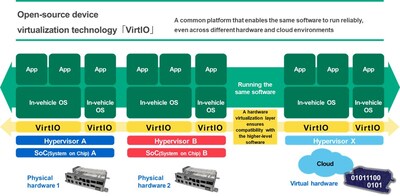
The automotive industry is entering the era of Software-Defined Vehicles (SDVs), where much of product value and innovation is realized through software. The ability to accelerate software evolution has become a key factor in competitiveness. It is essential to standardize software across different vehicle models and generations and ensure its continuous development. To achieve this, an open-source device virtualization technology that enables common software to run seamlessly on different hardware platforms is required.
VirtIO is a key technology for enabling device virtualization. By adopting VirtIO, companies can create virtual hardware environments on computing platforms such as cloud servers. This approach allows software development and evolution to begin long before physical vehicle hardware becomes available, significantly accelerating development speed and time to market.
Since 2018, we have taken the lead globally in developing VirtIO for automotive applications and promoting its industry-wide standardization, engaging the automotive industry, related IT sectors, and the semiconductor industry. Establishing VirtIO as an industry standard will enable the creation of an open and transparent ecosystem in which manufacturers can freely choose the optimal hardware technologies. Our efforts to standardize VirtIO, as well as our broader standardization initiatives, have gained global endorsement from major automakers and related companies. We have completed the development of a VirtIO-compliant in-vehicle software platform and will continue to advance it, driving automotive innovation well suited to the SDV era.
- Masashige Mizuyama, Representative Director, Executive Vice President, and Chief Technology Officer (CTO)
"To drive innovation in automotive development in the SDV era, it is essential for companies to adopt VirtIO and develop their in-vehicle software assets in compliance with VirtIO. In addition to software platforms, we have developed vSkipGen—a VirtIO-compliant virtual hardware solution—which is used in our own SDV development and is also available to external partners. We encourage automakers, as well as companies involved in the development of in-vehicle software and components, to endorse this initiative and ensure that their products comply with VirtIO standards, thereby contributing to the global growth of the ecosystem."
In the SDV era, we aim to accelerate the evolution of software—whose technological asset value continues to grow—while expanding the scope of VirtIO's application and further developing the ecosystem. By leveraging open-source technologies to drive standardization and broader adoption, we view this as a highly meaningful initiative that signals the future direction of technological innovation not only in the automotive industry, but across the broader manufacturing sector, where software-defined paradigms are rapidly gaining momentum.
Endorsement Comments from Companies Supporting VirtIO Standardization Efforts:
<Comments from Automakers>
- Honda Motor Co., Ltd.
"Honda envisions that the realization of SDV will fundamentally transform and enhance vehicle value. Achieving this vision requires scaling our development capabilities, integrating complex systems, and accelerating development cycles—objectives that present significant technical challenges. Specifically, it is critical to treat software as a continuous asset, necessitating a hardware-agnostic architecture that remains resilient to underlying hardware evolution. We recognize VirtIO as a key technology for hardware virtualization, offering the potential to overcome these challenges and accelerate SDV development. Furthermore, we believe that the adoption of VirtIO will go beyond Honda's own advancements to fortify the entire industry's technological foundation, driving sustainable value creation across the mobility ecosystem." –
- Mazda Motor Corporation
"Mazda has set forth its 2030 VISION: "To be a car-loving company that creates moving experiences through the joy of driving." In pursuit of this vision, Mazda is advancing a transformation of development technologies and processes to address increasing complexity through the evolution of model-based development and the use of AI. To realize enhanced human-centered experiential value by leveraging the evolution of software, a common foundation is indispensable—one that enables flexible selection of optimal hardware configurations while supporting the continuous development of software responsible for vehicle functions and services. Mazda views VirtIO as a common interface that helps maintain architectural consistency in line with the evolution of future system configurations. Recognizing its potential early on, Mazda has been actively evaluating and promoting the adoption of VirtIO as an effective technology to underpin this common foundation. Mazda expects VirtIO to further mature as a technology that contributes to value creation and remains committed to contributing to its continued advancement." –
- Mitsubishi Motors Corporation
"Mitsubishi Motors Corporation is accelerating initiatives to continuously enhance vehicle value through the operation of connected platforms and over-the-air (OTA) updates, with the aim of delivering sustained customer value. In software development, the standardization of device virtualization using VirtIO enables a hardware independent development environment, ensures a high degree of correlation and reproducibility between cloud-based environments and actual vehicle hardware, and promotes the development of multi-vender environments and expanded ecosystem interoperability through industry wide adoption of VirtIO. We endorse this initiative and are committed to further advancing and expanding mobility experiences in the SDV era." – Tohru Ishiguro, Vice President, Division General Manager Vehicle Engineering Development Division2, Mitsubishi Motors Corporation
-
Nissan Motor Co ., Ltd.
"Nissan views the standardization of VirtIO as one of the key foundations for realizing the innovative mobility experiences required in the SDV era. By resolving performance and real-time challenges in ECU virtualization through VirtIO, and implementing a standardized virtualization interface on actual ECUs, we enable high-precision verification of behavior closely resembling real-vehicle onboard systems using common binaries—even in cloud-native off-board development and verification environments. We believe this advancement in development and verification processes will accelerate the evolution of customer value, and we will support the adoption and development of VirtIO standardization." –
<Comments from Related Companies>
- Amazon Web Services Japan G.K.
"
- AMD
"The shift to Software-Defined Vehicles demands open standards that decouple software innovation from hardware lifecycles. Panasonic
-
Arm
"The next wave of physical AI innovation will be defined by AI and software running reliably under real-world constraints, creating a need for open, standards-based platforms that enable reliability, scalability, and long-term innovation. VirtIO is an important building block in advancing AI-defined vehicles, and through ecosystem collaboration we are helping to advance SOAFEE-aligned approaches that scale trusted, efficient automotive software platforms worldwide." –
- Automotive Grade Linux
"Panasonic Automotive Systems (PAS) has been a cornerstone of the Automotive Grade Linux (AGL) community since our inception. As a valued AGL board member and leader of the
-
Eclipse Foundation
"Open source plays a critical role in software-defined vehicles by enabling shared building blocks and common interfaces that decouple software from hardware and improve portability across platforms. Within the Eclipse SDV ecosystem, initiatives such as Eclipse S-CORE bring stakeholders together to develop reusable, interoperable components in the open. Industry efforts advancing open interfaces and virtualization technologies are complementary to this work, and we welcome broad, constructive engagement across OEMs, suppliers, silicon providers, and the global open-source community." –
"VirtIO is a pivotal foundational technology for achieving virtualization and hardware independence in automotive software development. At Google, we have officially adopted VirtIO as the standard I/O interface for many years, both in Android Automotive OS and our cloud-native development environments. It supports extensions for a wide range of devices and ensures stable operation and high versatility across multiple hypervisors and hardware configurations. We appreciate
- MediaTek Inc.
"VirtIO plays a strategic role in enabling software-defined vehicles by addressing the growing complexity of next-generation automotive architectures. To reduce extensive software rework in migration challenges and keep scalability, MediaTek will work closely with partners and customers to integrate VirtIO into our Dimensity Auto platforms, accelerating time-to-market and enabling the ongoing transition toward software-defined vehicles." – Dr.
-
Qualcomm Technologies, Inc.
"Virtualization is a foundational pillar of the software defined vehicle, playing an increasingly important role in decoupling the inherent complexity of the automotive domain, where diverse platforms and fragmented architectures demand scalable solutions. By enabling portability across devices and cloud environments, it accelerates development, testing, and rapid prototyping.
- Renesas Electronics Corporation
"As a leading provider of automotive semiconductor solutions, Renesas is strengthening hardware virtualization in our SoCs and actively driving software-based virtualization technologies. As part of these efforts, we are expanding VirtIO capabilities in our SoC software. We fully support
- Telechips Inc.
"In the rapidly changing automotive market, the scale of software development is becoming even more of a burden. VirtIO represents an important step toward improving software consistency between virtual and real environments, enabling more accurate and efficient development. We believe that VirtIO will become more important technology in the SDV era and Telechips is committed to supporting VirtIO. It's pleased to collaborate with Panasonic Automotive Systems in advancing an open and scalable automotive software ecosystem." –
-
Xen Project
"
Notes:
*1:Automotive Grade Linux (AGL) is a
*2:
*3:Scalable Open Architecture For Embedded Edge (SOAFEE) is an initiative that brings together the automotive industry and software industry to make AI-enabled Software Defined Vehicles a reality.
Google and Android are trademarks of
About
Headquartered in
We are changing our company name and brand to
To learn more about our company, please visit https://automotive.panasonic.com/en

 View original content to download multimedia:https://www.prnewswire.com/news-releases/panasonic-automotive-systems-secures-industry-wide-endorsement-for-its-initiative-to-standardize-virtio-device-virtualization-technology-302693732.html
SOURCE
