Kyocera Develops Pluggable Optoelectronic Module Supporting PCIe® 6.0, Contributing to High-Speed, Power-Efficient AI Data Centers
Product to be exhibited at OFC 2026 in AuthenX Booth #5204,
This press release features multimedia. View the full release here: https://www.businesswire.com/news/home/20260309968307/en/
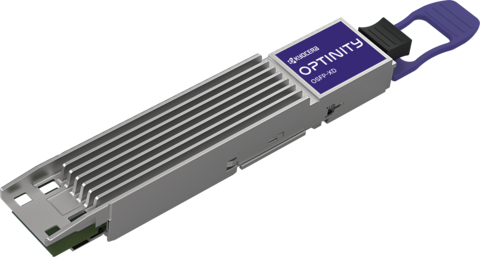
OPTINITY® OSFP-XD
Kyocera has been developing onboard-type optoelectronic modules that support PCIe® 5.0 and convert electrical signals from CPUs, GPUs, and other components into optical signals. With this latest development, by advancing the communication standard to PCIe® 6.0, Kyocera has achieved a new level of high-speed, high-capacity communication. Further, the new module’s pluggable configuration enhances design flexibility, system configuration versatility, and ease of implementation. Kyocera will continue developing onboard-type modules as well, aiming to provide optoelectronic interfaces for specific applications and system configurations.
This product was developed in collaboration with AuthenX, Inc., a company in which Kyocera has invested through Kyocera Venture Innovation Fund I (KVIF-I)*3, the company's corporate venture capital (CVC) fund. The newly developed product will be exhibited at the AuthenX booth at OFC 2026, an international exhibition for the optical communications industry, which will be held in
Development Background
In recent years, with the advancement of generative AI and other technologies, the volume of data handled in data centers has been rapidly increasing. Accordingly, PCIe® interfaces that connect high-performance computing devices such as GPUs and AI accelerators must support even higher data speeds and capacities.
Conventional PCIe® connections using electrical wiring face the challenge of increased signal loss and power consumption as transmission distances increase. Additionally, retimers*4 are needed to ensure communication stability, which increase latency and power consumption further. This limits flexibility for equipment placement within racks, making it difficult to optimize cooling efficiency and maintainability.
To address these challenges, PCIe® connections using optical signals are attracting attention as a technology that enables low-loss, stable transmission even between physically distant devices and resources, while enhancing system design flexibility and contributing to improved efficiency and power savings across entire data centers.
To address these challenges, in addition to developing onboard-type optoelectronic modules, Kyocera has newly developed a pluggable module supporting PCIe® 6.0.
Features of New OSFP-XD
1. Contributing to Higher Capacity and Lower Power Consumption with Next-Generation Standard PCIe® 6.0 Optical Interconnects
Using the OSFP-XD form factor, Kyocera has achieved high-capacity communication with PCIe® 6.0 x16 (64 GT/s per lane). Additionally, optical transmission enables us to eliminate the retimers that are required in electrical wiring, significantly reducing power consumption between PCIe® devices. This contributes to power savings across the entire data center, enabling both reduced environmental impact and lower running costs.
2. High Versatility through Pluggable Type Module
The pluggable format enhances system design flexibility, enabling integration into existing systems and future expansion.
3. Improved Design Flexibility Through Long-Distance Connections
Optical fiber transmission can extend the connection distance between PCIe® devices to several hundred meters or more, compared to the conventional electrical wiring limit of under 10 meters. This enables flexible equipment placement within and between racks, with expectations for optimized cooling efficiency and significantly improved maintainability.
In addition to onboard-type and OSFP-XD modules, Kyocera plans to develop modules supporting various other form factors for different applications, including Optical CDFP*5, and will sequentially expand its lineup. This will contribute to large-scale computing well into the future.
Exhibition at OFC 2026
This achievement will be exhibited at "OFC 2026," one of the world's largest international exhibitions in the optical communications field, to be held in
AuthenX is a Taiwanese startup company with strengths in the design and development of high-speed optical transceivers utilizing silicon photonics technology. Kyocera has been advancing joint development of optical interconnect technology for next-generation data centers with AuthenX, and made an investment through KVIF-I in
This newly developed product was realized by combining AuthenX's module design technology with Kyocera's PCIe® protocol processing, signal quality management, and link training technologies cultivated over many years. Both companies will continue to work closely together and accelerate efforts toward commercialization and market launch of this technology.
|
About AuthenX |
|
|
Company |
|
|
Business Overview |
A Taiwanese startup developing silicon photonics technology and other unique products including ELS and metalenses based on its strengths in optoelectronic integration and optical engine design to address the global challenge of energy consumption in AI servers. |
|
President |
|
|
Address |
19F-2 No. 168, Sec. 2, |
|
Web page |
|
*1 OSFP-XD: One of the form factors for pluggable optical modules, designed for next-generation high-density, multi-lane applications.
*2 PCIe (Peripheral Component Interconnect Express): An interface standard for high-speed connection among devices such as CPUs, GPUs, AI accelerators, and storage.
*3KVIF-I: A corporate venture capital fund jointly established in
*4Retimer: A chip used to correct signals degraded by loss and noise.
*5 Optical CDFP: One of the form factors for pluggable optical modules, mainly used in the 400G generation.
*This development is based on results obtained from a project, JPNP21029, subsidized by the
*PCIe is a registered trademark of PCI-SIG.
*OPTINITY is a trademark of
View source version on businesswire.com: https://www.businesswire.com/news/home/20260309968307/en/
Head Office TEL: +81-(0)75-604-3416 E-mail: webmaster.pressgl@kyocera.jp
Source:
