Copper Giant Intersects 257 Metres of 0.63% CuEq* (0.47% Cu and 0.03% Mo) in Infill Drilling and Identifies Higher Grades at Depth Along the Southern Margin of Mocoa
-
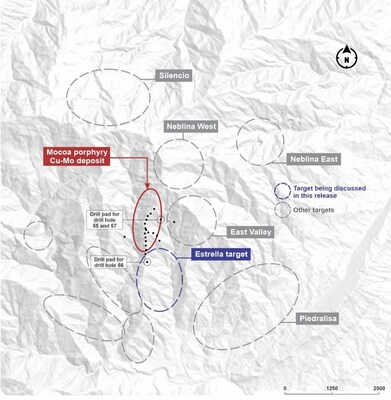
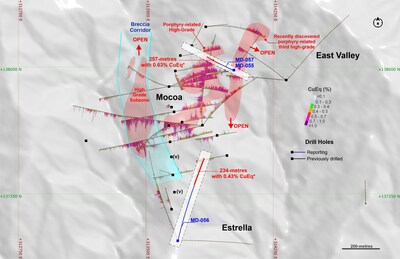
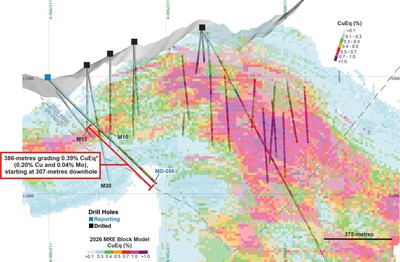
Hole MD-056 intercepted higher copper and molybdenum grades at depth on the southern edge of the MRE footprint at Mocoa towards the La Estrella target (Figure 1) with 386 metres grading 0.39% CuEq* (0.20% Cu and 0.04% Mo) starting at 307m including last 77 metres of the hole with 0.49% CuEq* (0.33% Cu and 0.03% Mo) over a microdiorite porphyry phase potentially related to the recently discovered third high-grade zone at Mocoa.
- Importantly, the mineralization intersected in hole MD-056 occurs within an area of the current MRE block model previously interpreted as waste due to limited past drilling, highlighting the exploration potential in under-drilled sections of the current resource, in this case along the southern edge of the deposit towards the La Estrella target (Figure 3).
-
Hole MD-057 returned 257 metres with 0.63% CuEq* (0.47% Cu and 0.03%Mo) starting at 275m and 191 metres with 0.72% CuEq* (0.54% Cu and 0.034% Mo) starting at 341m; within a broader interval of 476 metres with 0.43% CuEq* (0.28% Cu and 0.029% Mo) starting at 56m (Table 1). The hole was terminated at the planned design depth for this mother hole while still intersecting strong copper and molybdenite mineralization.
- Holes MD-056 and MD-057 represent the first "mother holes" drilled in the history of the Mocoa project, establishing the foundation for directional drilling that will allow multiple daughter holes to be drilled from a single platform, improving drilling efficiency and reducing surface disturbance.
"Hole MD-056 provides important geological information along the southern margin of the Mocoa deposit, where grades improve at depth and the intersection of microdiorite porphyry may be related to the same intrusive phase associated with the recently identified third high-grade zone. At the same time, hole MD-057 confirms the predictability of our current resource model, which is a key step as we increase drill density in selected areas of the deposit with the objective of upgrading resources and advancing Mocoa toward PEA-level evaluation." –
|
1
For further information refer to NI 43-101 Technical Report, entitled
"Technical Report and Updated Mineral Resource Estimate for |
|
Hole |
From |
To |
Interval |
Cu (%) |
Mo (%) |
CuEq* (%) |
|
MD-056 |
- |
693 |
693 |
0.14 |
0.02 |
0.26 |
|
Including |
161 |
693 |
531 |
0.17 |
0.03 |
0.33 |
|
and including |
459 |
693 |
234 |
0.24 |
0.04 |
0.43 |
|
and including |
616 |
693 |
77 |
0.33 |
0.03 |
0.49 |
|
MD-057 |
0 |
532 |
532 |
0.25 |
0.027 |
0.39 |
|
Including |
56 |
532 |
476 |
0.28 |
0.029 |
0.43 |
|
and including |
341 |
532 |
191 |
0.54 |
0.034 |
0.72 |
|
Table 1 – Assay results for drill holes MD-056 and MD-057. |
|
*Copper equivalent (CuEq) for drill hole interceptions is calculated as: CuEq (%) = Cu (%) + 5.278 × Mo (%), utilizing metal prices of Cu - |
MD-056
Drill hole MD-056 was designed to test the southern margin of the current MRE1 footprint, an area drilled by shallow and sub-vertical holes completed (M10, M12 and M30) by Ingeominas and
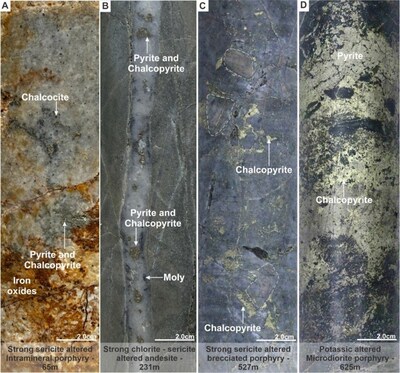
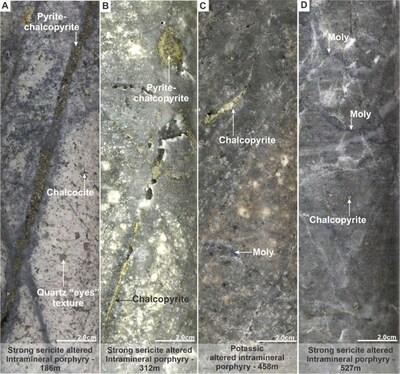
Hole MD-056 intercepted higher copper and molybdenum grades at depth, returning 386 metres grading 0.39% CuEq* (0.20% Cu and 0.04% Mo) starting at 307 metres, including the last 77 metres of the hole grading 0.49% CuEq* (0.33% Cu and 0.03% Mo) (Table 1 and Figure 3). Similar to MD-054, hole MD-056 intersected continuous Mocoa-style porphyry mineralization, characterized by disseminated chalcopyrite and molybdenite hosted within hydrothermally altered porphyry phases and associated quartz-sulfide stockwork veining (Figure 4). Importantly, copper and molybdenum grades improved at depth, where the hole intersected a microdiorite porphyry phase displaying strong potassic alteration and stockwork veining (Figure 4D). This intrusive phase is interpreted to be comparable to the microdiorite porphyry associated with the recently identified third high-grade zone within the Mocoa system.
The presence of this intrusive phase at the southern margin suggests that the fertile intrusive architecture controlling higher-grade mineralization elsewhere within the deposit may continue into this sector, reinforcing the exploration potential along the southern edge of the current resource footprint. Hole MD-056 also represents one of the first mother holes drilled in the history of the Mocoa project, designed to serve as the parent hole for future directional daughter holes that will allow multiple targets to be tested efficiently from a single drill platform.
Hole MD-057
Drill hole MD-057 was completed as part of the Company's infill drilling strategy, targeting an area of the deposit characterized by wider historical drill spacing (Figure 5) within the current MRE1 footprint with the objective of potentially upgrading portions of the Inferred Mineral Resource to the Indicated category in support of future PEA-level technical evaluation. The hole intersected continuous copper and molybdenum porphyry mineralization (Figure 6) typical of the Mocoa system, returning grades consistent with, and locally exceeding, those predicted by the current MRE block model1. MD-057 represents one of the first mother holes drilled in the history of the Mocoa project, forming part of the Company's strategy to utilize directional drilling technology to efficiently test multiple targets from a single drill platform. This approach improves drilling efficiency, increases geological information per metre drilled, and reduces surface disturbance.
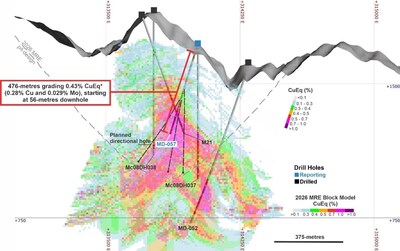
Hole MD-057 returned 257 metres grading 0.63% CuEq* (0.47% Cu and 0.03% Mo) starting at 275 metres, including 191 metres grading 0.72% CuEq* (0.54% Cu and 0.034% Mo) from 341 metres, within a broader interval of 476 metres grading 0.43% CuEq* (0.28% Cu and 0.029% Mo) starting at 56 metres (Table 1 and Figure 5). Drilling of MD-057 was completed at the planned design depth for this mother hole, corresponding approximately to the base of the conceptual open-pit shell currently used for resource evaluation. The hole was terminated while still intersecting strong copper and molybdenum mineralization, as the primary objective at this location was to establish a mother hole from which directional daughter holes (Figure 5) can be drilled to test additional portions of the porphyry system. These results reinforce the geological continuity and reliability of the resource model and support the Company's strategy of increasing drill data density in selected areas of the deposit.
Hole MD-055
Drill hole MD-055 was initiated from the same existing drill platform later used for hole MD-057, targeting grade continuity at depth between high-grade results intercepted in holes MD-050 (refer to news release dated
Qualified Person and Technical Notes
Inferred Mineral Resources are considered too speculative geologically to have economic considerations applied to them that would enable them to be categorized as Mineral Reserves. There is no certainty that all or any part of the Inferred Mineral Resources will be upgraded to an Indicated or Measured category.
Copper equivalent (CuEq) for drill hole interceptions is calculated as: CuEq (%) = Cu (%) + 5.278 × Mo (%), utilizing metal prices of Cu -
1 Notes on the MRE of the project
- The MRE was completed by
Kevin Hon ,B.Sc .,P.Geo ., Senior Resource Geologist, andWarren Black ,M.Sc .,P.Geo ., Senior Consultant: Mineral Resources and Geostatistics, both of APEX.Mr. Hon andMr. Black are independent Qualified Persons, as defined by NI 43-101, and are responsible for the completion of the Mineral Resource Estimate, with an effective date ofNovember 18, 2025 .Michael Dufresne ,M.Sc .,P.Geo ., President & CEO of APEX, completed a peer review of the estimate. - Mineral Resources that are not Mineral Reserves do not have demonstrated economic viability.
- The estimate of Mineral Resources may be materially affected by environmental, permitting, legal, title, taxation, socio-political, marketing, or other relevant issues.
- The Inferred Mineral Resource in this estimate has a lower level of confidence than that applied to an Indicated Mineral Resource and must not be converted to a Mineral Reserve. It is reasonably expected that the majority of the Inferred Mineral Resource could potentially be upgraded to an Indicated Mineral Resource with continued exploration.
-
The Mineral Resources were estimated in accordance with theCanadian Institute of Mining , Metallurgy and Petroleum (CIM), CIM Standards on Mineral Resources and Reserves, Definitions (2014) and Best Practices Guidelines (2019) prepared by theCIM Standing Committee on Reserve Definitions and adopted by theCIM Council . - Economic assumptions used include
US$4.00 /lb Cu,US$20.00 /lb Mo, process recoveries of 90% for Cu and 95% for Mo, aUS$10 /t processing cost, G&A costs ofUS$1.00 /t, and a 3% NSR royalty - CuEq* values are calculated using a Cu-to-Mo value ratio of 1:5.278, incorporating both metal prices and metallurgical recoveries.
- The constraining pit optimization parameters include a
US$2.5 /t mining cost for both mineralized and waste material and 45° slopes. Pit-constrained Mineral Resources are reported at a cutoff of 0.25% CuEq*.
About the Mocoa Porphyry System
Mocoa was first identified in 1973 through a regional geochemical survey conducted by the
The deposit is hosted in Middle Jurassic dacite and quartz-diorite porphyries intruding andesitic to dacitic volcanics of the Central Cordillera, a 30-kilometre-wide tectonic belt that extends into
A distinguishing geological feature of Mocoa is the presence of a fertile magmatic window spanning roughly ten million years, a prolonged and unusually productive interval of magma generation and evolution that is not commonly observed in other Jurassic porphyry systems within the same belt. This extended fertile period provides a compelling explanation for the system's large metal endowment, broad alteration footprint, and overlapping intrusive and hydrothermal events.
The deposit demonstrates more than 1,000 metres of vertical continuity, with multiple intrusive phases, brecciation episodes, and vein generations reflecting a dynamic and long-lived magmatic–hydrothermal evolution, likely influenced by more than one porphyry center. Mocoa remains open in all directions, and several satellite targets across the broader land package support the interpretation of a district-scale mineralized system.
Mocoa's Mineral Resource Estimate1 comprises Inferred resources of 12.7 billion pounds (Blbs) copper-equivalent (CuEq*) at an average grade of 0.51% CuEq*, including 7.7 Blbs of copper at 0.31% Cu and 1.0 Blbs of molybdenum at 0.039% Mo, within 1,120 million tonnes (Mt).
About Copper Giant
The Company is led by a team with uncommon experience, having successfully taken some of the few major copper mines developed in the past two decades from discovery through to construction.
Copper Giant's current focus is the Mocoa copper-molybdenum deposit in southern Colombia, one of the largest undeveloped resources of its kind in the
Guided by the values of respect and responsibility, and grounded in its Good Neighbor philosophy, Copper Giant is committed to creating enduring values for all stakeholders and playing a meaningful role in the global energy transition.
Neither the TSX Venture Exchange nor its Regulation Services Provider (as that term is defined in the policies of the
This news release includes forward-looking statements that are subject to risks and uncertainties. All statements within, other than statements of historical fact, including statements regarding the assay results of drill holes 56 and 57, the potential of drill hole 55, the outcome of the Company's current resource expansion strategy; other activities and achievements of the Company, including but not limited to: the timing and success for the advancement of the

SOURCE
