Thesis Gold & Silver Identifies Two Distinct Porphyry Targets on the Lawyers-Ranch Project
The 2025 exploration program focused on two priorities: advancing the understanding of near-surface, high-grade gold in areas such as Bingo, and Steve, and testing for porphyry potential at Ranch and
With metal prices currently well above those base-case assumptions, the project already carries meaningful economic upside. The newly identified porphyry targets at Ranch and
Key Highlights
-
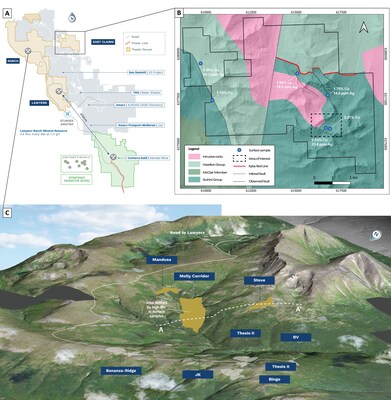
Two high-quality porphyry exploration targets identified within the Lawyers–Ranch project represent different exposure levels within the continuum of porphyry–epithermal systems:
- Ranch:
- The established resource is hosted in a well-developed high-sulfidation lithocap defined by silicic and advanced argillic alteration (alunite, pyrophyllite, dickite, pyrite)
- A major hydrothermal upflow zone at Moly Corridor was identified by targeting elevated molybdenum in surface samples and coincident resistivity and chargeability anomalies
- Well-developed silicic alteration and the presence of gusano textures and diatreme breccia supports proximity to a porphyry system
- Interpretation: Ranch lithocap is inferred to overlie a potential porphyry system at depth
Ranch East :- Exposes high-temperature inner propylitic alteration at surface across a >1 km footprint
- Includes magnetite–actinolite veins with albite halos and clast-selective epidote alteration
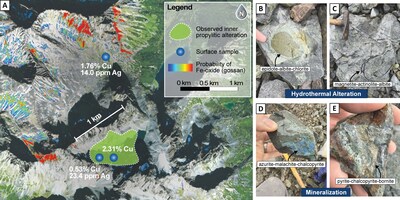
- Surface grab sampling returned elevated copper and silver values, including:
- 2.31% Cu (bornite-bearing)
- 1.76% Cu with 14.0 ppm Ag (chalcopyrite-bearing)
- Interpretation: consistent with exposure of deeper levels of a porphyry system
- Ranch:
-
Exploration Implications: The presence of both lithocap-hosted and deeper porphyry-level alteration indicates potential for multiple porphyry systems within the
Lawyers-Ranch district- The target identified at Ranch underlies many existing shallow, high-grade gold targets
- During the 2026 field season, Thesis will continue the work to advance these drill targets in addition to critical-path data collection required for an upcoming Feasibility Study
Porphyry Exploration in a Magmatic-Hydrothermal System
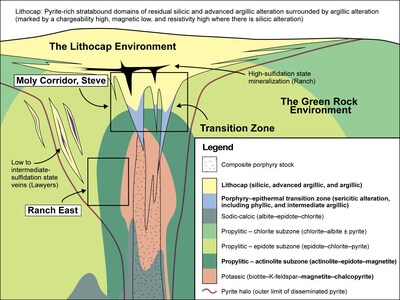
Porphyry–epithermal systems are characterized by predictable alteration patterns and overprinting relationships that can be used to vector toward mineralized intrusions at depth (Figure 2). At deeper levels, these systems commonly develop a domain of propylitic alteration (Figure 2: "The Green Rock Environment") that is zoned outward from a central intrusive complex. This alteration is characterized by mineral assemblages that transition from actinolite-bearing through epidote-dominant and outward into chlorite-altered rocks, reflecting a decrease in temperature away from the intrusion.
At shallow crustal levels, these systems may be overprinted by lithocaps consisting of silicic, advanced argillic, and argillic alteration, which may host high-sulfidation mineralization (Figure 2: "The Lithocap Environment"). The Ranch resource area is characterized by the features that define a Lithocap environment.
The Green Rock and Lithocap environments are separated by a sericite-dominated transition zone, characterized by phyllic and intermediate argillic alteration. This zone represents the interface between lithocap and porphyry environments (Figure 2: "
Ranch Lithocap: High-Sulfidation System Above a Potential Porphyry
Within the Ranch area, high-sulfidation deposits like at
Within this broader system, the Moly Corridor emerged as a key zone of interest for the 2025 exploration program based on elevated molybdenum and gold values in surface samples and coincident geophysical anomalies (Figure 1C). Elevated molybdenum is atypical of high-sulfidation epithermal systems and more commonly associated with porphyry environments, suggesting the lithocap may overlie a porphyry system at depth.
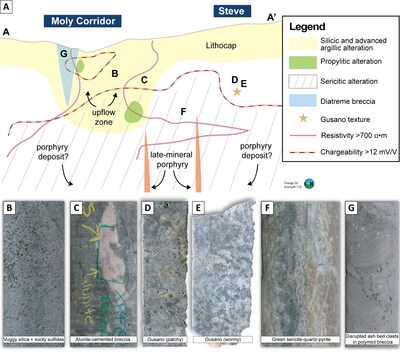
Several additional features further support this interpretation. Gusano textures, defined by wormy and patchy domains of dickite, pyrophyllite, diaspore, and white mica (Figure 3A,
A diatreme breccia (Figure 3A, E) has also been identified within the Moly Corridor. In lithocap environments, these breccias are typically linked to the focused release of hydrothermal fluids above underlying porphyry intrusions and can highlight zones of concentrated fluid "upflow". The interpretation of a hydrothermal upflow zone adjacent to the diatreme in the Moly Corridor is supported by intensely developed silicic and alunite-dominant advanced argillic alteration and a coincident resistivity anomaly (Figure 3A, B, C). Similar upflow zones in high-sulfidation systems are typically positioned directly above porphyry intrusions and represent key vectors toward mineralized centres at depth.
At both Steve zone and Moly Corridor, alteration transitions from advanced argillic assemblages into sericite-dominant alteration with localized windows of propylitic alteration. This transition is broadly coincident with a chargeability anomaly, interpreted to reflect the presence of a pyrite-rich plume (Figures 2 and 3).
Taken together, these geological, geochemical, and geophysical observations are interpreted to define the transition from lithocap alteration into porphyry-style alteration, supporting the presence of a preserved porphyry system beneath the Ranch lithocap.
In contrast to the Ranch lithocap and underlying transition zone, the target at Ranch East is characterized by high-temperature, inner propylitic alteration (actinolite subzone) and copper–silver mineralization. These characteristics were observed at surface during a 2025 field mapping campaign and suggest that erosion has exposed the deeper portions of a porphyry system (Figures 2 and 4) in this area.
The zone of inner-propylitic-altered rock outlined in Figure 4A contains clast-selective and pervasive epidote alteration and veins (Figure 4A, B), quartz–sulfide veins, and, most notably, magnetite–actinolite veins with albite halos (Figure 4C) developed within volcanic host rocks. These features are extensive and occur across an area at least one km in length within a surrounding ~3 km long gossanous zone. Copper–silver mineralization identified through surface sampling is locally associated with the inner-propylitic features described above and is more broadly present across the Ranch East tenure.
Together, these observations, and the spatial extent across which they occur indicate that
Exploration Implications
The coexistence of inner propylitic alteration at Ranch East and a high-sulfidation lithocap and underlying upflow zone at Ranch indicates that the district preserves multiple levels of porphyry-related hydrothermal systems. This framework significantly expands the exploration potential across the Ranch area and supports the interpretation that additional porphyry systems may be present within the broader project area.
Future exploration in 2026 will focus on advancing these targets through continued mapping and sampling across the Ranch East alteration system, expanding geophysical surveys to refine potential intrusive centres, and drilling to test priority porphyry targets across the project.
Quality Assurance and Control
Samples were analyzed at
The technical content of this news release has been reviewed and approved by
Grant of Equity Compensation
Thesis granted, to directors, officers and employees an aggregate of: (i) 1,360,000 stock options (the "Options") (ii) 402,000 restricted share units ("RSUs"); (iii) 393,000 performance share units ("PSUs"); and (vi) 261,000 deferred share units ("DSUs") with all awards governed by the Company's Omnibus Long-Term Incentive Plan and each applicable award agreement.
Each vested Option entitles the holder to purchase one common share of the Company (each, a "Common Share") at an exercise price of
Each vested RSU entitles the holder to receive one Common Share upon settlement. The RSUs vest one third on the first, second and third anniversaries of the Grant Date.
Each vested PSU entitles the holder to receive one Common Share upon settlement. The PSUs vest upon satisfaction of certain corporate objectives established by the Company over a three year period.
Each vested DSU entitles the holder to receive one Common Share upon settlement. The DSUs vest and settle on the DSU holder's termination date.
On behalf of the Board of Directors,
Thesis Gold & Silver Inc.,
"Ewan Webster"
About Thesis Gold & Silver Inc.
Thesis Gold & Silver Inc. is Canadian precious metals development company focused on advancing its 100%-owned
Thesis Gold & Silver is advancing
Neither
the
TSX
Venture
Exchange
nor
its
Regulation
Services
Provider
(as
that
term
is
defined
in the policies of the
Cautionary Statement Regarding Forward-Looking Information
This press release contains "forward-looking information" within the meaning of applicable Canadian securities legislation. Forward-looking information includes, without limitation, statements regarding the potential for Steve to contribute to future mineral resource growth, support mine plan expansion and provide a foundation for follow-up drilling in 2026, interpretations with respect to vertically extensive epithermal systems and reinforcement of potential depth extensions at the
 View original content to download multimedia:https://www.prnewswire.com/news-releases/thesis-gold--silver-identifies-two-distinct-porphyry-targets-on-the-lawyers-ranch-project-302728191.html
SOURCE Thesis Gold & Silver

 View original content to download multimedia: http://www.newswire.ca/en/releases/archive/March2026/30/c7387.html
