METALLIS ADVANCES GEOLOGICAL INTERPRETATION OF GREYHOUND SHEAR AND REFINES TARGETING MODEL FOR 2026 DRILL PROGRAM
The Company's updated interpretation builds on a strong foundation of historical exploration and recent drilling. By integrating legacy underground data with modern 3D modelling and recent surface and drill results, Metallis has enhanced its understanding of the structural controls on mineralization and the distribution of higher-grade zones across the Project.
Metallis' VP of Exploration,
"The updated geological interpretation represents an important step forward in understanding how mineralization is distributed at Greyhound and helps explain the variability observed in the 2025 drill results. By pulling historical underground information, recent drilling and surface sampling into 3D space, our team has developed a clearer picture of the geometry of the mineralized system and where higher-grade concentrations of silver, gold, lead, zinc, and antimony are most likely to occur.
This improved understanding allows us to more precisely target the high-grade portions of the system as we plan the 2026 drill program. We have identified multiple priority target areas along the 3.5 km trend, along with new geochemical anomalies that suggest the system may extend beyond what was previously recognized. With a strengthened geological model and more clearly defined targeting criteria, we are entering the upcoming season with increased confidence in the scale of the opportunity and the potential to continue building long-term value at Greyhound."
Highlights
- Refined vein models indicate the Greyhound shear system comprises multiple southwest-dipping shear veins, improving understanding of vein geometry and structural controls on high-grade mineralization.
- Ore shoots are interpreted to be associated with dilation zones related to cross-cutting faults, structural bends, and pre-mineral dyke contacts.
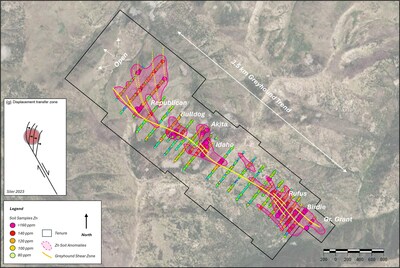
- Reinterpreted soil geochemistry outlines new anomalies and suggests the Greyhound trend may extend north and northwest beyond the currently defined 3.5 km strike extent.
- A 2026 drill program of approximately 3,000 m is planned, focused on high-grade shoots within the
Rufus Zone , and surface mineralization at Birdie, Bulldog, andIdaho .
Refined 3D Structural Model
The technical review has resulted in a meaningful advancement in the Company's understanding of structural controls on mineralization at Greyhound. Using the historical underground surveys of the Lower and Upper Rufus adits, Metallis has identified and corrected spatial inaccuracies in the historical dataset georeferencing, which previously placed the adits 30 m northeast of the corrected locations. This work has led to a revised interpretation of the main Rufus shear zone, which is now understood to dip steeply to the southwest rather than to the northeast as previously modeled.
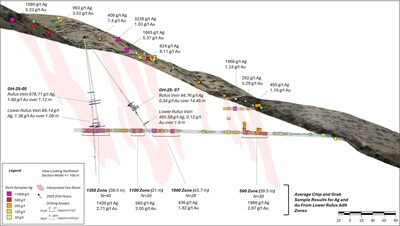
This updated structural framework is supported by results from drill holes completed in 2025. Holes GH-25-05, -06, and -07 did not return grades and widths consistent with the high-grade shoots identified in historical underground chip sampling, however the holes successfully intersected the shear zone and support a southwest dip orientation. Importantly, these holes also identified additional adjacent veins carrying elevated silver, gold, lead, zinc, and antimony values within an envelope measuring 30-40 m wide, revealing a broader, multi-vein mineralized system than previously interpreted.
While hole GH-25-07 intersected the primary Rufus vein, it is interpreted to have tested a portion of the vein system outside of the higher-grade shoots identified in historical underground workings, where we see average grades above 400 g/t Ag and 1 g/t Au. Comparison of the intercept from hole GH-25-07 (94.76 g/t Ag and 0.34 g/t Au over 15.45 m; 3-4 m true thickness) with underground chip sampling indicates that the grades encountered are more consistent with mineralization between higher-grade shoots, reinforcing the importance of structural controls in localizing high-grade zones.
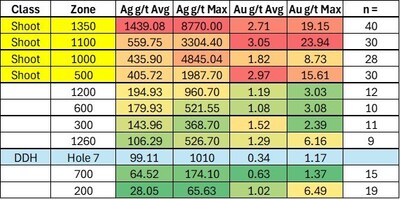
Building on this work, Metallis has developed a new 3D geological model of the Greyhound system extending from surface to approximately 300 m depth. Within this model, the Company has identified priority high-grade shoot targets along the Rufus shear zone, including the 500, 1000, and 1350 zones. These targets represent sub-vertically oriented mineralized shoots linking historical underground workings with surface geochemical anomalies and mapped vein exposures.
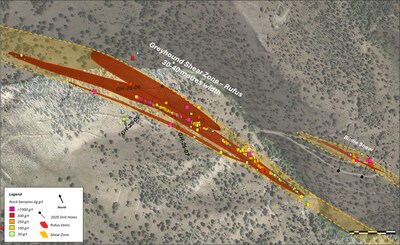
At the
Depth Potential
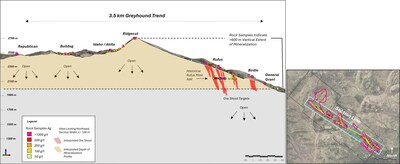
Depth extent provides a key driver of exploration potential at Greyhound. Surface and underground sampling indicate anomalous Au, Ag, and Sb mineralization over a vertical extent of at least 600 metres between mineralized outcrops at the Ridge Cut and
The implied vertical continuity, combined with a 3.5 km strike extent, supports potential for a vertically and laterally extensive mineralized system. The refined model highlights compelling targets for testing down plunge of the 1350, 1000, and 500 zones, as well as below underexplored zones along trend, including
Geochemistry Highlights New Targets
A re-evaluation of 2024 soil geochemistry using zinc as a pathfinder element -- based on its strong correlation (r = 0.75; n = 536) with silver in rock samples -- successfully delineates all known mineralized zones, including
A significant new anomaly measuring approximately 900 by 600 m has been identified north of the Republican zone. This anomaly is comparable in size to the footprint of the Rufus soil anomaly, which encompasses collectively the Rufus, Birdie, and
This previously untested area represents a compelling new target and will be prioritized for trenching, mapping, and sampling in 2026. The Company also plans to extend the soil grid to the north and northwest to fully define the extent of this anomaly.
2026 Exploration Program
Metallis is planning a comprehensive exploration program to test the refined geological model and expand known mineralization.
Drilling will focus on the
- Test the southwest-dipping multi-vein architecture of the shear zone
- Target grades and widths associated with historical production areas (high-grade shoots) in the upper and lower Rufus Adits; and
- Extend mineralization along strike and at depth
Additional drill targeting at Bulldog, Birdie,
Surface exploration will include mapping, trenching, and expanded rock and soil sampling, with emphasis on defining structural controls and advancing new geochemical targets to drill-ready status.
Summary
The updated geological model at Greyhound represents a significant step forward in understanding the controls on high-grade mineralization and provides a more predictive framework for exploration. By integrating historical data with recent drilling and surface work, Metallis has strengthened its targeting approach and identified multiple high-priority opportunities across the Project.
With a refined exploration strategy, strong geochemical support, and demonstrated continuity of mineralization along a 3.5 km trend, the Company is entering the 2026 field season with increased confidence, positioning Greyhound as a compelling discovery-stage asset with meaningful upside potential.
Analytical Techniques
Core samples taken for assay were halved with a diamond saw with one half being sent to ALS Labs (an independent ISO-IEC 17025:2017 and ISO 9001:2015 accredited geo-analytical laboratory), with the other half being retained on site for future reference. ALS uses four-acid digestion and inductively coupled plasma atomic emission spectroscopy for analytical analysis. All samples were analyzed using the ME-MS61 methodology (Four acid ICP Super Trace Analysis). In addition, selectively samples were fire assayed for gold and silver (ME-GRA21) with 30-gram sample and a gravimetric finish.
Metallis followed industry standard procedures for the work carried out on the Greyhound Project, incorporating a quality assurance/quality control (QA/QC) program. Blank, duplicate, and standard samples were inserted into the sample sequence and sent to the laboratory for analysis. No significant QA/QC issues were detected during review of the data. Other than some recovery problems at the top of the Bulldog holes, we are not aware of any drilling, sampling, recovery, or other factors that could materially affect the accuracy or reliability of the data referred to herein.
Reference Material
SLR, 2022 Technical Report Summary on the
* Historical results of rock and chip sampling in the lower Rufus adit cannot be confirmed but are believed to be valid and are presented for completeness of disclosure.
2024-2025 rock, chip, and soil samples were collected by company geologists under supervision from a
About the Greyhound Property
In
Greyhound mineralization is hosted by prominent shear zones with polymetallic quartz-sulphide veins containing elevated concentrations of gold, silver, antimony (a critical mineral), lead, and zinc.
Greyhound shares certain geological characteristics with the
Metallis states that while the
Qualified Person
About Metallis
Metallis trades under the symbols MTS on the
On behalf of the Board of Directors:
/s/ "Fiore Aliperti"
Chief Executive Officer, President, and Director
CAUTION REGARDING FORWARD-LOOKING STATEMENTS
This Press Release may contain statements which constitute 'forward-looking' statements, including statements regarding the plans, intentions, beliefs and current expectations of the Company, its directors, or its officers with respect to the future business activities and operating performance of the Company. The words "may",would", "could", "will", "intend", "plan", "anticipate", "believe", "estimate", "expect" and similar expressions, as they relate to the Company, or its management, are intended to identify such forward-looking statements. Investors are cautioned that any such forward-looking statements are not guarantees of future business activities or performance and involve risks and uncertainties, and that the Company's future business activities may differ materially from those in the forward-looking statements because of numerous factors. Such risks, uncertainties and factors are described in the periodic filings with the Canadian securities' regulatory authorities, including quarterly and annual Management's Discussion and Analysis, which may be viewed on SEDAR at www.sedarplus.ca. Should one or more of these risks or uncertainties materialize, or should assumptions underlying the forward-looking statements prove incorrect, actual results may vary materially from those described herein as intended, planned, anticipated, believed, estimated, or expected.
Although the Company has attempted to identify important risks, uncertainties and factors which could cause actual results to differ materially, there may be others that cause results not to be as intended, planned, anticipated, believed, estimated, or expected. The Company does not intend, and does not assume any obligation, to update these forward-looking statements.
Neither
SOURCE

