New Survey from LegalZoom Reports Entrepreneurs Use AI to Move Faster, But Turn to Human Guidance When Risk is Real
New research of 1,000 aspiring founders and established entrepreneurs reveals AI has become a daily operating tool, but they pull back when the stakes involve legal liability, human impact, or regulatory exposure
This press release features multimedia. View the full release here: https://www.businesswire.com/news/home/20260518144263/en/
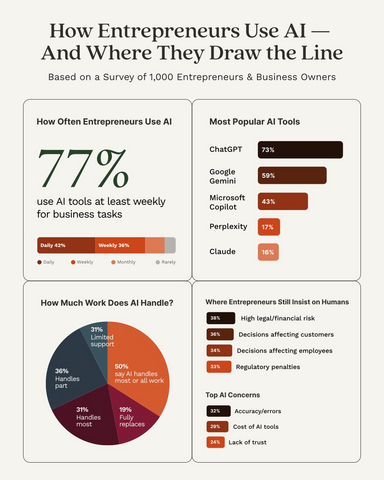
Among those who use AI, the usage patterns are striking. Forty-two percent of entrepreneurs use AI tools daily, and 36% use them weekly. Combined, more than three-quarters, or 77%, use AI at least weekly. In terms of specific platforms, 73% report using ChatGPT, 59% use Google Gemini, and 43% use Microsoft Copilot, with additional traction from tools like Perplexity (17%) and Claude (16%). Increasingly, business owners are not relying on a single platform, but instead adopting a multi-tool approach.
When asked how they view AI’s role in entrepreneurship, 27% say AI makes starting a business more accessible than ever, while another 27% say it lowers barriers, but guidance is still essential. A further 22% describe AI as helpful but not critical. Notably, the continued emphasis on the need for guidance underscores that entrepreneurs recognize AI's limits, particularly in areas such as legal compliance, tax strategy, and business structuring.
Entrepreneurs are setting clear boundaries. When asked in which situations they would not rely on AI, regardless of convenience, 38% cited high-risk legal or financial decisions, 36% said decisions affecting customers, 34% cited decisions affecting employees, and 33% said situations involving regulatory penalties. These responses reflect a pragmatic mindset. Entrepreneurs are eager to use AI for efficiency, but remain cautious about the level of risk involved.
“What we are seeing is a tectonic shift in how entrepreneurs build and run their businesses, with AI now serving as a daily operating tool for small business owners,” said
"I used AI from shaping the concept and business plan to building the website itself,” said
AI Usage Patterns
Among current business owners, adoption varies considerably by company size and sector. Larger companies are leading the way, with 73% of businesses with 50 or more employees reporting regular AI use, compared to 42% of those with 2–9 employees and 39% of solo operators. Industry adoption is similarly uneven. Consulting and professional services (54%), healthcare and pharmaceuticals (57%), and manufacturing (61%) rank among the highest-adoption sectors. Adoption is notably lower in arts and entertainment, where just 29% of current business owners report regularly using AI tools, likely due to concerns about authenticity and intellectual property.
High confidence, high cost savings
Confidence in AI is nevertheless sky-high, which may surprise some AI skeptics. Sixty-seven percent of respondents say AI has increased their confidence in making business decisions, including 24% who say it has done so significantly. Only 4% say AI has decreased their confidence.
However, entrepreneurs also report a range of frustrations, including concerns about accuracy or errors (32%), cost (29%), lack of trust in AI-generated advice (24%), time required to learn or set up tools (22%), legal or compliance risks (21%), and difficulty applying outputs to real-world situations (19%). Even so, AI is proving to be a cost-saving tool for many: 18% say it has significantly reduced their costs, and 34% say it has somewhat reduced them.
AI is handling more and more
When asked at what stage they’ve used or plan to use AI, entrepreneurs cited a broad range of use cases. Forty-three percent use AI for day-to-day administrative tasks, and 42% use it for building a website, app, or online customer experience. Thirty-eight percent turn to AI for planning or researching a business idea, 37% for marketing or customer acquisition, and 34% for scaling or growing the business.
One of the most significant findings is the extent to which entrepreneurs are using AI as a replacement, or partial replacement, for professional services. When asked how complete the substitution is, just 19% say AI fully replaces the professional service, and 31% say AI handles most of the work with minimal human involvement. Thirty-six percent say AI handles part of the work but that humans remain essential, while 11% say AI provides limited support, with humans doing most of the work.
As artificial intelligence transforms how legal work gets done,
About
As AI reshapes how legal work gets done,
View source version on businesswire.com: https://www.businesswire.com/news/home/20260518144263/en/
Press
press@legalzoom.com
Source:
