Sun Life Asia Financial Resilience Index: Financial Security Declines as Cost-of-Living Pressure Bites
- More than eight in ten people surveyed across
Asia (83%) say inflation has made it harder for them to meet their monthly costs. - Cost of everyday essentials is soaring; rising grocery prices are affecting 95% of people surveyed, followed by utilities (94%), transport fuel (92%), healthcare (91%) and cooking fuel (91%).
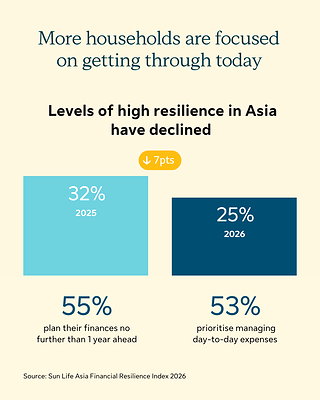
- As a result, just 25% of those surveyed are highly resilient, down from 32% in 2025. Only 13% feel fully secure about their financial position.
- Faced with a short-term budget squeeze, more than half of respondents (55%) are planning no further than a year ahead.
- Nearly two-thirds (61%) would not cope beyond six months in the event of a sudden loss of income.
- Households with higher financial literacy are more likely to feel confident (by 49 percentage points), more likely to feel optimistic (by 43 points), and less likely to experience frequent stress (by 14 points) about the economic environment.

Cost of living pressure hits household finances
The findings highlight inflation's real-world impact as geopolitical and macroeconomic headwinds, including
Nearly half (48%) of those surveyed say rising costs are the biggest barrier to taking control of their finances, highlighting how much financial decision-making in 2026 is shaped by affordability, and more than eight in 10 (83%) say it is harder to cover their monthly expenses. In response, households are making short-term trade-offs to balance the books, yet these compromises are coming at the expense of long-term financial security and the ability to weather future storms.
Fewer families firmly positioned to withstand financial pressure
In an uncertain economic environment, the proportion of highly resilient households has fallen from 32% in 2025 to 25% this year. As families live with a reduced financial buffer, only 13% say they feel fully secure about their financial situation, down from 19% last year, underscoring the scale of the financial impact across
In response to rising everyday expenses, people are shortening financial planning horizons and making decisions that compromise their long-term stability. Short-term decisions are becoming a key driver of declining resilience across the region; one in four respondents are drawing down savings, 27% are reducing or skipping essential spending, and 10% have paused retirement contributions.
Managing day-to-day expenses is the top priority for 53% of people over the next 12 months, ahead of saving, investing, or long-term planning. More than half (55%) of people have no financial plan or are planning no further than a year ahead, and 61% would not be able to cope for more than six months without external financial support in the event of job loss or illness.
Financial literacy fuels confidence
While cost-of-living pressures are widespread across
Households with higher financial literacy are more likely to feel confident (by 48 percentage points), more likely to feel optimistic (by 43 points), and less likely to experience frequent stress (by 14 points). These differences are also reflected in behaviour, as households with stronger financial capability are more likely to plan ahead and maintain longer-term financial habits, while others remain focused on immediate costs.
Against a challenging economic backdrop, access to financial information has expanded significantly, including the growing use of generative AI tools in financial decision-making. Around two-thirds (60%) of respondents say they use GenAI tools regularly for financial advice compared to 18% in 2025. However, greater access to information has not consistently translated into stronger financial confidence or preparedness across the board. Strong financial literacy remains a key differentiator in how households react to economic pressure.
In volatile times, household financial resilience is becoming increasingly uneven across
Broom said, "As financial decisions become more short-term, the risk is that people lose sight of longer-term outcomes. Even with more access to information and tools, navigating complex financial decisions still requires guidance. This is where professional financial advice continues to play an important role in helping people turn short-term choices into long-term plans."
The full report is available here.
About this survey
The research surveyed more than 6,000 respondents across Hong Kong SAR,
The Index categorises households into low, moderate, and high resilience groups based on how secure they feel and how they manage their finances. It highlights the behaviours and attitudes that distinguish those who are prepared for shocks from those who are more vulnerable.
The Index looks at five key aspects of everyday financial life:
- Financial security: whether households feel secure or insecure in their current situation
- Planning horizon: how far ahead they plan, from only a few months to more than five years
- Emergency preparedness: their ability to cope with unexpected financial shocks
- Financial literacy: how well they understand personal finance concepts and rate their own knowledge
- Confidence in long-term goals: whether they feel able to meet future financial commitments
Together, these dimensions provide a fuller picture of how households are managing today's pressures, and how prepared they are for what comes next.
About Sun Life
Sun Life is a leading international financial services organization providing asset management, wealth, insurance and health solutions to individual and institutional Clients. Sun Life has operations in a number of markets worldwide, including Canada, the U.S., the United Kingdom, Ireland, Hong Kong, the Philippines, Japan, Indonesia, India, China, Australia, Singapore, Vietnam, Malaysia and Bermuda. As of March 31, 2026, Sun Life had total assets under management of $1.58 trillion. For more information, please visit www.sunlife.com.
Media relations contact: Adam Welch, Director, Communications, Asia, M: +852 9071 1821, E: