OCEANIC CONFIRMS CRITICAL MINERAL LEVEL, DIRECT REDUCTION CONCENTRATE WITH EXCELLENT IRON RECOVERY AT HOPES ADVANCE
The results of Phase 2 of the Program concluded that, among other things:
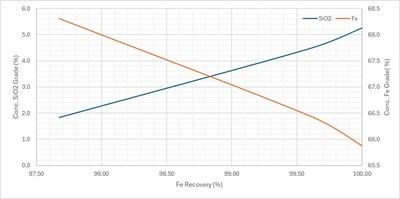
- Based on optimized flotation conditions, bench-scale rougher-cleaner tests on the Project's gravity concentrate product, which constitutes 84% of the total product feed at Hopes Advance, yielded roughly 98% Fe recovery with a Direct Reduction ("DR") iron ore grade of 68% Fe with only 2% SiO2 and 95% weight recovery, confirming DR grade feed potential at Hopes Advance for the benefit of green steel producers and other potential strategic partners seeking low operating cost sources of high quality product.
-
This data also aligns with current critical mineral qualification standards, both provincially and federally in
Canada . - Initial bench-scale magnetic separation testing of the Project's gravity concentrate ground to 45 microns produced a 2.2% SiO2 concentrate recovering 96.8% Fe and 93.5% of mass. The results merit further investigation and flowsheet trade-offs: mainly a flotation circuit, a wet high intensity magnetic separation ("WHIMS") circuit as well as the potential for low intensity magnetic separation prior to flotation to reduce the capital and operating intensity of the flotation circuit.
- Initial testing on the Project's magnetic concentrate showed separation potential to supplement DR level gravity concentrate feed.
The Company originally announced the results of Phase 1 of the Program on
|
______________________________ |
|
1 IIMA 2021, Vendor Guidance, Market Comparable Products |
The Program
The overall objective of the Program was to evaluate whether the Project can generate a high grade, low impurity DR grade premium iron ore product for the benefit of green steel producers and other potential strategic partners seeking low operating cost sources of high quality product, that also aligns with current critical mineral qualification standards, both provincially and federally in
The potential benefits of producing a DR Iron product include, but are not limited to, the following:
- Recognition as "High-Purity Iron", identified as a critical mineral in
Québec and inCanada ; - A required high-quality product, used in green-steel making, reducing related carbon emissions, compared to the typical BF/BOF steel making process;
- Further price premia for a higher grade and lower impurity product, relative to Benchmark pricing;
- Facilitates steelmaking planning to potentially blend with other operator's lower grade product; and
- Offers optionality for potential strategic partners as to product choice. The current Hopes Advance BF/BOF product is already at a relatively high grade of 66.6%Fe with 4.5%SiO2.
Since Al2O3 and Phosphorus levels are already negligible in the concentrate, the testwork focused on a target SiO2 level, being 2% or lower. Low silica levels are desirable in DR-Electric Arc Furnace steel processing as higher impurity levels can reduce DR furnace operability and increase slag formation in the EAF, leading to iron losses and higher energy and operating costs.
The Program currently comprises 2 phases, with Phase 1 covering mineralogical analysis as well as initial flotation testwork to assess the potential to achieving a DR grade product, with Phase 2 applying results from Phase 1 to optimize relative reverse flotation conditions. Based on the Company's PEA Study, the Project was able to recover 84% of its final product through its gravity circuit, with the remaining 16% being recovered through low intensity magnetic separation. As such, the Company elected to focus Phase 1 testing on the
The Company engaged Corem, based in
Material Selected for Testing
In 2012, the Company conducted both a comprehensive metallurgical bench scale testing program as well as a pilot plant testwork program on the Hopes Advance BF/BOF product (the "2012 Program"). The 2012 Program confirmed, among other things:
- Product quality suitable for (Blast Furnace) pellet or sinter feed
- 66.6% Fe grade concentrate with low deleterious elements and silica content ≤ 4.5%
- High weight and Fe recoveries using a simple flow sheet
The 2012 Program produced both a gravity concentrate product, as well as a magnetic concentrate product at pilot plant scale at its principal
Phase 1 – Objectives and Results
Phase 1 Objectives
- Analyze the physical and mineralogical characteristics of the
Castle Mountain gravity concentrate - Evaluate potential for DR grade metallurgical characteristics under aggressive flotation conditions
- Use results to inform conditions to run subsequent tests on
Castle Mountain magnetic concentrate in Phase 2.
Phase 1 Results
Mineralogical Assessment
Mineralogical analyses revealed that the
Flotation Results and Methodology
Initial flotation testing was conducted at Corem using a reagent scheme developed in collaboration with and approved by management and BBA. The program leveraged BBA and Corem's expertise in reverse silica flotation of iron ore. Collector addition was staged at two-minute intervals, and froth was collected to monitor silica rejection.
Both grind sizes evaluated reached the target of obtaining a gravity iron ore concentrate containing less than 2.0% SiO2 + Al2O3 while achieving iron concentrations superior to 67.5% Fe.
Phase 2 – Objectives and Results
Phase 2 Objectives
- Developing a preliminary unit operation flowsheet and reagent scheme
- Establishing grade-recovery relationships
- Optimizing grind size for optimal high-purity
Castle Mountain gravity DR concentrate production - Using results from Phase 1 testing on
Castle Mountain gravity concentrate to inform parameters with respect to initial testing onCastle Mountain magnetic concentrate
Phase 2 Results – Optimization Testing – Gravity Concentrate
Grind Size
Two grind sizes were tested based on target liberation sizes suggested from mineralogical investigations: P80 of 75 and 53 µm. The iron recoveries for a 2% SiO2 concentrate were 95.6 and 96.0% respectively. Given the additional energy and grinding media required to achieve a P80 of 53 µm and similar iron recoveries between the 2 grind sizes, it was determined that 75 µm would be retained for Phase 2 testing.
Reagent scheme, grade and recovery
The Program considered two different collectors for gravity concentrate flotation: a diamine (Tomamine) and a monoamine (Flotigam), one depressant (Dextrine) and one frother (MIBC) in varying dosages. All other test conditions (pH, conditioning time, feed % solids, temperature, etc.) were kept constant. Reagent schemes were adjusted based on the following parameters:
- Ensure a minimum concentrate quality of less than 2% SiO2 and over 67% Fe
- Balance depressant and collector dosage to improve iron unit recovery
- Minimize reagent usage requirements
Once the scheme with the most appropriate results was observed, tests were performed with a rougher and cleaner stage with reagents dosed per each stage. The bench-scale rougher-cleaner tests yielded roughly 97.8% Fe recovery with a concentrate grade of 2% SiO2, 68% Fe and 95% weight recovery. The grade recovery curve for this test is demonstrated in Figure 1 below.
Phase 2 Results – Magnetic Separation
Two tests involving low intensity magnetic separation ("LIMS") followed by WHIMS were performed on the gravity concentrate. Tests were able to obtain a concentrate with 2.2% SiO2 and 93.5% weight recovery by grinding to a P80 of 45microns. This may serve for future flowsheet trade-offs (flotation versus WHIMS) which may weigh various flowsheet options in terms of capital and operating costs versus the quantity and quality of concentrate grades anticipated.
The low intensity magnetic separation results alone suggest that future variability testing should consider investigating the potential of adding LIMS after re-grinding to see if a consistent concentrate at 2% SiO2 can be recovered prior to flotation. The goal of these tests would be to assess if the magnetic portion of the gravity concentrate can be removed (at the proper grade) prior to flotation in order to reduce the capital and operating cost intensity of the flotation circuit.
Phase 2 Results – Magnetic Concentrate Flotation Testwork
Phase 2 performed initial exploratory flotation tests on the magnetic concentrate based on the experience of the gravity concentrate results. Testwork demonstrated that there was an indication of separation potential which can serve as guidance for modifying the flotation parameters in a future testwork campaign. An additional testwork program is being considered to further evaluate the range of target grades achievable with more optimal parameters.
Furthermore, based on the results of the 2012 Program, a mixed concentrate (magnetic concentrate without flotation and gravity flotation concentrate) could respect the target impurity levels under more aggressive gravity flotation conditions. To do so, the gravity flotation concentrate would need to target silica grades in the range of 1.2-1.8% silica to account for variable magnetic concentrate impurity levels.
Next steps
The Company will be considering a number of follow-up mineralogical and metallurgical testing, both at bench-scale and a pilot plant scale as part of its ongoing discussions as to optimize the flowsheet and development of the Project generally.
The Company will provide further updates in due course.
Technical Disclosure
The technical information contained in this news release has been reviewed and approved by
On behalf of the Board of Directors
"Steven Dean"
Executive Chairman
About Oceanic:
Oceanic is focused on the development of its 100% owned Hopes Advance,
In
More recently, the Company has completed preliminary metallurgical testwork that indicates the potential to produce a high-grade, direct reduction Iron product, based on bench-scale flotation testing which may be achievable with modest modifications to the existing flowsheet, thereby providing versatility in product choice and contributing to the global green-steel movement. Further information in respect of the
Forward Looking Statements:
This news release includes certain "Forward-Looking Statements" as that term is used in applicable securities law. All statements included herein, other than statements of historical fact, including, without limitation, statements regarding the Study, the assumptions and pricing contained in the Study, the economic analysis contained in the Study, the results of the Study, the technical report for the Study, the development of the Project, securing a partner for the Project, securing additional financing for the Project, the mineral resources at the Project, and future plans and objectives of Oceanic are forward-looking statements that involve various risks and uncertainties. In certain cases, forward-looking statements can be identified by the use of words such as "plans", "expects" or "does not expect", "scheduled", "objective", "believes", "assumes", "likely", or variations of such words and phrases or statements that certain actions, events or results "potentially", "may", "could", "would", "should", "might" or "will" be taken, occur or be achieved. There can be no assurance that such statements will prove to be accurate, and actual results could differ materially from those expressed or implied by such statements. Forward-looking statements are based on certain assumptions that management believes are reasonable at the time they are made. In making the forward-looking statements in this presentation, the Company has applied several material assumptions, including, but not limited to, the assumption that: (1) there being no significant disruptions affecting operations, whether due to labour/supply disruptions, damage to equipment or otherwise; (2) permitting, development, expansion and power supply proceeding on a basis consistent with the Company's current expectations; (3) certain price assumptions for iron ore; (4) prices for availability of natural gas, fuel oil, electricity, parts and equipment and other key supplies remaining consistent with current levels; (5) the accuracy of current mineral resource estimates on the Company's property; and (6) labour and material costs increasing on a basis consistent with the Company's current expectations. Important factors that could cause actual results to differ materially from the Company's expectations are disclosed under the heading "Risks and Uncertainties " in the Company's most recently filed MD&A (a copy of which is publicly available on SEDAR+ at www.sedarplus.caunder the Company's profile) and elsewhere in documents filed from time to time, including MD&A, with the
Neither the
SOURCE
