FPX Nickel Reports Confirmatory Results from Geotechnical Drilling at the Baptiste Nickel Project
As previously announced (see FPX's
Data obtained from the 2025 field program provides valuable input for developing and refining the pit geotechnical and hydrogeological models. Results indicate that rock mass structural orientations are generally consistent with the regional structural features, and that previously defined structural domains within the pit remain valid.
"The 2025 field program achieved all objectives in continuing to build a robust dataset for Baptiste, supporting both the recently launched environmental assessment process and the planned completion of a feasibility study for the Project," said
Feasibility Study Drilling and Mineralized Intersections
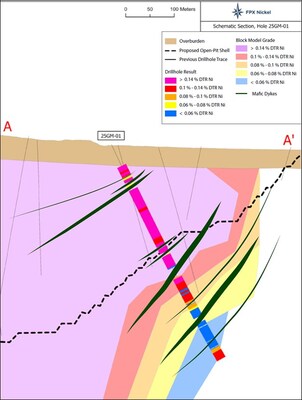
Three drill holes completed for geotechnical characterization purposes during the 2025 engineering field investigation program were secondarily sampled and analyzed for DTR nickel (see Figure 1 plan map). Holes were oriented to intersect the planned open pit walls and therefore include intervals both within and exterior to the planned open pit (see Figure 2).
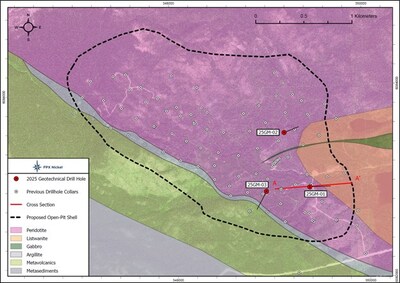
Hole 25GM-01, drilled to the southeastern portion of the planned open pit wall, intersected awaruite nickel mineralization hosted by serpentinized ultramafic rocks with grades locally exceeding those estimated in the current MRE block model. The hole returned 290.65 m at 0.134% DTR nickel including a higher-grade interval within the current open pit shell of 194.30 m at 0.142% DTR nickel.
Hole 25GM-02, drilled toward the northeastern portion of the planned open pit wall, intersected awaruite nickel mineralization consistent with grades predicted by the current MRE block model. 345.35 m at 0.117% DTR nickel including a higher-grade interval of 115.70 m at 0.128% DTR nickel were returned.
Hole 25GM-03 was drilled toward the southwestern portion of the planned open pit wall, targeting the unmineralized footwall for geotechnical engineering purposes. This hole intersected awaruite nickel mineralization within ultramafic rocks with grades and thicknesses consistent with those estimated in the current MRE block model, with 66.00 m at 0.103% DTR nickel including 44.00 m at 0.124% DTR nickel.
|
Hole-ID |
From (m) |
To (m) |
Mineralized Interval (m) |
>5m Dyke Intervals (excluded) (m) |
DTR Ni1 (%) |
Total Ni1 (%) |
Comments |
|
25GM-01 2 |
49.80 |
367.90 |
290.65 |
27.45 |
0.134 |
0.198 |
|
|
Including |
49.80 |
250.30 |
194.30 |
6.20 |
0.142 |
0.196 |
Within pit shell |
|
Including |
257.40 |
367.90 |
89.25 |
21.25 |
0.126 |
0.207 |
Outside pit shell |
|
and |
475.10 |
501.80 |
26.70 |
0.00 |
0.117 |
0.208 |
Outside current MRE |
|
25GM-02 2 |
3.30 |
368.60 |
345.35 |
19.95 |
0.117 |
0.202 |
|
|
Including |
3.30 |
117.30 |
114.00 |
0.00 |
0.130 |
0.206 |
|
|
25GM-03 |
22.20 |
88.20 |
66.00 |
0.00 |
0.103 |
0.213 |
|
|
Including |
22.20 |
66.20 |
44.00 |
0.00 |
0.124 |
0.213 |
|
Table 1 – Selected mineralized intervals from 2025 geotechnical drilling at the
1All mineralized core samples are assayed for Davis Tube Recoverable ("DTR") Nickel and Total Nickel. DTR Nickel analyses measure only the magnetically recoverable nickel hosted in medium- to coarse-grained awaruite (nickel–iron alloy), and the Davis Tube method is a bench-scale metallurgical test procedure that provides an estimation of magnetically recoverable nickel and represents the global industry-standard geometallurgical test for magnetic recovery operations and exploration projects (see "Sampling and Analytical Methods" below). Elevated DTR nickel values in the Baptiste zones indicate that nickel in these target areas is primarily contained in awaruite with grain sizes sufficiently coarse to be recovered by magnetic separation. Total Nickel analyses measure the bulk nickel content of the sample, comprising both magnetically recoverable and non-recoverable nickel. Total nickel values in ultramafic core samples collected to date range from 0.13% to 0.37% and average 0.21%, values that are consistent with typical background nickel concentrations in ultramafic rocks sampled globally and reflect total nickel content rather than magnetically recoverable nickel.
2 Mineralized domains at Baptiste are intersected by steeply dipping, non-mineralized dykes. Dykes exceeding 5 meters in thickness were modelled as waste and excluded from the Mineral Resource, whereas dykes less than 5 meters thick were modelled as internal dilution and assigned a zero-grade value. Reporting of mineralized intervals follows the approach taken by the 2022 Mineral Resource with dykes of greater than 5 m width excluded from the mineralized interval.
Sampling and Analytical Method
HQ size drill core were halved and quartered, respectively, on-site using a diamond blade core cutting saw. Drill core was sampled continuously downhole at nominal 4 m intervals except for post mineralization dikes and non-mineralized rock types as they historically have had zero grade. Samples were bagged and sealed with tamper proof tags and shipped to
QA/QC procedures involved the analysis of field and prepared duplicates, insertion of certified reference materials and DTR, and non-certified blanks to assess the accuracy and precision of the Davis tube magnetic separation and XRF analysis that are used to determine the DTR Nickel content. The Davis Tube method is a bench-scale metallurgical test procedure which provides an estimation of magnetically recoverable nickel and is the global industry-standard geometallurgical test for magnetic recovery for operations and exploration projects.
About the
The
In 2024, the
About
FPX Nickel Corp. is focused on the exploration and development of the
On behalf of
"Martin Turenne"
Forward-Looking Statements
Certain of the statements made and information contained herein is considered "forward-looking information" within the meaning of applicable Canadian securities laws. These statements address future events and conditions and so involve inherent risks and uncertainties, as disclosed in the Company's periodic filings with Canadian securities regulators. Actual results could differ from those currently projected. The Company does not assume the obligation to update any forward-looking statement.
Neither the
SOURCE
