GenAI Delivering Now, Tokenization Is Next: Financial Services Enters Period of Accelerating Transformation, Landmark Broadridge Study Finds
According to the sixth annual 2026 Digital Transformation & Next-Gen Technology Study from global Fintech leader
The global study, based on a survey of more than 900 financial services technology and operations leaders across wealth management, capital markets, and asset management, finds the industry at a pivotal moment: AI is becoming foundational to day-to-day operations, while tokenization represents the next wave of market evolution.
"AI proved the industry can modernize at speed," said
AI Moves from Pilots to Production
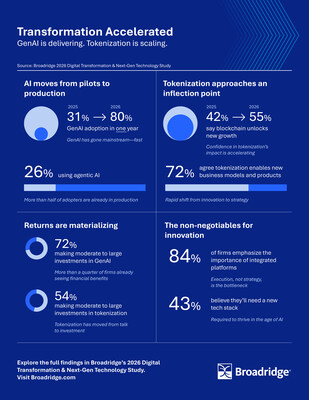
AI adoption has accelerated dramatically over the past year. Eighty percent of firms report using generative or predictive AI in operations, up from 31% last year, reflecting a rapid move from pilot programs to enterprise deployment. AI is also viewed as delivering the greatest business impact among next-generation technologies, surpassing cloud. As confidence in returns grows, 72% of firms report making moderate to large GenAI investments, while concern about GenAI ROI has fallen to 33%, down from 42% a year ago.
That shift is translating into results: 27% of firms report measurable business benefits from GenAI, a 13-point increase year over year, underscoring AI's growing impact on productivity and operational efficiency.
As generative AI matures, firms are beginning to deploy agentic AI—more autonomous systems capable of executing tasks and orchestrating workflows with limited human intervention. While still early, 26% of firms report current use of agentic AI, with more than half of those deployments already beyond pilot phases. Adoption is most advanced among large institutions, where nearly one-third of firms managing more than
Tokenization Approaches an
As AI becomes embedded in operating models, firms are turning their attention to longer-term structural change, reimagining how assets are issued, traded, and settled through tokenization.
A majority of firms increasingly view tokenization as a structural evolution of market infrastructure rather than a near-term replacement for existing systems. While near-term adoption remains measured, confidence in blockchain and distributed ledger technology continues to rise with 53% of firms believing DLT will have a dramatic effect on the way assets are settled—underscoring growing conviction that next-generation infrastructure will reshape post-trade operations and core market infrastructure.
That conviction is increasingly translating into capital commitments. More than half (54%) of firms report making moderate to large investments in tokenization and digital asset infrastructure, signaling that the industry is moving beyond exploration toward scaled buildout.
Market participants expect a significant portion of major asset classes, including equities, mutual funds, and alternatives, to be tokenized within the next four to five years—with its perceived strategic importance projected to rise sharply over the next five years. Seventy percent of firms say external partnerships will be critical to capturing value as tokenized market infrastructure develops, signaling the need for ecosystem collaboration as standards and interoperability frameworks mature.
While firms cite benefits including enhanced liquidity, improved operational efficiency and faster settlement, they also acknowledge risks related to regulatory uncertainty, interoperability challenges, cybersecurity, and market structure fragmentation. The study found that 64% of firms cite cybersecurity risks associated with tokenization and 55% point to increased valuation risk. Notably, many firms believe that forthcoming digital asset regulations will ultimately have a positive impact on adoption by providing greater clarity and market stability.
Execution, Not Strategy, Is the Bottleneck
Across both AI and tokenization initiatives, the primary barriers to progress lie in firms' ability to execute.
Eighty-four percent of firms emphasize the importance of integrated platforms, and 43% expect to rebuild core systems to support AI-driven operating models.
At the same time, talent gaps are becoming more acute: 37% of firms cite lack of skilled talent as a barrier to agentic AI adoption, reflecting rising demand for advanced technical and data capabilities. Regarding GenAI, 38% of firms said lack of skilled talent is their biggest barrier to adoption of GenAI, up from 28% in 2025. When asked about AI overall, 65% of firms say they have no formal mandate or incentives in place to use AI, and 61% say AI training is encouraged, but there are no formal targets in place
An Industry Embarking on Structural Change
Taken together, the findings point to an industry transitioning from digital experimentation to operational transformation. AI is delivering measurable impact today. Tokenization represents the next structural shift in how financial markets function.
The firms that succeed will be those that pair ambition with disciplined execution—modernizing core infrastructure while building the capabilities required to operate in increasingly digitized, interoperable markets.
Methodology
Broadridge commissioned
About Broadridge
Our technology and operations platforms process and generate over 7 billion communications per year and underpin the daily trading of more than $15 trillion of securities globally. A certified
For more information about us, please visit www.broadridge.com.
Broadridge Contacts:
Investors:
broadridgeir@broadridge.com
Media:
Global Head of Corporate Communications
Gregg.Rosenberg@broadridge.com

 View original content to download multimedia:https://www.prnewswire.com/news-releases/genai-delivering-now-tokenization-is-next-financial-services-enters-period-of-accelerating-transformation-landmark-broadridge-study-finds-302696514.html
SOURCE
