Co-PSMA data presented at EAU Annual Congress 2026 with manuscript accepted for publication in the European Urology journal
HIGHLIGHTS
- Oral presentation on key results from the Co-PSMA (NCT06907641)[1] Investigator-Initiated Trial (IIT) was delivered by Prof
Louise Emmett (St Vincent's Hospital Sydney ) at theEuropean Association of Urology (EAU) Congress 2026 on the 16th ofMarch 2026 inLondon, UK [2]. - Co-PSMA trial data has also been accepted for publication in the prestigious European Urology, the official journal of EAU with an impressive impact factor of 25.2.
- Clarity's 64Cu-SAR-bisPSMA (24-hour imaging) demonstrated considerable improvement in diagnostic performance in a head-to-head comparison with standard-of-care (SOC) 68Ga-PSMA-11 positron emission tomography (PET)/computed tomography (CT) in 50 patients with biochemical recurrence (BCR) of prostate cancer with low prostate-specific antigen (PSA; 0.2 – 0.75 ng/mL) who were candidates for curative salvage therapy following radical prostatectomy.
- The study's primary endpoint was to assess the difference in mean per-patient lesion between 64Cu-SAR-bisPSMA and 68Ga-PSMA-11. Key secondary endpoints included evaluation of diagnostic accuracy against composite reference standard and patient management impact.
- Mean per-patient lesion was higher for 64Cu-SAR-bisPSMA (24-hour imaging) vs. 68Ga-PSMA-11 (1.26 vs. 0.48, respectively), difference: 0.78 (95% confidence interval [CI]: 0.52 – 1.04) ratio 2.63 (95% CI: 1.64 – 4.20) (p <0.0001).
- Next-day imaging with 64Cu-SAR-bisPSMA, compared with 68Ga-PSMA-11, identified a greater number of total lesions (63 vs. 24, respectively). The biggest difference in lesion detection between the tracers was in the prostate fossa and in lymph nodes. 64Cu-SAR-bisPSMA also resulted in a higher number of trial participants with a positive scan compared to 68Ga-PSMA-11 (78% vs. 36%, respectively).
- 64Cu-SAR-bisPSMA (24-hour imaging) demonstrated a higher true positive rate (71% vs. 29%) and lower false negative rate (21% vs. 65%) than 68Ga-PSMA-11.
- 64Cu-SAR-bisPSMA next-day imaging resulted in management change in 44% (22/50) of trial participants, with the majority changing from surveillance to targeted radiotherapy.
- Co-PSMA trial data, combined with Phase II COBRA and anticipated results from a pivotal Phase III AMPLIFY study, are intended to be submitted to the
United States (US) Food and Drug Administration (FDA) for a market authorisation of 64Cu-SAR-bisPSMA in patients with BCR of prostate cancer.
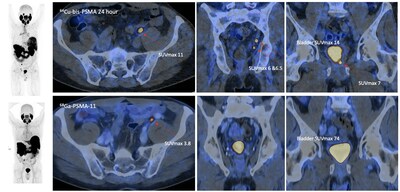
Co-PSMA (Comparative performance of 64Copper [64Cu]-SAR-bisPSMA vs. 68Ga-PSMA-11 PET CT for the detection of prostate cancer recurrence in the setting of biochemical failure following radical prostatectomy) was a Phase II IIT evaluating the performance of Clarity's diagnostic product, 64Cu-SAR-bisPSMA, in a head-to-head comparison to SOC 68Ga-PSMA-11 in 50 patients with low PSA (0.2 – 0.75 ng/mL) who were candidates for curative salvage therapy. Eligible patients were required to have had radical prostatectomy with no salvage therapy. 68Ga-PSMA-11 PET/CT was followed by 64Cu-SAR-bisPSMA PET/CT (at 1 hour and 24 hours post-injection, same-day and next-day imaging, respectively) on the same digital PET camera.[1],[3]
The primary endpoint of the Co-PSMA study was to assess the difference in mean per patient lesion number. Using a paired means test, a sample size of 50 provided power of 90% to detect a minimum alternative mean difference greater than zero of 0.432. Secondary endpoints included management impact questionnaires between 64Cu-SAR-bisPSMA and 68Ga-PSMA-11 and accuracy of the PET findings determined using a comprehensive reference standard, including biopsy, response to targeted treatment without androgen deprivation therapy (ADT), PSA rise without treatment or corroborative imaging.
Overall, 64Cu-SAR-bisPSMA PET/CT (24-hour imaging) was found to identify a higher number of disease recurrences than 68Ga-PSMA-11 PET/CT with substantial management impact and a high true positive rate in men with BCR post-radical prostatectomy.
Participants enrolled had a median PSA of 0.43 (IQR: 0.31 – 0.63) and 74% had an
|
Variable |
68Ga-PSMA-11 |
24-hour 64Cu-SAR-bisPSMA |
|
Number of participants with a positive scan, n/N (%) |
18/50 (36%) |
39/50 (78%) |
|
Total number of lesions identified (across participants), n |
24 |
63 |
|
Location of recurrence, n/N (%) Local recurrence Pelvic or extra-pelvic lymph nodes Bone Viscera (lung) |
11/50 (22%) 4/50 (8%) 5/50 (10%) 1/50 (2%) |
28/50 (56%) 10/50 (20%) 8/50 (16%) 1/50 (2%) |
Table 1. Comparison between 68Ga-PSMA-11 and 64Cu-SAR-bisPSMA scans: number of participants with a positive scan and location of recurrence. 24-hour 64Cu-SAR-bisPSMA scans resulted in a higher number of lesions detected and prostate-specific membrane antigen (PSMA) PET-positive participants as compared to 68Ga-PSMA-11 scans. The increase in the number of lesions identified by 64Cu-SAR-bisPSMA was noted in the prostatic bed region (local recurrence), pelvic/extra-pelvic lymph nodes and bone.
On a per patient level, 36% (18/50) of participants were positive on 68Ga-PSMA-11 PET/CT, compared to 78% (39/50) on 64Cu-SAR-bisPSMA PET/CT (next-day imaging). Planned patient management changed following the assessment of the 64Cu-SAR-bisPSMA scans in 22/50 (44%) trial participants. Among the participants with an evaluable standard of truth (SOT), the true positive rate was 71% for 24-hour 64Cu-SAR-bisPSMA (24/34) compared to 29% (10/34) for 68Ga-PSMA-11. The false negative rate was 21% for 24-hour 64Cu-SAR-bisPSMA (7/34) vs. 65% for 68Ga-PSMA-11 (22/34).
These results from the Co-PSMA IIT further build on the growing body of evidence demonstrating that 64Cu-SAR-bisPSMA improves the detection of prostate cancer compared to the current SOC PSMA PET agents which have lower sensitivity in patients with low PSA levels[4],[5]. In the Phase II COBRA trial, 64Cu-SAR-bisPSMA was evaluated in patients with BCR who had a negative or equivocal scan at study entry. Among participants with a follow-up SOC PSMA PET, 90% were positive on 24-hour 64Cu-SAR-bisPSMA PET compared with only 60% on SOC PSMA PET. Overall, next-day imaging with 64Cu-SAR-bisPSMA identified more than 2.6 times lesions than SOC PSMA PET[6]. The COBRA data, combined with the Co-PSMA IIT results, will complement the anticipated findings from the Phase III registrational trial, AMPLIFY, which recently reached its target number of participants[7]. Together, they are intended to be submitted to the
Prof
Clarity's Executive Chairperson, Dr
"The high quality of these data now adds to the substantial body of evidence supporting our product, the optimised SAR-bisPSMA. The discovery and pre-clinical work has been previously circulated in numerous journals, including publications by our long-term collaborator, Prof
"The extraordinary quality of the academic research is coupled with the feverish pace of commercialisation where our registrational Phase III trials, AMPLIFY and CLARIFY, are nearing completion. We have recently shared that AMPLIFY reached its target number of participants with rising or detectable PSA after initial definitive treatment at clinical sites across the US and
About SAR-bisPSMA
SAR-bisPSMA derives its name from the word "bis", which reflects a novel approach of connecting two PSMA-targeting agents to Clarity's proprietary SAR technology that securely holds copper isotopes inside a cage-like structure, called a chelator. Unlike other commercially available chelators, the SAR technology prevents copper leakage into the body. SAR-bisPSMA is a Targeted Copper Theranostic that can be used with isotopes of copper-64 (Cu-64 or 64Cu) for imaging and copper-67 (Cu-67 or 67Cu) for therapy.
Disclaimer
64Cu-SAR-bisPSMA and 67Cu-SAR-bisPSMA are unregistered products. Their safety and efficacy have not been assessed by health authorities such as the
About Prostate Cancer
Prostate cancer is the second most common cancer diagnosed in men globally and the fifth leading cause of cancer death in men worldwide[9]. Prostate cancer is the second-leading cause of cancer death in American men.
About
Clarity is a clinical stage radiopharmaceutical company focused on the treatment of serious diseases. The Company is a leader in innovative radiopharmaceuticals, developing Targeted Copper Theranostics based on its SAR Technology Platform for the treatment of cancers.
www.claritypharmaceuticals.com
|
For more information, please contact: |
|
|
|
|
|
Dr Alan Taylor |
Lisa Sadetskaya |
|
Executive Chairperson |
Director, Corporate Communications |
References
- Clinicaltrials.gov Identifier: NCT06907641. https://clinicaltrials.gov/study/NCT06907641
- EAU26. The
Congress . https://eaucongress-new.uroweb.org/the-congress - Emmett L et al. Prospective comparison of 64Copper [64Cu]SAR-bis-PSMA vs. 68Ga PSMA-11 PET CT for prostate cancer detection in patients with biochemical recurrence after radical prostatectomy (Co-PSMA trial). 2026 Annual
European Association of Urology Congress : https://urosource.uroweb.org/267380/abstract. - Fendler WP et al. Assessment of 68Ga-PSMA-11 PET Accuracy in Localizing Recurrent Prostate Cancer: A Prospective Single-Arm Clinical Trial. JAMA Oncol. 2019
Jun 1 ;5(6):856-863. doi: 10.1001/jamaoncol.2019.0096. PMID: 30920593; PMCID: PMC6567829. - Mena E, Lindenberg ML, Turkbey IB, Shih JH,
Harmon SA , Lim I, Lin F, Adler S, Eclarinal P, McKinney YL, Citrin D, Dahut W, Wood BJ, Krishnasamy V, Chang R, Levy E, Merino M, Pinto P, Eary JF, Choyke PL. 18F-DCFPyL PET/CT Imaging in Patients with Biochemically Recurrent Prostate Cancer After Primary Local Therapy. J Nucl Med. 2020 Jun;61(6):881-889. doi: 10.2967/jnumed.119.234799. Epub 2019Nov 1 . PMID: 31676732; PMCID: PMC9374042. - Nordquist et al. COBRA: Assessment of safety and efficacy of 64Cu-SAR-bisPSMA in patients with biochemical recurrence of prostate cancer following definitive therapy. EANM 2024.
-
Clarity Pharmaceuticals . Registrational Phase III AMPLIFY trial: Target number of participants achieved. https://www.claritypharmaceuticals.com/news/amplify_target_achieved/ -
Katherine A. Morgan ,Stacey E. Rudd ,Asif Noor , andPaul S. Donnelly . Theranostic Nuclear Medicine with Gallium-68, Lutetium-177, Copper-64/67, Actinium-225, and Lead-212/203 Radionuclides Focus Review. Chemical Reviews. 2023 123 (20), 12004-12035. DOI: 10.1021/acs.chemrev.3c00456 - Global Cancer Statistics 2020: GLOBOCAN Estimates of Incidence and Mortality Worldwide for 36 Cancers in 185 Countries. https://acsjournals.onlinelibrary.wiley.com/doi/10.3322/caac.21660
-
American Cancer Society : Key Statistics for Prostate Cancer. https://www.cancer.org/cancer/prostate-cancer/about/key-statistics.html
This announcement has been authorised for release by the Executive Chairperson.

 View original content to download multimedia:https://www.prnewswire.com/news-releases/co-psma-data-presented-at-eau-annual-congress-2026-with-manuscript-accepted-for-publication-in-the-european-urology-journal-302715362.html
SOURCE
