The Hackett Group® Study Finds GBS Leaders Betting on AI to Close Widening Productivity Gap
2026 GBS Key Issues Study shows AI delivering measurable gains across customer experience, service quality and employee engagement as organizations race to close a record efficiency gap
This press release features multimedia. View the full release here: https://www.businesswire.com/news/home/20260324492437/en/
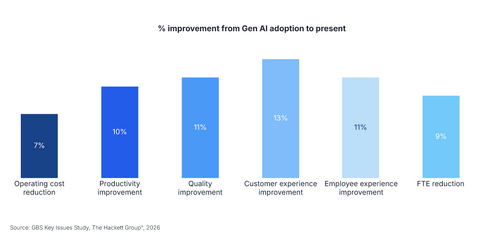
AI delivers broader value than cost savings alone. Early Gen AI deployments are yielding measurable results across multiple dimensions. Organizations report a 13% improvement in customer experience, 11% gains in both employee engagement and service quality, and a 10% increase in productivity. Cost reduction and full-time equivalent (FTE) savings have been modest at 7% and 9%, respectively, suggesting that AI’s primary value lies in enhancing service delivery rather than simply cutting expenses. These benefits extend to outsourced operations as well. Business process outsourcing (BPO) providers leveraging Gen AI are delivering value beyond traditional labor arbitrage. This includes improving customer experience, service quality and employee engagement for their clients. The relationship is shifting from transactional to transformational, with organizations expecting partners who deliver automation and AI-driven solutions, not just cost savings.
The study finds the GBS workload is forecast to grow by 15% in 2026, outpacing projected staffing growth of 10% and budget increases of just 7%. This creates a 5% productivity gap and an 8% efficiency gap – the most significant imbalance GBS leaders have faced in years. In response, organizations are deploying Gen AI and automation as strategic transformation engines to reimagine how work is structured and delivered – not incremental productivity enhancement tools.
“Facing this kind of pressure, the organizations that will come out ahead are those that move beyond adopting AI as a surface-level add-on and instead use it to fundamentally reimagine how work gets done – combining digital innovation with operational resilience,” said
AI delivers broader value than cost savings alone
AI is already transforming GBS operations. Nearly 90% of GBS leaders report that AI is reshaping routine tasks, and more than half see measurable effects on complex work. Early Gen AI deployments are delivering a 13% improvement in customer experience, 11% gains in both employee engagement and service quality, and a 10% productivity boost. Cost reduction and full-time equivalent (FTE) savings have been more modest, reinforcing that AI’s primary value lies in elevating service performance rather than simply reducing expenses.
One-quarter of GBS organizations expect broad deployment in 2026, up from under 10% a year ago. Customer service leads with 32% planning wide-scale deployment, followed by information technology at 25% and supply chain at 21%. In established GBS domains – finance, procurement and human resources – 13% to 18% are preparing for broad rollout, and a majority are actively piloting or selectively deploying AI.
As Gen AI adoption expands, outsourcing relationships are also evolving from labor arbitrage to AI-enabled digital transformation partnerships. Business process outsourcing (BPO) providers are embedding AI into service delivery to transform manual labor to digital labor, improving experience, quality and workforce effectiveness. Increasingly, organizations are seeking partners that can deliver AI-enabled solutions rather than simply lower-cost labor. For GBS leaders, these partnerships can provide another option to accelerate the shift from manual labor to digital labor while accessing AI capabilities and investment scale that would be challenging to replicate internally.
Closing the AI execution gap in GBS
Even as AI adoption accelerates, confidence in achieving core GBS objectives is declining. While 70% of GBS leaders rank cost leadership as a top priority and 69% prioritize value creation, only 30% now express high confidence in meeting cost reduction targets (down from 44% last year), and just 21% are highly confident in achieving value creation goals (down from 41% last year). Rising workloads, constrained budgets, and uncertainty around how to operationalize AI execution are widening the gap between ambition and outcomes.
Execution discipline, rather than strategic intent, is now the primary challenge. Nearly three-quarters (72%) of leaders cite misalignment between expected and actual AI benefits as a significant concern – tied with process complexity and technology immaturity. However, concerns around data privacy, regulatory issues and ethics have declined in priority, signaling a shift from whether to adopt to how to deploy it effectively.
For leading GBS organizations, the opportunity lies in moving beyond experimentation to process-level transformation supported by clear business cases. By combining process intelligence, benchmarking and targeted AI deployment, organizations can identify where automation and digital labor deliver the greatest productivity and service improvement.
To accelerate progress in 2026, GBS leaders are focused on five priorities: expand automation into higher-value and complex activities; build digital skills and capabilities; align cost optimization with value creation; strengthen data integrity and governance; and redefine performance management to include customer experience, employee engagement, service quality and innovation alongside traditional cost metrics.
“AI and automation are becoming foundational to GBS performance,” said Amar Changulani, research director at
Download The Hackett Group’s 2026 GBS Key Issues Study.
About
Trademarks
Cautionary Statement Regarding “Forward-Looking” Statements
This release contains “forward-looking” statements within the meaning of Section 27A of the Securities Act of 1933 as amended and Section 21E of the Securities Exchange Act of 1934, as amended. Statements including without limitation, words such as “expects,” “anticipates,” “intends,” “plans,” “believes,” “seeks,” “estimates,” or other similar phrases or variations of such words or similar expressions indicating, present or future anticipated or expected occurrences or outcomes are intended to identify such forward-looking statements. Forward-looking statements are not statements of historical fact and involve known and unknown risks, uncertainties and other factors that may cause the Company’s actual results, performance or achievements to be materially different from the results, performance or achievements expressed or implied by the forward-looking statements. Factors that may impact such forward-looking statements include without limitation, the ability of
© 2026
View source version on businesswire.com: https://www.businesswire.com/news/home/20260324492437/en/
Source:
