Toshiba Starts Sample Shipments of New “SmartMCD™” Series Product Integrating Microcontroller and Motor Driver
— Low-Speed Sensorless Control Technology for Three-Phase Brushless DC Motor Control —
This press release features multimedia. View the full release here: https://www.businesswire.com/news/home/20260415255043/en/
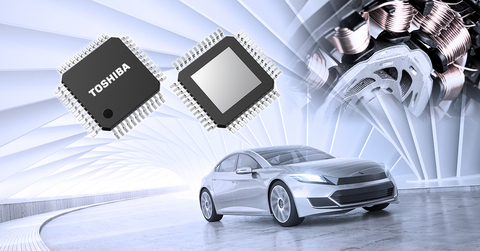
Toshiba: TB9M030FG, the latest product in the Smart Motor Control Driver “SmartMCD™” series.
As the electrification of automotive systems such as water pumps, oil pumps, and fans continues, automobile makers want more compact, more efficient and quieter motors. Alongside this, with increasing numbers of electronic controlled units (ECUs)[2] installed in vehicles, lowering component counts and minimizing board space have become increasingly important, and are driving growing demand for highly integrated devices that combine an MCU and a motor‑control gate driver.
Sensorless control of three‑phase brushless DC motors presents the challenge of accurate detection of rotor position at low-speeds, creating strong demand for high‑performance sensorless field oriented control (FOC)[3] technology that delivers stable control from zero speed[4].
TB9M030FG integrates an
The new MCD also incorporates Toshiba’s proprietary vector engine hardware, which reduces CPU workload and software program size in FOC motor‑control applications. Toshiba’s sensorless control technology developed for low‑speed operation enables position‑sensorless FOC control from zero speed through low speeds when used with salient‑pole motors[6]. This approach eliminates the noise generated by the standard high-frequency signal injection method[7], caused by harmonic injection, and also leads to quieter motor operation.
TB9M030FG complies with the automotive electronics qualification standard AEC‑Q100[8] (Grade 0).
The characteristics of the TB9M030FG contribute to the miniaturization of automotive systems and lower component counts while enabling more advanced and sophisticated motor-control, and making it suitable for a wide range of automotive motor applications.
Toshiba will continue to expand the lineup of its SmartMCD™ series by incorporating the functions required for automotive systems, thereby contributing to the miniaturization of automotive systems and lower component counts.
|
Notes: |
|
|
[1] |
Smart MCD: A series of automotive motor control drivers (MCDs) developed by |
|
[2] |
Electronic control unit (ECU): A general term for electronic control units installed in automotive systems. |
|
[3] |
Field oriented control (FOC): A typical method of vector control (A control method that independently controls motor torque and magnetic flux as orthogonal components) that uses the motor’s rotating reference frame (dq coordinate system) to independently control the magnetic flux component (d‑axis) and the torque component (q‑axis). |
|
[4] |
Zero speed: a state in which the motor is electrically energized and actively controlled, while the rotational speed is zero. |
|
[5] |
Local interconnect network (LIN): One of the serial communication protocols primarily used for communication between electronic control units (ECUs) in automobiles. |
|
[6] |
Salient‑pole motor: A three‑phase brushless DC motor whose rotor has magnetic anisotropy, resulting in a difference between the d‑axis and q‑axis inductances (Ld ≠ Lq), and which can generate reluctance torque due to differences in magnetic reluctance within the motor. |
|
[7] |
High-frequency signal injection method: A sensorless control method in which a high-frequency voltage (or current) signal is superimposed on and injected into the fundamental waveform used to drive the motor to detect the rotor position. |
|
[8] |
AEC-Q100: An automotive electronics qualification standard established by the |
Applications
Automotive equipment
- Electric water pumps
- Electric oil pumps
- Electric fans
- Electric blowers, etc.
Features
- Sensorless control gate driver IC for three-phase brushless DC motors (built-in charge pump circuit)
-
32-bit MCU (
Arm ® Cortex®‑M0) with 40 MHz operating frequency (built-in low‑speed and high‑speed oscillators) -
Built-in memory with ECC[9]
Code flash: 64KBytes; ROM: 12KBytes; RAM: 4KBytes - Built‑in vector engine (VE) for FOC control and programmable motor driver (PMD)[10]
- Built-in 1-shunt resistor current sense amplifier[11], 12-bit A/D converter, and 10-bit A/D converter
- Enables position‑sensorless FOC control from zero speed through the low‑speed operating range when used with salient‑pole motors
|
Notes: |
|
|
[9] |
Built-in error correction code (ECC) function supports 1-bit error correction (SEC) and 2-bit error detection (DED). |
|
[10] |
Programmable motor driver: A motor-control hardware module that generates pulse width modulation (PWM), controls current conduction and detects faults in hardware, thereby reducing the processing load required for motor-control. |
|
[11] |
1-shunt resistor current sense amplifier: The motor current is estimated indirectly using a current‑sensing shunt resistor and a current‑sense amplifier. |
|
Main Specifications |
|||
|
Part number |
|||
|
Supported motors |
Three-phase brushless DC motor |
||
|
Main functions |
1-shunt resistor current sense amplifier, Hardware for sensorless FOC control and square‑wave control hardware (VE, PMD, ENC[12]) LIN physical layer: 1 channel (responder only) |
||
|
Communication method |
Selectable LIN communication / PWM communication[13], UART, SPI |
||
|
Main error detections |
Under voltage detection (Vcc (generated 5V)), Over voltage detection (Vdd (generated 1.5V)), Thermal shutdown, Overcurrent detection, Open/short fault detection of external power MOSFETs, etc. |
||
|
Absolute
|
Power supply voltage
|
-0.3 to +40 |
|
|
Operating
|
Power supply voltage
|
6 to 18 |
|
|
Operating temperature
|
Ta=-40 to +150 |
||
|
Tj=-40 to +175 |
|||
|
Package |
|
P-HTQFP48-0707-0.50-002 |
|
|
Size (mm) |
Typ. |
9.0×9.0 |
|
|
Reliability |
AEC-Q100 (Grade 0) qualified |
||
|
Mass production |
|
||
|
Notes: |
|
|
[12] |
Encoder input circuit (ENC): A circuit that receives signals from an encoder to detect the motor’s operating status, including position, speed, and direction of rotation. |
|
[13] |
PWM communication: A communication method in which the duty cycle (pulse width) of a pulse width modulation (PWM) signal is used as the primary information for communication between modules. |
Follow the link below for more on the new product.
TB9M030FG
Follow the link below for more on Toshiba’s automotive motor drivers.
Analog Devices
*
* SmartMCD™ is a trademark of
* Other company names, product names, and service names may be trademarks of their respective companies.
* Information in this document, including product prices and specifications, content of services and contact information, is current on the date of the announcement but is subject to change without prior notice.
About
Its 17,000 employees around the world share a determination to maximize product value, and to promote close collaboration with customers in the co-creation of value and new markets. The company looks forward to building and to contributing to a better future for people everywhere.
Find out more at https://toshiba.semicon-storage.com/ap-en/top.html
View source version on businesswire.com: https://www.businesswire.com/news/home/20260415255043/en/
Customer Inquiries
Tel: +81-44-548-2219
Contact Us
Media Inquiries:
semicon-NR-mailbox@ml.toshiba.co.jp
Source:
